Introduction
Why do some businesses successfully attract customers, build strong brands, and maintain a competitive advantage, while others struggle despite offering good products and services? The answer often lies in how effectively they understand their internal capabilities and external business environment.
In today's competitive marketplace, businesses cannot depend solely on product quality, attractive pricing, or promotional campaigns. They must understand what they do well, where they need improvement, which market opportunities they can exploit, and what external challenges may affect their growth.
This is where SWOT Analysis in Marketing becomes an important strategic management tool.
SWOT analysis helps businesses evaluate their internal strengths and weaknesses alongside external opportunities and threats. It provides a structured framework for understanding the current business position and developing effective marketing strategies.
Whether you operate a small local business, manage an established brand, run an e-commerce company, or work in marketing management, SWOT analysis can help you make more informed business decisions.
In this article, we will explore the meaning of SWOT analysis, its four components, how to conduct a SWOT analysis step by step, practical business examples, and how businesses can convert SWOT findings into effective marketing strategies.
What Is SWOT Analysis in Marketing?
SWOT analysis is a strategic planning technique used to identify and evaluate an organization's Strengths, Weaknesses, Opportunities, and Threats.
It helps marketers understand the organization's internal capabilities and external business environment before making important marketing decisions.
The term SWOT represents four elements:
S – Strengths: Internal advantages that help a business perform better than its competitors.
W – Weaknesses: Internal limitations that may reduce business performance or competitive ability.
O – Opportunities: External conditions or market developments that a business can use to achieve growth.
T – Threats: External factors that may negatively affect business operations, profitability, or market position.
In marketing management, SWOT analysis is particularly useful for evaluating brand positioning, customer satisfaction, competitive advantage, market expansion, product development, and promotional strategies.
For example, a small clothing retailer may identify its personalized customer service as a strength, limited online visibility as a weakness, increasing demand for online shopping as an opportunity, and competition from large e-commerce platforms as a threat.
By examining these factors together, the retailer can develop a marketing strategy that uses its strengths, addresses its weaknesses, takes advantage of opportunities, and prepares for potential threats.
The Four Components of SWOT Analysis
SWOT analysis is divided into two major dimensions: internal and external factors.
Internal factors: Strengths and weaknesses are associated with the resources, capabilities, and limitations of the business. Management can generally influence or improve these factors.
External factors: Opportunities and threats originate from the business environment. Organizations cannot directly control them, but they can monitor and respond to them.
Let's understand each component in detail.
1. Strengths: Identifying Internal Competitive Advantages
Strengths refer to the positive internal characteristics, resources, and capabilities that give a business an advantage over its competitors.
These are the factors that help an organization attract customers, deliver value, improve performance, and establish a strong market position.
In marketing, strengths may include brand reputation, product quality, customer relationships, distribution networks, pricing advantages, skilled employees, and technological capabilities.
Examples of Business Strengths
Strong Brand Reputation: Customers recognize and trust the brand because of its consistent quality and positive market image.
High Product Quality: The organization offers reliable products that satisfy customer expectations.
Competitive Pricing: The business can offer attractive prices because of efficient operations or lower production costs.
Customer Loyalty: A significant number of customers repeatedly purchase from the business.
Effective Distribution Network: Products are easily available through retail outlets, distributors, or online platforms.
Skilled Workforce: Employees possess the knowledge and expertise required to deliver quality products and services.
Strong Digital Presence: The business has an effective website, search engine visibility, and active social media engagement.
How to Identify Strengths
A business can identify its strengths by asking the following questions:
What does our business do better than competitors?
Why do customers prefer our products or services?
What resources or capabilities give us a competitive advantage?
Which products or services generate the highest customer satisfaction?
What positive feedback do we regularly receive from customers?
Marketing Example:
Consider a local restaurant known for its delicious food, reasonable prices, and personalized customer service.
Its strengths may include:
Loyal local customers.
Consistent food quality.
Affordable pricing.
Positive word-of-mouth promotion.
The restaurant can use these strengths in its marketing campaigns to attract new customers and strengthen its market position.
2. Weaknesses: Identifying Internal Limitations
Weaknesses are the internal factors that place a business at a disadvantage compared with its competitors.
They represent areas where the organization lacks resources, capabilities, efficiency, or performance.
Identifying weaknesses is important because businesses cannot develop effective marketing strategies without understanding their limitations.
For example, a company may manufacture high-quality products but struggle to attract customers because of poor distribution, weak advertising, or limited brand awareness.
Examples of Business Weaknesses
Low Brand Awareness: Potential customers are unfamiliar with the company's products or services.
Limited Marketing Budget: The organization cannot invest sufficiently in advertising, promotions, and customer acquisition.
Poor Online Presence: The business lacks a professional website or effective digital marketing strategy.
Weak Distribution Network: Products are not easily accessible to customers in important markets.
Inconsistent Product Quality: Variations in product quality negatively affect customer satisfaction.
Limited Product Range: The company offers fewer choices than its competitors.
Poor Customer Service: Delayed responses, complaints, and inadequate after-sales support reduce customer loyalty.
How to Identify Weaknesses
Businesses can identify weaknesses by examining their internal performance and customer feedback.
Some important questions include:
Where are we performing worse than our competitors?
What complaints do customers frequently make?
Which business activities require improvement?
Do we have sufficient financial and human resources?
Are our marketing campaigns generating the expected results?
Are customers facing difficulties while purchasing our products?
Marketing Example:
Suppose a local furniture manufacturer produces high-quality furniture but does not have an updated website, an online product catalogue, or an effective social media presence.
Its weaknesses may include:
Limited digital visibility.
Dependence on local customers.
Difficulty reaching customers outside its geographical area.
Limited online enquiry generation.
The business can address these weaknesses by developing a professional website, publishing product photographs, improving local SEO, and using digital marketing to reach a wider audience.
3. Opportunities: Identifying External Growth Possibilities
Opportunities are favorable external factors or developments in the business environment that organizations can exploit to achieve growth and improve their market position.
Unlike strengths and weaknesses, opportunities are not created solely by the internal capabilities of an organization. They arise from changes in customer preferences, technology, market demand, government policies, demographics, and industry trends.
Businesses that identify opportunities at the right time can develop new products, enter new markets, acquire customers, and gain a competitive advantage.
Examples of Business Opportunities
Growing Market Demand: Increasing demand for a particular product or service creates opportunities for business expansion.
Digital Transformation: The increasing use of the internet, mobile applications, and e-commerce creates new marketing and sales channels.
Changing Consumer Preferences: New lifestyle trends and customer expectations may create demand for innovative products.
New Market Segments: Businesses can target previously unexplored customer groups.
Technological Developments: Artificial intelligence, automation, and data analytics can help businesses improve marketing efficiency.
Geographical Expansion: A business can expand its operations into new cities, regions, or international markets.
Strategic Partnerships: Collaborations with distributors, influencers, suppliers, and other businesses can increase market reach.
How to Identify Opportunities
Businesses should continuously monitor the external environment to identify favorable market developments.
They can ask:
Is demand for our products or services increasing?
Are new customer segments emerging?
Can we use digital platforms to reach more customers?
Are technological developments creating new business possibilities?
Can we expand into new geographical markets?
Are competitors ignoring any important customer needs?
Marketing Example:
Consider a traditional clothing retailer that primarily sells products through its physical shop.
The increasing popularity of online shopping creates an opportunity for the retailer to establish an e-commerce website, promote products through social media, and serve customers beyond its local market.
By using this opportunity, the retailer can increase its customer base and generate additional revenue.
4. Threats: Identifying External Business Challenges
Threats refer to external factors that may negatively affect a business's performance, profitability, market share, or long-term sustainability.
These factors generally originate outside the organization and are not directly controllable by management.
However, businesses can identify potential threats in advance and develop strategies to minimize their impact.
Examples of Business Threats
Intense Competition: New competitors or established market leaders may reduce the company's market share.
Changing Customer Preferences: Customers may shift towards alternative products, brands, or technologies.
Economic Instability: Inflation, recession, and declining purchasing power may reduce consumer spending.
Technological Disruption: New technologies may make existing products or business models less competitive.
Government Regulations: Changes in taxation, licensing, and industry regulations may increase business costs.
Rising Operating Costs: Increasing raw material, transportation, and labour costs may reduce profitability.
Negative Online Reviews: Unfavourable customer experiences shared online may damage brand reputation.
How to Identify Threats
Businesses should regularly evaluate external environmental developments and competitive activities.
Some important questions include:
Who are our major competitors?
Are new competitors entering the market?
Are customer preferences changing?
Could inflation or economic conditions affect our sales?
Are new technologies making our products less competitive?
Are regulatory changes likely to increase operating costs?
Marketing Example:
Suppose a traditional bookstore faces increasing competition from online retailers offering discounts, home delivery, and a wider selection of books.
The threats may include:
Lower prices offered by online competitors.
Changing customer purchasing habits.
Reduced footfall in physical stores.
Increasing customer expectations for convenience.
The bookstore can respond by introducing online ordering, offering personalized recommendations, organizing reading events, and building stronger relationships with local customers.
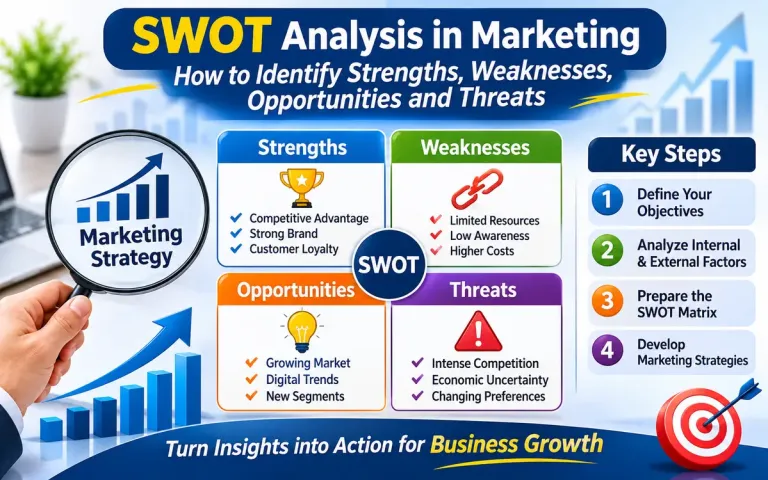
SWOT Analysis Matrix: Understanding the Four Elements
A SWOT matrix presents all four components in a simple visual format, making it easier for managers to understand the organization's overall position.
| Internal Factors | External Factors |
|---|---|
| Strengths (S) | Opportunities (O) |
| Brand reputation | Growing market demand |
| Product quality | Emerging technologies |
| Customer loyalty | New market segments |
| Skilled workforce | Geographical expansion |
| Weaknesses (W) | Threats (T) |
| Limited marketing budget | Intense competition |
| Low brand awareness | Economic uncertainty |
| Poor online presence | Changing customer preferences |
| Limited distribution | Technological disruption |
The matrix helps managers organize relevant information before developing marketing strategies.
However, simply listing these factors is not enough. The real value of SWOT analysis comes from understanding how these factors interact and using the findings to make strategic decisions.
How to Conduct a SWOT Analysis in Marketing: Step-by-Step Process
A meaningful SWOT analysis requires systematic evaluation rather than simply preparing a list of positive and negative factors.
The following steps can help businesses conduct an effective SWOT analysis.
Step 1: Define Your Business Objectives
Before conducting a SWOT analysis, clearly identify what you want to evaluate.
For example:
Increasing market share.
Launching a new product.
Improving brand awareness.
Expanding into new geographical markets.
Improving customer retention.
Increasing online sales.
A clearly defined objective helps ensure that the SWOT analysis remains focused and relevant.
Step 2: Collect Internal Business Information
Examine the organization's internal resources, performance, and capabilities.
Important areas include:
Financial resources.
Product quality.
Employee skills.
Customer satisfaction.
Brand reputation.
Marketing performance.
Distribution capabilities.
Technological infrastructure.
This information helps identify the organization's strengths and weaknesses.
Step 3: Analyze the External Business Environment
Study the market and industry conditions that may create opportunities or threats.
Consider:
Competitor strategies.
Market demand.
Consumer behaviour.
Technological developments.
Economic conditions.
Government regulations.
Social and demographic changes.
Businesses can also use market research, customer surveys, competitor analysis, and PESTLE analysis to understand their external environment.
Step 4: Prepare the SWOT Matrix
Organize the collected information into four categories:
Strengths.
Weaknesses.
Opportunities.
Threats.
Focus on factors that are relevant to your business objectives rather than including every possible observation.
Step 5: Prioritize the Most Important Factors
Not all SWOT factors have equal importance.
For example, a small business may have several weaknesses, but limited online visibility may be more urgent than a lack of office space if its main objective is increasing online sales.
Therefore, prioritize factors according to their potential impact and urgency.
Step 6: Develop Marketing Strategies
The final step is to convert SWOT findings into practical marketing strategies.
Managers should determine how the organization can use its strengths, overcome weaknesses, exploit opportunities, and minimize threats.
This leads to four important strategic approaches, explained below.
TOWS Matrix: Converting SWOT Analysis into Marketing Strategies
SWOT analysis identifies the internal and external factors affecting a business. The TOWS matrix takes the process further by matching these factors to develop strategic alternatives.
There are four major TOWS strategies.
1. SO Strategy (Strengths–Opportunities)
This strategy uses internal strengths to take advantage of external opportunities.
Example:
A restaurant has a strong local reputation and loyal customers. Online food delivery is becoming increasingly popular.
The restaurant can use its established reputation to launch online food ordering and delivery services.
2. WO Strategy (Weaknesses–Opportunities)
This strategy focuses on overcoming internal weaknesses by taking advantage of external opportunities.
Example:
A furniture manufacturer has limited market reach because it does not have an effective online presence. Growing demand for online furniture shopping creates an opportunity.
The manufacturer can develop an e-commerce website and use digital marketing to reach customers in new locations.
3. ST Strategy (Strengths–Threats)
This strategy uses internal strengths to minimize or overcome external threats.
Example:
A local grocery store faces competition from large supermarket chains. However, it has strong customer relationships and provides personalized service.
It can use these strengths to differentiate itself through home delivery, personalized product recommendations, and convenient local service.
4. WT Strategy (Weaknesses–Threats)
This strategy aims to reduce internal weaknesses and avoid or minimize external threats.
Example:
A small clothing retailer has limited financial resources and faces intense competition from large e-commerce platforms.
It can reduce unnecessary operating costs, focus on a profitable niche market, improve customer retention, and avoid competing directly on price with large retailers.
The TOWS matrix makes SWOT analysis more action-oriented because it connects business observations with specific strategic decisions.
Practical SWOT Analysis Example: A Small E-Commerce Business
Let's understand how SWOT analysis works through a practical marketing example.
Consider a small business selling fashion products through its own e-commerce website.
Its objective is to increase online sales and expand its customer base.
The business can conduct the following SWOT analysis:
SWOT Analysis Table
| Strengths | Weaknesses |
|---|---|
| Competitive product pricing | Limited brand recognition |
| Direct customer relationships | Small marketing budget |
| Flexible product selection | Limited delivery network |
| Own e-commerce website | Low customer trust initially |
| Opportunities | Threats |
|---|---|
| Increasing online shopping | Established e-commerce competitors |
| Growing social media usage | Price competition |
| Influencer marketing | Rising advertising costs |
| Expansion into new markets | Changing customer preferences |
Marketing Strategies Based on the SWOT Analysis
After identifying the four components, the business can develop the following strategies:
SO Strategy: Use competitive pricing and an existing e-commerce website to attract customers from growing online shopping markets.
WO Strategy: Improve brand recognition through social media marketing, influencer collaborations, customer testimonials, and search engine optimization.
ST Strategy: Build direct customer relationships and offer personalized service to differentiate the business from larger competitors.
WT Strategy: Focus on a specific product category, control advertising expenditure, improve delivery reliability, and build customer trust through transparent policies.
This example demonstrates that SWOT analysis is not merely a theoretical management concept. It can be applied to real business situations to develop practical marketing decisions.
Importance of SWOT Analysis in Marketing Management
SWOT analysis plays an important role in marketing management because it connects business capabilities with market conditions.
Its major benefits include:
1. Helps in Strategic Marketing Planning
SWOT analysis provides valuable information for developing marketing objectives and strategies.
It helps businesses determine which markets to target, how to position their products, and how to allocate marketing resources.
2. Identifies Competitive Advantages
By identifying internal strengths, organizations can understand what differentiates them from competitors.
This helps businesses develop a unique value proposition and strengthen their market position.
3. Improves Decision-Making
Marketing decisions involve uncertainty. SWOT analysis provides a structured way to evaluate internal capabilities and external conditions before taking action.
4. Supports Market Expansion
Businesses can identify emerging markets, new customer segments, and changing consumer preferences that may create opportunities for growth.
5. Helps Manage Business Risks
Identifying external threats in advance allows businesses to prepare suitable strategies and reduce potential losses.
6. Improves Resource Allocation
SWOT analysis helps managers identify areas where investment is most necessary, such as product development, employee training, customer service, or digital marketing.
7. Supports Product Development
By examining customer needs, market opportunities, and internal capabilities, businesses can identify opportunities to improve existing products or introduce new offerings.
SWOT Analysis vs PESTLE Analysis: What Is the Difference?
SWOT and PESTLE analysis are both strategic management tools, but they serve different purposes.
SWOT analysis evaluates an organization's internal strengths and weaknesses alongside external opportunities and threats.
PESTLE analysis examines six external environmental factors that may influence business operations and strategic decisions.
| Basis | SWOT Analysis | PESTLE Analysis |
|---|---|---|
| Full form | Strengths, Weaknesses, Opportunities, Threats | Political, Economic, Social, Technological, Legal, Environmental |
| Focus | Internal and external factors | External macro-environment |
| Main purpose | Evaluate business position and develop strategies | Understand external environmental changes |
| Internal factors | Yes | No |
| External factors | Yes | Yes |
| Application | Strategic and marketing planning | Environmental scanning and strategic planning |
For example, a business may use PESTLE analysis to understand how inflation, technological developments, and government regulations affect its industry.
It can then use relevant findings to identify opportunities and threats within its SWOT analysis.
Therefore, these two tools can complement each other in the strategic planning process.
Limitations of SWOT Analysis
Although SWOT analysis is a useful strategic planning tool, it also has certain limitations.
1. Subjective Evaluation
The identification of strengths and weaknesses may depend on managerial opinions rather than objective evidence.
2. Lack of Prioritization
A SWOT matrix may contain many factors without indicating which ones are most important.
3. Static Nature
Market conditions, consumer preferences, and competitive environments change continuously. A SWOT analysis may become outdated if it is not reviewed regularly.
4. Does Not Provide Automatic Solutions
SWOT analysis identifies important business factors but does not independently provide a complete marketing strategy.
Managers must interpret the findings and develop appropriate action plans.
5. Possibility of Oversimplification
Complex business situations cannot always be explained through four categories. Excessively simplifying the analysis may result in overlooking important market realities.
How to overcome these limitations: Businesses should use reliable market research, customer feedback, competitor analysis, measurable performance indicators, and periodic reviews to make their SWOT analysis more accurate and actionable.
Frequently Asked Questions (FAQs)
1. What is SWOT analysis in marketing?
SWOT analysis in marketing is a strategic planning technique used to evaluate a business's strengths, weaknesses, opportunities, and threats. It helps marketers understand internal capabilities and external market conditions to develop effective marketing strategies.
2. What are the four elements of SWOT analysis?
The four elements are:
Strengths: Internal competitive advantages.
Weaknesses: Internal limitations.
Opportunities: External possibilities for growth.
Threats: External challenges that may negatively affect the business.
3. What is the difference between internal and external factors in SWOT analysis?
Internal factors include strengths and weaknesses that originate within an organization, such as product quality, employee skills, financial resources, and brand reputation.
External factors include opportunities and threats that originate outside the organization, such as competition, technological developments, market trends, and economic conditions.
4. Why is SWOT analysis important in marketing management?
SWOT analysis helps marketing managers identify competitive advantages, understand market conditions, evaluate business limitations, identify growth opportunities, and develop effective marketing strategies.
5. What is the difference between SWOT and TOWS analysis?
SWOT analysis identifies strengths, weaknesses, opportunities, and threats. TOWS analysis matches these factors to develop strategic alternatives, including SO, WO, ST, and WT strategies.
6. Can small businesses use SWOT analysis?
Yes. SWOT analysis is useful for businesses of all sizes, including startups, small retailers, service providers, manufacturers, and large organizations. It helps small businesses identify their competitive advantages and make better use of limited resources.
7. How often should a business conduct SWOT analysis?
A business should review its SWOT analysis periodically, such as quarterly or annually, and whenever significant changes occur in its market, competition, technology, or business objectives.
8. What is an example of a marketing opportunity in SWOT analysis?
Increasing demand for online shopping is an example of an external opportunity. A traditional retailer can use this opportunity by launching an e-commerce website and promoting its products through digital marketing.
Conclusion
SWOT analysis is an essential strategic planning tool that helps businesses understand their internal capabilities and external market environment.
By identifying strengths, weaknesses, opportunities, and threats, organizations can make informed decisions, develop competitive marketing strategies, and prepare for future challenges.
However, the real value of SWOT analysis does not lie in simply preparing a four-part matrix. It lies in converting the findings into practical actions.
Businesses should use their strengths to exploit opportunities, address weaknesses, protect themselves against threats, and continuously monitor changes in the marketplace.
In an increasingly competitive and technology-driven business environment, regularly conducting SWOT analysis can help organizations remain adaptable, customer-focused, and strategically prepared for sustainable growth.
Related articles:-
What Is Marketing Management? Definition, Importance, Functions and Process
Marketing Environment: Micro and Macro Factors That Influence Business Decisions
Market Segmentation: How Businesses Divide and Target Different Customer Groups
Target Market Selection: How to Choose the Right Customers
Positioning Strategy: How to Create a Strong Position in the Customer's Mind
Consumer Behaviour: Understanding How Customers Make Buying Decisions
Marketing Mix: The 4Ps of Marketing Explained With Examples
Product Life Cycle: Stages, Strategies and Marketing Implications
Pricing Strategy: Methods, Objectives & Factors Influencing Pricing Decisions
Promotion Mix: Advertising, Sales Promotion, PR, Personal Selling & Direct Marketing
Brand Management: How to Build, Maintain and Strengthen a Brand
Customer Relationship Management (CRM): Strategies for Long-Term Relationships
Marketing Strategy: How to Develop an Effective Marketing Strategy
Competitive Analysis in Marketing: How to Understand Your Competitors
At BizInfoTech, we believe that effective business growth begins with understanding the market, identifying opportunities, and making informed strategic decisions. Explore our business and marketing resources to develop your understanding of modern marketing management and business strategy.