Introduction
A business cannot always serve every customer in the market effectively. Customers have different needs, purchasing power, preferences, expectations, and buying behaviors. Even after dividing a broad market into different customer segments, a business still needs to decide which segments it should actually serve.
This process is known as target market selection.
Target market selection is an important part of marketing strategy because it connects market analysis with practical business decisions. Instead of attempting to sell to everyone, a business identifies the customer groups that best match its products, capabilities, objectives, and resources.
For example, a company selling premium business software may decide to focus on medium-sized and large organizations rather than individual consumers. Similarly, a local web development company may focus on professionals, small businesses, startups, or organizations that need website redesign services.
The objective is not simply to find the largest group of customers. The objective is to identify customer groups that the business can serve effectively and sustainably.
What Is Target Market Selection?
Target market selection is the process of evaluating different market segments and choosing one or more segments that a business intends to serve with its marketing strategy.
In simple terms:
Segmentation divides the market, while target market selection decides which segment or segments the business will focus on.
For example, suppose a company identifies the following market segments:
Students
Working professionals
Business owners
Retired customers
The company then evaluates these groups based on factors such as market size, growth potential, competition, profitability, and its own capabilities.
After evaluation, it may choose working professionals and business owners as its target markets.
Target Market Selection in the STP Process
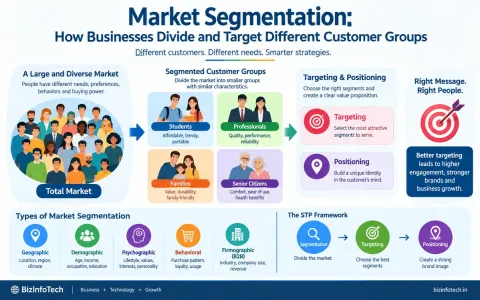
Target market selection is the second stage of the STP marketing framework.
STP stands for:
S — Segmentation
T — Targeting
P — Positioning
The process can be understood as follows:
Step 1: Segmentation
The business divides the broader market into meaningful customer groups.
Step 2: Target Market Selection
The business evaluates those groups and chooses the ones it wants to serve.
Step 3: Positioning
The business develops a value proposition and marketing strategy designed to create a distinctive perception among the selected customers.
Therefore:
Segmentation → Target Market Selection → Positioning
Target market selection transforms market research into a specific strategic direction.
Why Is Target Market Selection Important?
Choosing the right target market can influence almost every part of a company's marketing strategy.
1. Helps Focus Marketing Resources
Businesses have limited budgets, employees, time, and technology.
Instead of distributing resources across the entire market, a company can concentrate its efforts on selected customer groups.
For example, a small business may not have enough resources to serve both mass-market and premium customers simultaneously.
2. Improves Marketing Communication
Different customers respond to different messages.
Once a business identifies its target market, it can create communication that addresses the specific needs and problems of those customers.
For example:
A general message:
"We provide website development services."
A targeted message:
"Professional website development for doctors, lawyers, consultants, and growing businesses."
The second message communicates more clearly with a specific audience.
3. Supports Product Development
Understanding the target market helps businesses develop products and services around actual customer requirements.
For example, if a company targets small businesses, it may prioritize:
Affordable pricing
Simple implementation
Easy-to-use features
Customer support
Flexible packages
A product designed for large enterprises may require a completely different approach.
4. Helps Build Competitive Advantage
Selecting a specific target market can help a business develop expertise in serving a particular group.
A company that specializes in serving a particular customer category may develop:
Specialized knowledge
Relevant products
Better customer service
Industry-specific content
Stronger relationships
5. Improves Customer Understanding
A clearly defined target market allows marketers to study customers more deeply.
Businesses can understand:
Customer problems
Purchase motivations
Budget constraints
Preferred communication channels
Buying behavior
Expectations
This information can improve marketing decisions.
Factors to Consider When Selecting a Target Market
A business should not select a target market simply because it is large.
Several factors should be evaluated.
1. Market Size
The business should estimate how many potential customers exist within the segment.
A very small market may not generate sufficient demand for some business models.
However, a smaller niche can still be attractive if customers have specialized needs and the business can serve them effectively.
2. Market Growth
Businesses should examine whether the segment is growing, stable, or declining.
A growing segment may create opportunities for expansion.
Growth can be influenced by:
Changing consumer preferences
Technology
Demographic changes
Economic conditions
Regulatory developments
Cultural trends
3. Profitability Potential
A large market does not automatically mean high profitability.
Businesses should consider:
Potential revenue
Cost of serving customers
Price sensitivity
Customer acquisition costs
Expected customer lifetime value
Competitive pressure
A smaller segment can sometimes be economically attractive if customers value the offering and the business can serve them efficiently.
4. Competition
The level and nature of competition should be examined.
Questions include:
How many competitors serve the segment?
Who are the major competitors?
What products do they offer?
How strong are their brands?
What prices do they charge?
What customer needs remain underserved?
The purpose is not necessarily to avoid competition completely, but to understand whether the business has a realistic opportunity to create value.
5. Customer Needs
A target market should have a meaningful need or problem that the business can address.
For example, a company selling accounting software should identify businesses that actually require accounting and financial management solutions.
A segment with no meaningful need for the product is unlikely to be an appropriate target market.
6. Accessibility
The business must be able to reach the target customers.
A segment may appear attractive but be difficult or expensive to reach.
Businesses should consider:
Distribution channels
Digital channels
Sales teams
Advertising platforms
Geographic accessibility
Communication channels
7. Company Resources
The target market should match the organization's capabilities.
A small business with limited capital may not be able to compete effectively in a market dominated by large corporations.
The company should evaluate:
Financial resources
Human resources
Technology
Production capacity
Marketing capabilities
Distribution capabilities
8. Strategic Fit
The target market should be consistent with the company's broader objectives.
For example, a business positioned as a premium brand may not want to focus primarily on customers whose purchasing decisions are driven almost entirely by the lowest price.
The target market should fit the company's:
Mission
Brand positioning
Capabilities
Business model
Long-term objectives
The Target Market Selection Process
Target market selection can be approached as a structured process.
Step 1: Analyze the Market
The business first studies the overall market.
This may involve analyzing:
Customer needs
Market trends
Competitors
Industry conditions
Demand
Technology
Economic factors
Step 2: Identify Market Segments
The business identifies meaningful customer groups.
For example:
Students
Professionals
Families
Small businesses
Large organizations
The actual segmentation variables will depend on the industry.
Step 3: Develop Segment Profiles
Each segment should be described in enough detail to understand its characteristics.
A segment profile may include:
Customer characteristics
Needs
Purchasing behavior
Price sensitivity
Preferred channels
Estimated size
Growth potential
Step 4: Evaluate Segment Attractiveness
The business compares the identified segments using relevant criteria.
For example:
| Factor | Segment A | Segment B | Segment C |
|---|---|---|---|
| Market size | High | Medium | Low |
| Growth | Medium | High | High |
| Competition | High | Medium | Low |
| Profit potential | Medium | High | Medium |
| Accessibility | High | High | Medium |
| Company fit | Medium | High | High |
This type of analysis helps management understand the trade-offs associated with different segments.
Step 5: Evaluate Company Capabilities
The company should compare the requirements of each segment with its own capabilities.
For example:
Target segment: Large enterprises
Requirements:
Large sales team
Advanced technology
Strong customer support
High implementation capacity
If the company does not have these capabilities, the segment may not be suitable despite its size.
Step 6: Select the Target Market
After evaluation, the business chooses one or more segments.
The selection can involve:
A single segment
Several segments
A niche market
A broader market with differentiated offerings
Step 7: Develop the Marketing Strategy
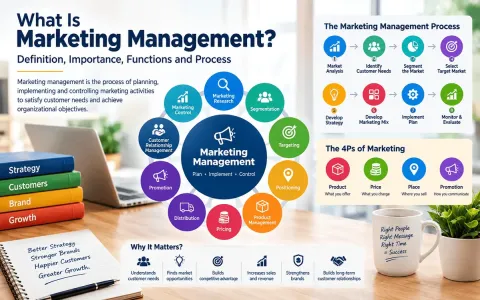
After selecting the target market, the business develops an appropriate marketing mix.
This includes:
Product
Price
Place
Promotion
The strategy should reflect the needs and characteristics of the selected target customers.
Step 8: Monitor the Target Market
Target market selection should not be treated as a permanent decision.
Customer preferences, technology, competition, and market conditions can change.
Businesses should therefore monitor:
Customer behavior
Sales
Market trends
Competitor activity
Customer satisfaction
Profitability
The company may modify its target market strategy when circumstances change.
Different Target Market Selection Strategies
Businesses can adopt different targeting strategies depending on their objectives and resources.
1. Undifferentiated Marketing
Under an undifferentiated approach, the business treats the broader market as a relatively homogeneous market and offers a common marketing strategy.
The company does not develop separate offerings for different segments.
Example
A basic commodity product may be marketed broadly with limited differentiation.
Advantages
Simpler marketing strategy
Lower complexity
Potentially lower marketing costs
Limitations
May overlook differences between customers
Can be difficult when customer needs are highly diverse
May expose the company to strong competition
2. Differentiated Marketing
Under differentiated marketing, a company targets multiple segments and develops different offerings or marketing strategies for each.
Example
An automobile company may offer:
Economy vehicles
Family vehicles
Premium vehicles
Performance-oriented vehicles
Each product may be promoted differently.
Advantages
Addresses different customer needs
Can expand market coverage
Allows more specialized marketing
Limitations
Higher costs
Greater operational complexity
Requires more resources
3. Concentrated Marketing
Concentrated marketing focuses on a particular segment or niche.
Instead of attempting to reach a large market, the business concentrates its resources on a specific group.
Example
A company may specialize in software designed specifically for dental clinics.
Rather than targeting every type of business, it focuses on one specialized customer group.
Advantages
Strong specialization
Efficient use of limited resources
Potential for strong customer knowledge
Useful for small businesses and niche providers
Limitations
Dependence on one segment
Market changes can have a larger impact
Limited overall market coverage
4. Micromarketing
Micromarketing involves tailoring marketing efforts to very specific customer groups or locations.
It can include:
Local Marketing
Marketing customized for a particular geographic market.
Individual Marketing
Marketing customized for individual customers based on their characteristics or behavior.
Digital technologies, customer data, and marketing automation have increased the ability of businesses to create highly customized marketing experiences.
Target Market Selection Example
Consider a company providing website development services.
After analyzing the market, the company identifies several potential segments:
Segment A: Doctors
Needs:
Professional website
Appointment information
Services pages
Patient-friendly design
Mobile accessibility
Segment B: Lawyers
Needs:
Professional credibility
Practice-area pages
Lawyer profiles
Contact and enquiry systems
Informational content
Segment C: Small Retail Businesses
Needs:
Product information
Local visibility
Contact details
Basic e-commerce capabilities
Segment D: Startups
Needs:
Business website
Landing pages
Lead generation
Branding
Digital marketing integration
The company may decide to focus primarily on professional service providers and startups because these segments match its expertise and resources.
The next step would be to develop separate value propositions and marketing messages for these customers.
This illustrates an important principle:
The target market should be selected not only because customers exist, but because the business can create meaningful value for them.
Target Market Selection in B2B Marketing
Target market selection is particularly important in business-to-business marketing.
B2B companies may evaluate potential customers based on:
Industry
Company size
Revenue
Location
Technology adoption
Purchasing requirements
Decision-making structure
Business problems
For example, a cybersecurity company may decide to target medium-sized businesses that have growing digital operations but require additional security capabilities.
A software company may instead focus on large organizations with complex operational requirements.
The target market should therefore reflect the company's product capabilities and sales model.
Target Market Selection in Digital Marketing
Digital marketing provides businesses with many ways to reach specific target audiences.
Businesses can use:
Search engines
Social media
Content marketing
Paid advertising
Websites
Online communities
Marketing automation
For example, a company targeting business owners may create:
Business-focused blog articles
Case studies
LinkedIn content
Search-optimized guides
Email campaigns
The selected target market should influence both the content and the channel used to communicate with customers.
Target Market Selection and SEO
Target market selection can also improve SEO strategy.
Once a business knows who it wants to reach, it can create content around the questions and problems relevant to those customers.
For example, a web development company targeting doctors could create content such as:
"Why Doctors Need a Professional Website"
"Essential Features of a Medical Practice Website"
"How a Website Can Help a Clinic Build Online Visibility"
If the business targets lawyers, it could create different content:
"Website Essentials for Law Firms"
"How Law Firms Can Improve Their Online Presence"
"Why Professional Website Design Matters for Lawyers"
The service may remain similar, but the audience, search intent, content, and message change.
This is one reason target market selection is closely connected to modern content marketing and SEO.
Target Market Selection and the Marketing Mix
Once the target market has been selected, the marketing mix should be designed around that market.
Product
What features and benefits does the target customer value?
Price
What price level is appropriate for the customer's needs and purchasing power?
Place
Where and how does the customer prefer to obtain the product?
Promotion
What message and communication channels are most appropriate?
For example, a premium B2B software product may require a very different marketing mix from a low-cost consumer product.
Target Market vs Target Audience
The terms target market and target audience are related but are not always identical.
Target Market
The broader group of customers that the business intends to serve.
Target Audience
The specific group of people a particular marketing communication is designed to reach.
For example:
A company may have small businesses as its target market.
For one advertising campaign, its target audience might be:
Small-business owners aged 30–50 who are actively looking for website development services.
Thus, the target audience can be narrower and campaign-specific.
Common Mistakes in Target Market Selection
Businesses can make several mistakes when choosing target markets.
1. Trying to Serve Everyone
A company may believe that reaching everyone will create more sales.
However, limited resources can make broad targeting ineffective.
2. Choosing a Segment Only Because It Is Large
Market size is important, but it is only one factor.
A large segment may also have:
Strong competition
Low margins
High customer acquisition costs
3. Ignoring Company Capabilities
A business should not select a market that requires capabilities it cannot provide effectively.
4. Ignoring Customer Needs
A target market must have a meaningful need that the company's offering can address.
5. Focusing Only on Short-Term Sales
A target market should ideally support the broader strategic direction of the business.
6. Failing to Monitor Changes
Markets evolve.
A target market that was attractive several years ago may have different characteristics today.
How Small Businesses Can Select a Target Market
Small businesses often have limited resources, making focused targeting particularly relevant.
A practical approach is to ask five questions:
1. Who needs our product or service?
Identify customers with a genuine problem or requirement.
2. Who can we serve particularly well?
Consider expertise, technology, employees, location, and capabilities.
3. Who can we reach efficiently?
Examine online and offline channels.
4. Who is commercially viable?
Consider willingness to pay, demand, costs, and potential revenue.
5. Where can we create meaningful value?
Choose customers for whom the company's offering provides a clear benefit.
These questions can help a small business avoid trying to compete everywhere at once.
Target Market Selection and Customer Value
The ultimate purpose of selecting a target market is not simply to identify customers.
It is to identify customers for whom the business can create meaningful value.
A strong target market typically represents an intersection between:
Customer Need
Market Opportunity
Business Capability
Strategic Fit
When these factors align, the business has a stronger foundation for developing its marketing strategy.
Frequently Asked Questions
What is target market selection?
Target market selection is the process of evaluating market segments and choosing one or more segments that a business intends to serve.
What is the difference between market segmentation and target market selection?
Market segmentation divides the broader market into groups, while target market selection evaluates those groups and chooses which ones the business will serve.
What factors should businesses consider when selecting a target market?
Important factors include market size, growth, profitability potential, competition, customer needs, accessibility, company resources, and strategic fit.
What are the major targeting strategies?
Common approaches include:
Undifferentiated marketing
Differentiated marketing
Concentrated marketing
Micromarketing
Can a small business target multiple markets?
Yes. A small business can target multiple segments if it has the resources and capabilities to serve them effectively.
Is the largest market always the best target market?
No. Market size is only one factor. A smaller segment may be more suitable if it has strong demand, appropriate profitability potential, manageable competition, and a good fit with the company's capabilities.
How does target market selection help digital marketing?
It helps businesses create more relevant content, advertising, SEO strategies, social media communication, and customer experiences for specific audiences.
Conclusion
Target market selection is a critical step between market segmentation and market positioning.
After identifying different customer segments, businesses need to evaluate them carefully rather than automatically targeting the largest group. Factors such as market size, growth, profitability potential, competition, accessibility, customer needs, company resources, and strategic fit can help management make more informed decisions.
Different businesses may use different targeting approaches. Some may serve the broader market, while others may focus on multiple segments, a specialized niche, or highly specific customer groups.
In today's competitive and digital business environment, choosing a clear target market can help businesses use their resources more efficiently, create relevant marketing messages, develop suitable products, and build stronger customer relationships.
The key principle is simple:
A business does not need to serve everyone. It needs to identify the customers it can serve effectively and create meaningful value for them.
Key Takeaway
Market Segmentation → Target Market Selection → Positioning → Marketing Mix → Customer Value
Understanding target market selection helps businesses move from simply identifying customer groups to making strategic decisions about which customers to serve and how to serve them effectively.
Related articles:-
Market Segmentation: How Businesses Divide and Target Different Customer Groups
Marketing Environment: Micro and Macro Factors That Influence Business Decisions
What Is Marketing Management? Definition, Importance, Functions and Process