Introduction
Marketing is much more than advertising a product or promoting a business. It involves understanding customer needs, selecting the right market, developing suitable products and services, setting prices, communicating value, building relationships, and creating long-term customer value.
To coordinate all these activities effectively, organizations need marketing management.
Marketing management provides a systematic approach to planning, implementing, and controlling marketing activities. It helps organizations understand their customers and markets while making informed decisions about products, pricing, promotion, distribution, and customer relationships.
Whether a company sells physical products, digital services, professional services, or educational solutions, effective marketing management can help it identify opportunities, respond to competition, and build sustainable customer relationships.
In this article, we will discuss the definition of marketing management, its importance, major functions, marketing management process, key concepts, examples, and its role in modern business.
What Is Marketing Management?
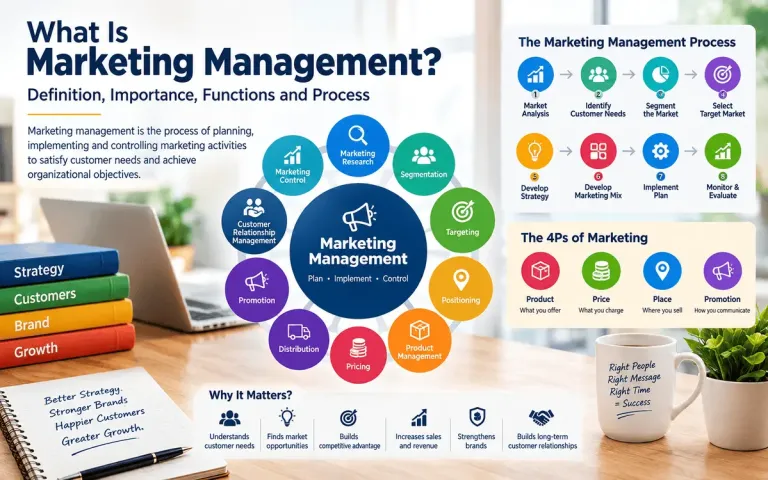
Marketing management is the process of planning, organizing, implementing, and controlling marketing activities to satisfy customer needs and achieve organizational objectives.
It involves understanding the market, identifying target customers, developing appropriate marketing strategies, implementing those strategies, and evaluating their results.
In simple terms:
Marketing management is the process of managing marketing activities to create, communicate, deliver, and exchange value for customers while achieving organizational goals.
Marketing management therefore connects two important areas:
Customer needs + Organizational objectives
A business needs customers, but it also needs to achieve objectives such as revenue growth, profitability, market share, customer retention, or brand development.
Marketing management attempts to create a balance between these objectives.
Marketing Management in Simple Terms
Consider a company planning to launch a new smartphone.
Marketing management would involve questions such as:
Who are the target customers?
What features do they want?
How should the product be positioned?
What price should be charged?
Where should the product be sold?
How should the product be promoted?
Who are the major competitors?
How should customers be retained?
How should marketing performance be measured?
These decisions collectively form part of marketing management.
Difference Between Marketing and Marketing Management
Marketing and marketing management are closely related, but they are not exactly the same.
Marketing
Marketing is the broader activity of understanding customer needs and creating, communicating, delivering, and exchanging value.
Marketing Management
Marketing management focuses on planning, coordinating, implementing, and controlling marketing activities.
For example:
Marketing: Understanding what customers want.
Marketing management: Developing and implementing a strategy to satisfy those needs profitably.
Why Is Marketing Management Important?
Marketing management plays an important role in connecting an organization with its customers and market.
Its importance can be understood through several areas.
1. Understanding Customer Needs
Customers have different needs, preferences, expectations, and purchasing behavior.
Marketing management helps organizations research and understand these differences.
For example, a company selling fitness products may identify different customer groups:
Professional athletes
Fitness enthusiasts
Beginners
Health-conscious consumers
Each group may require different products, messages, and pricing approaches.
2. Identifying Market Opportunities
Markets continuously change because of:
Technology
Competition
Consumer preferences
Economic conditions
Social trends
Demographic changes
Marketing management helps organizations identify opportunities created by these changes.
For example, increasing demand for online education can create opportunities for companies offering digital learning platforms.
3. Developing Marketing Strategies
A business needs a clear strategy to compete effectively.
Marketing management helps determine:
Target market
Positioning
Product strategy
Pricing strategy
Distribution strategy
Promotional strategy
These decisions provide direction to marketing activities.
4. Creating Customer Value
Customers do not simply buy products; they seek value.
Value may come from:
Product quality
Convenience
Price
Service
Brand reputation
Experience
After-sales support
Marketing management helps organizations understand what customers value and design their offerings accordingly.
5. Building Competitive Advantage
Organizations operate in competitive markets.
Marketing management helps businesses identify:
Competitors
Competitor strengths
Competitor weaknesses
Market gaps
Changing customer expectations
This information can help organizations develop differentiated offerings.
6. Increasing Sales and Revenue
Effective marketing management can support business growth by helping organizations:
Reach appropriate customers
Develop suitable products
Communicate value effectively
Improve customer acquisition
Increase customer retention
However, marketing does not operate independently from product quality, pricing, operations, finance, and other business functions.
7. Building Strong Brands
Marketing management also contributes to brand development.
A strong brand can help customers recognize and differentiate a business from competitors.
Brand management involves decisions related to:
Brand identity
Brand positioning
Brand communication
Customer experience
Brand consistency
8. Building Long-Term Customer Relationships
Modern marketing increasingly focuses on relationships rather than only individual transactions.
Businesses can build relationships through:
Customer service
Personalized communication
Loyalty programs
Feedback systems
After-sales support
Consistent customer experiences
Customer retention can be an important part of long-term marketing strategy.
Functions of Marketing Management
Marketing management includes several interconnected functions.
1. Marketing Research
Marketing research involves collecting and analyzing information about:
Customers
Competitors
Markets
Products
Consumer behavior
Market trends
Research helps managers make more informed marketing decisions.
For example, before launching a new product, a company might conduct surveys, interviews, competitor analysis, or market analysis.
2. Market Segmentation
A market often consists of customers with different characteristics and needs.
Market segmentation divides a broad market into groups based on factors such as:
Demographics
Geography
Psychographics
Behavior
Needs
For example, a clothing company may segment customers according to age, lifestyle, location, and purchasing behavior.
3. Target Market Selection
After segmenting the market, a company needs to decide which customer groups it wants to serve.
This is known as target market selection.
A company may evaluate segments based on:
Market size
Growth potential
Competition
Customer needs
Company resources
Profit potential
4. Market Positioning
Positioning refers to how a company wants its product or brand to be perceived by the target customers relative to competing offerings.
For example, a brand might position itself around:
Premium quality
Affordability
Innovation
Convenience
Sustainability
Performance
Effective positioning provides customers with a reason to distinguish one offering from another.
5. Product Management
Marketing management plays an important role in product decisions.
These may include:
Product development
Product features
Product design
Product quality
Product packaging
Branding
Product modifications
Product elimination
A product should be developed according to customer needs and market opportunities.
6. Pricing Management
Price directly affects both customer perceptions and business revenue.
Marketing managers consider factors such as:
Customer willingness to pay
Costs
Competitor prices
Demand
Market conditions
Product positioning
Business objectives
Different pricing approaches may be appropriate for different markets and products.
7. Distribution Management
Distribution involves making products or services available to customers.
Distribution decisions may include:
Direct selling
Retail stores
Wholesalers
Distributors
E-commerce
Online marketplaces
Digital delivery
The appropriate distribution system depends on the nature of the product, customer preferences, and market structure.
8. Promotion Management
Promotion involves communicating information about products, services, brands, and offers to target audiences.
The promotion mix may include:
Advertising
Sales promotion
Public relations
Personal selling
Direct marketing
Digital marketing
The objective is not simply to communicate more, but to communicate the right message to the appropriate audience through suitable channels.
9. Customer Relationship Management
Marketing management also involves developing and maintaining relationships with customers.
Businesses may use:
Customer databases
CRM systems
Feedback
Personalized communication
Loyalty programs
Customer support
The objective is to understand customers and improve their overall experience.
10. Marketing Control
Marketing activities need to be measured and evaluated.
Marketing control may involve monitoring:
Sales
Revenue
Market share
Customer acquisition
Customer retention
Marketing costs
Campaign performance
Return on marketing investment
If actual performance differs significantly from objectives, managers can make appropriate adjustments.
The Marketing Management Process
Marketing management can be understood as a continuous process rather than a one-time activity.
A simplified process is:
Market Analysis → Marketing Planning → Strategy Development → Implementation → Monitoring → Control → Improvement
Let's examine each stage.
Step 1: Analyze the Market
The first step is understanding the market.
Managers study:
Customers
Competitors
Industry trends
Economic conditions
Technology
Regulations
Social changes
Tools such as SWOT analysis and PESTLE analysis can help organize this information.
Step 2: Identify Customer Needs
After analyzing the market, the organization needs to understand customer needs.
Questions may include:
Who are our customers?
What problems do they experience?
What motivates their purchases?
What alternatives do they have?
What factors influence their decisions?
Customer research provides important inputs for subsequent marketing decisions.
Step 3: Segment the Market
The organization divides the market into meaningful customer groups.
For example, a software company might segment its market into:
Individual users
Small businesses
Medium-sized businesses
Large enterprises
Each segment may have different requirements.
Step 4: Select the Target Market
The company evaluates market segments and chooses the segments it intends to serve.
The selected target market should be consistent with:
Organizational resources
Product capabilities
Competitive conditions
Market opportunity
Business objectives
Step 5: Develop the Marketing Strategy
The organization then develops its marketing strategy.
This can involve decisions about:
Target customers
Positioning
Product
Price
Distribution
Promotion
Customer relationships
A useful marketing strategy should provide clear direction rather than simply listing promotional activities.
Step 6: Develop the Marketing Mix
The traditional marketing mix is commonly represented by the 4Ps:
Product
What is being offered to customers?
Price
How much will customers pay?
Place
Where and how will the product be made available?
Promotion
How will the organization communicate with customers?
For services, the marketing mix is often expanded to 7Ps by adding:
People
Process
Physical Evidence
Step 7: Implement the Marketing Plan
A strategy has little value without implementation.
Implementation involves converting plans into actual activities.
For example:
Launching a product
Setting prices
Establishing distribution
Creating advertising campaigns
Training sales personnel
Developing digital campaigns
Managing customer communication
Step 8: Monitor Performance
Managers need to determine whether marketing activities are producing the expected results.
Performance can be measured through indicators such as:
Sales
Leads
Conversion rate
Customer acquisition cost
Customer retention
Market share
Campaign response
Customer satisfaction
Step 9: Evaluate and Control
The final stage involves comparing actual results with planned objectives.
If performance is below expectations, managers can investigate the reasons.
For example:
Problem: Sales are below target.
Possible causes might include:
Incorrect target market
Weak product positioning
Pricing problems
Distribution limitations
Ineffective promotion
Strong competition
Corrective action can then be taken.
Marketing Management and the Marketing Mix
The marketing mix is one of the most important frameworks used in marketing management.
The 4Ps of Marketing
Product
The product must provide value to the target customer.
Price
Pricing must consider customer value, costs, competition, and organizational objectives.
Place
Distribution should make the offering available where and when customers need it.
Promotion
Communication should explain the product's value and encourage appropriate customer action.
Together, these decisions form an important part of marketing strategy.
Modern Marketing Management
Marketing management has changed significantly with technology and changing consumer behavior.
Traditional marketing relied heavily on channels such as:
Television
Newspapers
Magazines
Radio
Outdoor advertising
Direct mail
Modern marketing management can also involve:
Search engines
Social media
Email marketing
Content marketing
Marketing automation
Customer relationship management systems
Data analytics
Artificial intelligence
E-commerce platforms
However, technology does not replace the fundamental principles of marketing.
The basic questions remain:
Who is the customer?
What does the customer need?
What value can we provide?
How should we communicate that value?
Role of Data in Marketing Management
Modern marketing managers increasingly use data to support decision-making.
Marketing data can help organizations understand:
Customer behavior
Campaign performance
Website traffic
Conversion rates
Customer preferences
Sales trends
Retention
Market trends
For example, a company can compare the performance of different marketing channels and allocate resources based on the results.
However, data should support managerial judgment rather than replace it completely.
Role of Artificial Intelligence in Marketing Management
Artificial intelligence is increasingly being applied to marketing activities.
Potential applications include:
Customer segmentation
Recommendation systems
Content assistance
Predictive analytics
Customer service
Campaign optimization
Marketing automation
Sentiment analysis
For example, AI can analyze large amounts of customer data and identify patterns that may be difficult to detect manually.
However, organizations must also consider issues such as:
Data privacy
Accuracy
Bias
Transparency
Human oversight
Therefore, AI should be integrated into marketing management with appropriate governance and managerial oversight.
Example of Marketing Management
Consider a small company planning to launch a new online learning platform.
Market Analysis
The company studies:
Students
Working professionals
Competitors
Existing learning platforms
Pricing models
Segmentation
The market is divided into:
College students
Competitive-exam learners
Working professionals
Career changers
Targeting
The company selects working professionals as its primary target segment.
Positioning
The platform is positioned around:
Flexible, affordable, career-focused learning.
Product
The company develops online courses, assessments, certificates, and learning resources.
Pricing
Different subscription plans are created.
Promotion
The company uses:
Search marketing
Social media
Content marketing
Email marketing
Distribution
Courses are delivered through an online platform.
Control
The company monitors:
Registrations
Course completion
Customer acquisition
Subscription renewals
Customer feedback
This example demonstrates how marketing management coordinates different marketing decisions into one integrated process.
Importance of Marketing Management for Small Businesses
Marketing management is not limited to large corporations.
Small businesses also need to make marketing decisions carefully because their resources may be limited.
A small business can use marketing management to:
Identify profitable customer segments
Understand competitors
Develop appropriate products
Set suitable prices
Select effective promotional channels
Build customer relationships
Measure marketing performance
For a small business, effective targeting can be particularly important because limited resources cannot support every possible market segment.
Challenges of Marketing Management
Marketing managers face several challenges in today's business environment.
Changing Customer Expectations
Customer preferences can change rapidly.
Increasing Competition
Digital technologies can make it easier for businesses to enter markets and reach customers.
Data Management
Organizations have access to large quantities of customer and market data but must determine how to use it effectively.
Technological Change
Marketing technologies and platforms continue to evolve.
Privacy Concerns
Customer data must be handled responsibly and according to applicable requirements.
Measuring Marketing Performance
It can sometimes be difficult to determine how individual marketing activities contribute to overall business results.
Marketing Management vs Sales Management
Marketing management and sales management are related but have different focuses.
Marketing Management
Focuses broadly on:
Market research
Customer needs
Segmentation
Targeting
Positioning
Product
Pricing
Distribution
Promotion
Customer relationships
Sales Management
Focuses more specifically on managing the sales function, including:
Sales planning
Sales teams
Sales territories
Sales targets
Sales forecasting
Sales performance
Customer accounts
Sales is therefore an important part of the broader marketing system, although marketing management covers a wider range of activities.
Key Principles of Effective Marketing Management
Effective marketing management generally involves several principles.
Customer Orientation
Understand and respond to customer needs.
Value Creation
Provide meaningful value rather than focusing only on promotion.
Strategic Thinking
Connect marketing decisions with organizational objectives.
Market Orientation
Monitor customers, competitors, and changes in the business environment.
Integration
Coordinate product, price, distribution, and promotion decisions.
Measurement
Use appropriate performance indicators to evaluate results.
Adaptability
Adjust strategies when markets, technology, or customer behavior changes.
Conclusion
Marketing management is the systematic process of analyzing markets, understanding customer needs, developing marketing strategies, implementing marketing activities, and controlling their performance to achieve organizational objectives.
Its major functions include:
Marketing research
Segmentation
Targeting
Positioning
Product management
Pricing
Distribution
Promotion
Customer relationship management
Marketing control
The marketing management process generally moves from market analysis and planning to strategy development, implementation, measurement, and improvement.
In modern business, marketing management increasingly combines traditional marketing principles with digital technologies, data analytics, customer relationship systems, automation, and artificial intelligence.
Ultimately, effective marketing management is not simply about selling more products. It is about understanding markets, creating meaningful customer value, building sustainable relationships, and aligning marketing decisions with the organization's broader objectives.
Key Takeaways
Marketing management involves planning, implementing, and controlling marketing activities.
It begins with understanding customers and the market.
Segmentation, targeting, and positioning help organizations focus their marketing efforts.
The **4Ps—Product, Price, Place, and Promotion—**remain fundamental marketing decisions.
Marketing management includes both strategic and operational activities.
Data, digital technologies, and AI are increasingly influencing modern marketing management.
Marketing management is relevant to both large organizations and small businesses.
Effective marketing management requires continuous measurement, evaluation, and adaptation.
Next article in this Marketing Management series:
Marketing Environment: Micro and Macro Factors That Influence Business Decisions.
Related articles:-
Marketing in 2026: The Complete Guide to Growing Your Business in a Digital-First World
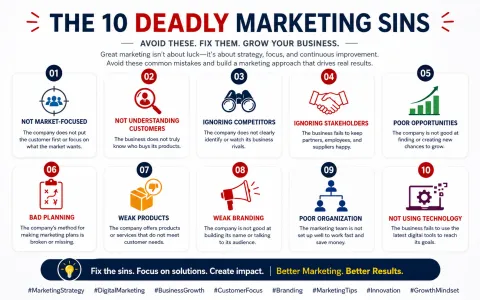
The 10 Deadly Marketing Sins That Hold Businesses Back (And How to Avoid Them)