Introduction
Businesses do not operate in isolation. Every organization is influenced by customers, competitors, suppliers, technology, government policies, economic conditions, social trends, and many other external forces.
These forces together form the marketing environment.
Understanding the marketing environment helps marketing managers identify opportunities, recognize threats, understand changing customer needs, and make better marketing decisions. A company may have an excellent product, but changes in the economy, technology, competition, regulations, or consumer behavior can significantly affect its success.
For example, the rapid growth of e-commerce has changed how businesses sell products, while social media has changed how brands communicate with customers. Similarly, inflation can influence purchasing power, and new regulations can affect how companies collect and use customer data.
Therefore, marketing managers need to continuously monitor the environment in which their organizations operate.
In this article, we will examine the meaning of the marketing environment, its importance, micro and macro environmental factors, the PESTLE framework, practical examples, and how businesses can respond to environmental changes.
What Is the Marketing Environment?
The marketing environment refers to all the internal and external factors that influence an organization's marketing activities, decisions, and ability to serve its target customers.
In simple terms:
The marketing environment is the collection of forces and factors that affect how a business understands customers, develops products, sets prices, communicates value, and delivers products or services to the market.
Some factors are relatively close to the organization and can be influenced to a certain extent. Others are external forces that a company cannot directly control.
This is why marketing managers need to distinguish between different levels of the marketing environment.
Types of Marketing Environment
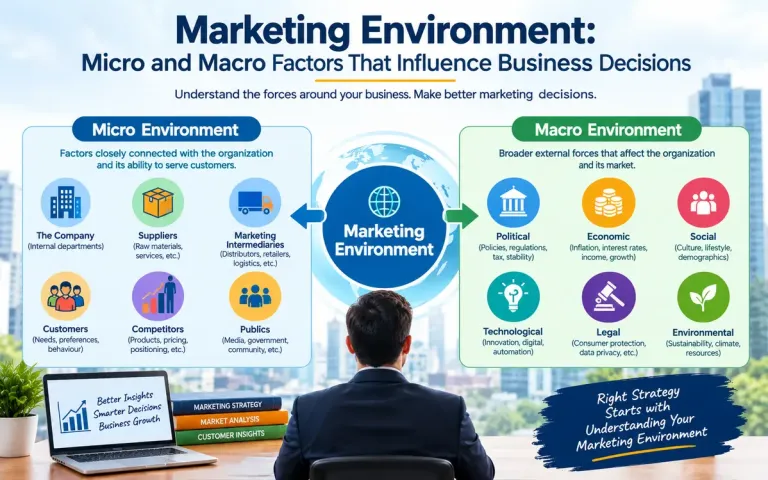
The marketing environment is commonly divided into two broad categories:
Micro Environment
Macro Environment
The basic relationship can be represented as:
Marketing Environment → Micro Environment + Macro Environment
The micro environment consists of factors closely connected with the organization and its ability to serve customers.
The macro environment consists of broader forces that affect the organization and its market.
What Is the Micro Environment?
The micro environment consists of individuals, organizations, and groups that are relatively close to a business and directly influence its ability to serve customers.
Important micro-environment factors include:
The company
Suppliers
Marketing intermediaries
Customers
Competitors
Publics
Let's examine each one.
1. The Company
Marketing decisions do not operate independently from other departments.
Marketing managers need to work with:
Top management
Finance
Operations
Human resources
Research and development
Procurement
Information technology
For example, the marketing department may want to launch a major promotional campaign, but the production department must have sufficient capacity to meet the expected increase in demand.
Similarly, finance may establish a marketing budget that affects the scale of promotional activities.
Therefore, internal coordination is an important part of marketing management.
2. Suppliers
Suppliers provide the resources that businesses need to produce and deliver their offerings.
These may include:
Raw materials
Components
Packaging
Technology
Software
Professional services
Logistics services
Supplier-related problems can directly affect marketing performance.
For example, if a supplier cannot provide an important component on time, a company may experience product shortages. This can affect customer satisfaction and brand reputation.
Marketing managers therefore need to understand how supplier conditions may affect product availability, quality, and cost.
3. Marketing Intermediaries
Marketing intermediaries help businesses promote, sell, distribute, and deliver products to customers.
Examples include:
Wholesalers
Retailers
Distributors
Logistics providers
Advertising agencies
Digital marketing agencies
Financial intermediaries
For example, an e-commerce business may depend on payment providers, logistics companies, online platforms, and digital advertising services.
Changes in the performance or cost of these intermediaries can affect the company's marketing strategy.
4. Customers
Customers are at the center of marketing.
Marketing managers need to understand:
Customer needs
Preferences
Purchasing behavior
Expectations
Buying motivations
Satisfaction
Feedback
Price sensitivity
Different types of customers may require different marketing approaches.
A business-to-business company, for example, may deal with organizational purchasing processes, while a consumer brand may deal with individual purchasing decisions.
Understanding the target customer is therefore fundamental to marketing management.
5. Competitors
Every business operates within a competitive environment.
Competitors may offer:
Similar products
Substitute products
Lower prices
Better services
Stronger brands
Greater convenience
New technologies
Marketing managers should monitor competitors':
Products
Prices
Distribution
Promotional activities
Positioning
Customer experience
New product launches
However, competitive analysis should focus not only on what competitors are doing today but also on how the competitive landscape may change.
6. Publics
A public is a group that has an actual or potential interest in, or impact on, an organization's ability to achieve its objectives.
Examples include:
Media
Financial institutions
Government organizations
Local communities
Consumer groups
Employees
Investors
General public
For example, media coverage can influence public perception of a company, while government authorities can influence the regulatory conditions under which it operates.
What Is the Macro Environment?
The macro environment consists of broader external forces that influence organizations and markets.
Businesses generally have limited or no direct control over these forces.
A widely used framework for analyzing the macro environment is PESTLE analysis.
PESTLE stands for:
P — Political
E — Economic
S — Social
T — Technological
L — Legal
E — Environmental
Let's examine each factor.
1. Political Factors
Political factors relate to government policies, political conditions, and public policy decisions that can influence businesses.
Examples include:
Government policies
Trade policies
Tax policies
Import and export regulations
Government stability
Public spending
Industry policies
Government support programs
Political changes can influence business costs, market opportunities, and investment decisions.
Example
Suppose the government introduces a policy that encourages domestic manufacturing.
Businesses operating in manufacturing may evaluate whether they can expand production or modify their supply chains to respond to the new environment.
Marketing managers should therefore monitor relevant policy developments.
2. Economic Factors
Economic conditions influence customers' purchasing power and businesses' costs.
Important economic factors include:
Inflation
Interest rates
Employment
Income levels
Economic growth
Consumer spending
Exchange rates
Availability of credit
Example
During periods of high inflation, consumers may become more price-conscious.
A business may respond by:
Reviewing product sizes
Introducing different price points
Emphasizing value
Adjusting promotional strategies
Revisiting product portfolios
Economic conditions can therefore influence both demand and marketing strategy.
3. Social Factors
Social factors relate to changes in society, culture, lifestyles, demographics, values, and consumer behavior.
Examples include:
Population growth
Age distribution
Education
Family structures
Lifestyle changes
Cultural values
Consumer attitudes
Health and wellness preferences
Changing work patterns
Example
The growth of remote and hybrid work has influenced demand for products and services related to home offices, collaboration tools, online learning, and digital communication.
Businesses that recognize such changes can explore new market opportunities.
4. Technological Factors
Technology is one of the most significant forces affecting modern marketing.
Technological factors include:
Artificial intelligence
Automation
E-commerce
Mobile technology
Cloud computing
Data analytics
Digital payment systems
Social media platforms
Search technology
Marketing automation
Technology can create new products, new business models, and new ways of reaching customers.
Example
A small local business that previously depended entirely on physical customers may use:
A website
Google Business Profile
Social media
Online ordering
Digital payments
Search engine optimization
to reach customers beyond its immediate physical location.
Technology can therefore change both market access and competitive conditions.
5. Legal Factors
Legal factors include laws and regulations that affect business activities.
These may relate to:
Consumer protection
Advertising
Product safety
Competition
Employment
Data protection
Intellectual property
E-commerce
Industry-specific regulations
Marketing managers need to ensure that marketing campaigns and business practices comply with applicable laws and regulations.
Example
A company collecting customer information through its website must consider applicable privacy and data protection requirements.
6. Environmental Factors
Environmental factors relate to ecological conditions and sustainability-related concerns.
Examples include:
Climate change
Resource availability
Waste management
Energy consumption
Pollution
Sustainable packaging
Environmental regulations
Consumer interest in sustainability
These factors can influence product design, packaging, production, transportation, and marketing communication.
Example
A company may reduce plastic packaging and communicate its packaging changes to environmentally conscious customers.
However, environmental claims should be accurate and supported by evidence.
Micro Environment vs Macro Environment
The two levels of the marketing environment differ in several ways.
| Basis | Micro Environment | Macro Environment |
|---|---|---|
| Meaning | Factors closely connected with the business | Broad external forces |
| Relationship | Relatively close to the organization | Wider external environment |
| Examples | Customers, suppliers, competitors | Economic, social, technological factors |
| Control | Some influence may be possible | Very limited direct control |
| Impact | Often more directly related to daily marketing activities | Can create broad opportunities or threats |
| Analysis | Competitor and customer analysis | PESTLE analysis |
Both environments need to be studied because they influence marketing decisions in different ways.
Why Is Marketing Environment Analysis Important?
Marketing environment analysis helps businesses make better decisions.
1. Identifying Opportunities
Environmental changes can create new market opportunities.
For example, technological developments may create demand for new digital services.
2. Identifying Threats
Environmental changes can also create risks.
Examples include:
New competitors
Economic downturns
Regulatory changes
Changing customer preferences
Technological disruption
Early identification can give organizations more time to prepare.
3. Understanding Customer Behavior
Social and economic changes can influence what customers buy and how they make purchasing decisions.
Marketing environment analysis helps managers understand these changes.
4. Supporting Strategic Planning
Marketing strategies should reflect the environment in which a business operates.
Environmental analysis can therefore support decisions about:
Target markets
Product development
Pricing
Distribution
Promotion
Market expansion
5. Improving Competitive Response
Competitor analysis helps organizations understand their position within the market.
A company can identify areas where it needs to improve or differentiate its offering.
6. Reducing Uncertainty
Businesses cannot eliminate uncertainty, but systematic environmental analysis can help managers identify important changes earlier.
This can improve preparedness and decision-making.
Marketing Environment and SWOT Analysis
Marketing environment analysis can also contribute to SWOT analysis.
SWOT stands for:
Strengths
Weaknesses
Opportunities
Threats
Internal factors generally include:
Strengths + Weaknesses
External factors generally include:
Opportunities + Threats
For example:
| Internal | External |
|---|---|
| Strengths | Opportunities |
| Weaknesses | Threats |
A business might identify:
Strength: Strong digital presence
Weakness: Limited distribution network
Opportunity: Growing demand for online purchasing
Threat: Increasing competition from large platforms
This information can support marketing strategy development.
Marketing Environment and Marketing Strategy
Marketing environment analysis should not be treated as a separate academic exercise.
Its purpose is to improve decision-making.
For example, suppose a company discovers through environmental analysis that:
Customer demand is shifting toward online purchasing.
Competitors are investing heavily in e-commerce.
Mobile usage is increasing.
Digital payment adoption is growing.
The company may respond by developing:
An e-commerce website
Mobile-friendly customer experiences
Digital payment options
Search marketing
Social media campaigns
Online customer support
The environmental analysis therefore influences actual marketing strategy.
How Businesses Can Analyze the Marketing Environment
A systematic process can make environmental analysis more useful.
Step 1: Define the Market
Clearly identify the market, industry, customers, and geographical area being studied.
Step 2: Analyze Customers
Study customer needs, preferences, behavior, and changing expectations.
Step 3: Analyze Competitors
Monitor competitors' products, prices, positioning, distribution, and promotional activities.
Step 4: Analyze the Micro Environment
Evaluate suppliers, intermediaries, customers, competitors, and relevant publics.
Step 5: Conduct PESTLE Analysis
Examine political, economic, social, technological, legal, and environmental factors.
Step 6: Identify Opportunities and Threats
Determine which environmental changes could create opportunities or risks.
Step 7: Assess Business Impact
Not every environmental change will have the same importance.
Managers should evaluate:
Potential impact
Probability
Timing
Business relevance
Step 8: Develop a Response
The organization can then decide whether to:
Adapt
Invest
Differentiate
Reduce risk
Enter a new market
Modify products
Change pricing
Adjust communication
Step 9: Monitor Continuously
The marketing environment changes continuously, so environmental analysis should also be an ongoing activity.
Example of Marketing Environment Analysis
Consider a small traditional retail business that sells clothing.
Micro Environment
The business examines:
Customers
Local competitors
Suppliers
Wholesalers
Delivery providers
Macro Environment
It also examines:
Economic: Changes in consumer purchasing power.
Social: Changing fashion preferences.
Technological: Growth of online shopping and digital payments.
Legal: Consumer and e-commerce requirements.
Environmental: Increasing interest in sustainable products.
The business may identify an opportunity to create an online sales channel.
It could then develop:
A website
Product catalog
Online payment
Delivery system
Social media presence
Search visibility
This illustrates how environmental analysis can lead to practical marketing decisions.
Marketing Environment in the Digital Era
Digital transformation has made the marketing environment more dynamic.
Customers can now:
Compare prices instantly
Read reviews
Research products online
Communicate with brands
Switch between competitors
Purchase products from different geographical markets
At the same time, businesses can collect more information about customer interactions through digital channels.
This creates opportunities but also increases competition and raises issues related to privacy, data security, and responsible marketing.
Role of Artificial Intelligence in Environmental Analysis
Artificial intelligence and data analytics can assist marketing managers in analyzing large amounts of information.
Potential applications include:
Trend analysis
Customer segmentation
Competitor monitoring
Demand forecasting
Sentiment analysis
Predictive analytics
Automated reporting
For example, businesses can analyze customer reviews and online conversations to identify emerging concerns or preferences.
However, AI-generated insights should be evaluated carefully because data can be incomplete, inaccurate, biased, or incorrectly interpreted.
Human judgment remains important when making strategic decisions.
Challenges in Analyzing the Marketing Environment
Marketing environment analysis also has limitations.
Rapid Change
Technology, customer behavior, and markets can change quickly.
Information Overload
Businesses may have access to more information than they can effectively analyze.
Uncertainty
Not every environmental development can be predicted accurately.
Data Quality
Poor-quality or outdated data can produce misleading conclusions.
Misinterpretation
The same environmental trend can affect different businesses differently.
Therefore, managers should combine data with market knowledge, experience, and strategic judgment.
Common Mistakes in Marketing Environment Analysis
1. Focusing Only on Competitors
Competitors are important, but the environment also includes customers, technology, economic conditions, regulations, and social changes.
2. Ignoring Small Changes
Small changes in customer behavior can eventually become major market trends.
3. Looking Only at the Current Situation
Managers should also consider how environmental factors may develop in the future.
4. Treating PESTLE as a Checklist
Simply listing political, economic, and social factors is not enough. Managers need to understand their potential impact on the organization.
5. Failing to Connect Analysis With Strategy
Environmental analysis should ultimately contribute to business and marketing decisions.
Marketing Environment: Key Questions for Managers
A marketing manager can regularly ask:
Customers
Who are our customers?
What are their changing needs?
What influences their buying decisions?
Competitors
Who are our major competitors?
What are they offering?
How are they positioning themselves?
Economic
Is purchasing power changing?
Are costs increasing?
Technology
What technologies could change our industry?
Are customers adopting new digital channels?
Social
Are lifestyles or consumer attitudes changing?
Legal
Are new regulations affecting our activities?
Environmental
Are sustainability expectations changing?
Strategy
What opportunities are emerging?
What threats should we prepare for?
These questions can turn environmental analysis into an ongoing management activity.
Conclusion
The marketing environment includes the internal and external forces that influence an organization's marketing decisions and ability to serve its customers.
The environment can broadly be divided into:
Micro Environment
Company
Suppliers
Marketing intermediaries
Customers
Competitors
Publics
Macro Environment
Political factors
Economic factors
Social factors
Technological factors
Legal factors
Environmental factors
Understanding these factors helps organizations identify opportunities, anticipate threats, understand customers, respond to competition, and develop appropriate marketing strategies.
For modern businesses, environmental analysis has become increasingly important because technology, customer behavior, competition, regulations, and economic conditions can change rapidly.
Marketing management therefore should not be viewed as simply promoting products. It requires continuous observation of the environment, strategic thinking, and the ability to adapt marketing decisions to changing market conditions.
A business cannot control its entire marketing environment, but it can monitor the environment, understand its implications, and prepare appropriate responses.
Key Takeaways
Marketing environment refers to the forces that influence marketing decisions and activities.
It consists of micro and macro environmental factors.
Customers, competitors, suppliers, intermediaries, and publics are important micro-environment factors.
Political, economic, social, technological, legal, and environmental forces form the major macro-environment factors.
PESTLE analysis is a useful framework for examining the macro environment.
Environmental analysis helps businesses identify opportunities and threats.
Marketing environment analysis should be connected to actual marketing strategy and decision-making.
In the digital era, technology and changing consumer behavior have made the marketing environment increasingly dynamic.
Environmental analysis should be continuous rather than a one-time exercise.
Related articles:-
What Is Marketing Management? Definition, Importance, Functions and Process
Marketing in 2026: The Complete Guide to Growing Your Business in a Digital-First World
Understanding SWOT analysis and it's impact
The 10 Deadly Marketing Sins That Hold Businesses Back (And How to Avoid Them)