Introduction
Not every customer has the same needs, preferences, purchasing behavior, budget, or expectations.
A business that tries to offer the same product, price, message, and experience to everyone may find it difficult to satisfy different groups effectively. This is where market segmentation becomes important.
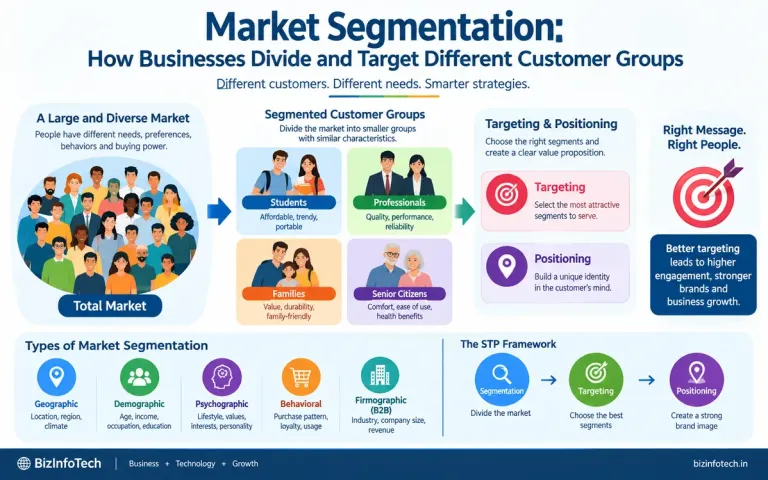
Market segmentation helps businesses divide a broad and diverse market into smaller groups of customers who share similar characteristics, needs, or behaviors. These groups can then be studied and evaluated to determine which customers the business should target.
For example, a clothing company may serve customers with very different preferences. College students may look for affordable and fashionable clothing, while working professionals may prioritize formal designs and quality. Treating both groups exactly the same may not produce the best marketing results.
By identifying meaningful customer segments, businesses can develop more relevant products, pricing strategies, distribution approaches, and promotional messages.
In this article, we will explore the meaning of market segmentation, its importance, major types, bases of segmentation, segmentation process, examples, advantages, limitations, and its relationship with targeting and positioning.
What Is Market Segmentation?
Market segmentation is the process of dividing a broad market into smaller groups of customers who have similar characteristics, needs, preferences, or purchasing behavior.
In simple terms:
Market segmentation means dividing a large market into meaningful customer groups so that a business can better understand and serve them.
For example, a smartphone company may divide its market into:
Budget-conscious customers
Students
Professionals
Gamers
Photography enthusiasts
Premium smartphone users
Each group may have different expectations from a smartphone.
Why Is Market Segmentation Necessary?
A market is rarely homogeneous.
Customers may differ in:
Age
Income
Location
Lifestyle
Education
Occupation
Buying behavior
Product preferences
Price sensitivity
Problems and needs
Because of these differences, a single marketing strategy may not be equally effective for every customer.
Market segmentation allows businesses to recognize these differences and develop more focused marketing strategies.
Market Segmentation and STP
Market segmentation is the first major stage of the STP marketing framework.
STP stands for:
Segmentation → Targeting → Positioning
Segmentation
Divide the market into meaningful groups.
Targeting
Evaluate those groups and select the segment or segments the business wants to serve.
Positioning
Develop a clear value proposition and position the offering in the minds of the selected customers.
The relationship can be represented as:
Market → Segmentation → Targeting → Positioning → Marketing Strategy
Therefore, segmentation provides the foundation for targeting and positioning decisions.
Importance of Market Segmentation
1. Helps Understand Customers Better
Segmentation helps businesses identify differences among customers.
Instead of treating the entire market as one group, managers can study specific customer groups and understand their:
Needs
Preferences
Problems
Buying behavior
Expectations
This can lead to more relevant marketing decisions.
2. Helps Identify Attractive Market Opportunities
Segmentation can reveal customer groups whose needs are not being adequately addressed.
For example, a company may discover that small businesses need an affordable software solution while existing competitors mainly focus on large enterprises.
This may represent a potential market opportunity.
3. Supports Better Targeting
A business generally has limited resources.
It may not be practical to target every possible customer.
Segmentation helps managers evaluate different groups and decide where marketing resources should be concentrated.
4. Enables More Relevant Marketing Communication
Different customer groups may respond to different messages.
For example:
Students:
Affordable technology for learning and entertainment.
Business professionals:
Productivity, reliability, and professional performance.
The underlying product may be similar, but the communication can emphasize different benefits.
5. Supports Product Development
Segmentation can provide insights for developing or modifying products.
For example, a company serving different fitness segments might offer:
Beginner fitness plans
Advanced training programs
Personalized coaching
Professional athlete services
Product offerings can therefore be adapted to specific customer needs.
6. Supports Pricing Decisions
Different customer groups may have different levels of price sensitivity.
For example, a software company may offer:
Free plan
Basic plan
Professional plan
Enterprise plan
This allows the company to serve customers with different requirements and budgets.
7. Improves Resource Allocation
Marketing resources are limited.
Segmentation helps businesses allocate resources toward customer groups that are strategically relevant to their objectives.
Major Types of Market Segmentation
The four traditional types of market segmentation are:
Geographic segmentation
Demographic segmentation
Psychographic segmentation
Behavioral segmentation
Businesses can also use other approaches, such as firmographic segmentation in B2B markets and needs-based segmentation.
1. Geographic Segmentation
Geographic segmentation divides customers according to their geographical location.
Possible variables include:
Country
State
City
Region
Urban or rural location
Climate
Population density
Example
A clothing company may promote winter jackets more heavily in colder regions and lightweight clothing in warmer regions.
Similarly, a food company may adapt products to regional tastes.
Benefits
Geographic segmentation can help businesses account for differences in:
Climate
Culture
Local preferences
Distribution conditions
Regional purchasing behavior
2. Demographic Segmentation
Demographic segmentation divides customers according to measurable population characteristics.
Common variables include:
Age
Gender
Income
Occupation
Education
Family size
Family life cycle
Religion or cultural characteristics where legally and ethically appropriate for the market context
Example
An educational company might develop different offerings for:
School students
University students
Working professionals
Career changers
Similarly, financial products may differ according to income and life stage.
Why It Is Widely Used
Demographic information is often relatively easy to collect and analyze, making it a common basis for market segmentation.
However, demographic characteristics alone do not always explain why customers make particular purchasing decisions.
3. Psychographic Segmentation
Psychographic segmentation divides customers according to psychological characteristics and lifestyle-related factors.
It may consider:
Lifestyle
Values
Interests
Personality
Attitudes
Opinions
Activities
Example
Two consumers may have similar ages and incomes but completely different lifestyles.
One may prioritize:
Fitness
Healthy food
Outdoor activities
Another may prioritize:
Luxury
Entertainment
Travel
A business can use these differences to develop more relevant marketing strategies.
4. Behavioral Segmentation
Behavioral segmentation divides customers according to their actual or expected behavior toward a product, service, or brand.
Variables may include:
Purchase frequency
Usage rate
Brand loyalty
Benefits sought
Purchase occasion
Product knowledge
Customer status
Engagement level
Example
An online retailer may identify:
First-time visitors
First-time buyers
Repeat customers
High-value customers
Inactive customers
Each group may require a different marketing approach.
Benefits-Sought Segmentation
Another useful approach is segmentation based on the benefits customers seek from a product.
For example, customers buying a smartphone may prioritize different benefits:
Low price
Camera quality
Gaming performance
Battery life
Business productivity
Design
The same product category can therefore contain customers seeking very different benefits.
This type of segmentation can be particularly useful for understanding customer motivation.
Firmographic Segmentation in B2B Marketing
Business-to-business markets often use firmographic segmentation.
Instead of focusing primarily on individual consumers, businesses can segment organizations according to characteristics such as:
Industry
Company size
Revenue
Number of employees
Location
Ownership
Business model
Example
A software company might divide its B2B market into:
Startups
Small businesses
Medium-sized companies
Large enterprises
The product, pricing, sales process, and communication may differ between these segments.
Market Segmentation Variables
A business may use one variable or combine several variables.
For example:
Demographic
Working professionals aged 25–40
Geographic
Customers living in major Indian cities
Psychographic
Technology-oriented professionals
Behavioral
Frequent users of productivity software
Combining multiple variables can create a more specific customer segment.
However, excessive segmentation can make a market unnecessarily complicated.
Criteria for Effective Market Segmentation
Not every possible customer grouping is useful.
A good market segment should generally satisfy several important criteria.
1. Measurable
The business should be able to estimate the size and characteristics of the segment.
2. Substantial
The segment should be sufficiently meaningful for the business to serve.
3. Accessible
The business should be able to reach the segment through suitable marketing and distribution channels.
4. Differentiable
The segment should respond differently in meaningful ways to marketing strategies.
5. Actionable
The organization should have the resources and capabilities needed to develop a strategy for the segment.
These criteria help distinguish useful segmentation from simple classification.
The Market Segmentation Process
Market segmentation can be developed through a systematic process.
Step 1: Define the Overall Market
First, identify the broader market.
For example:
Online education market
The business should clearly define what products, customers, and geographical boundaries are included.
Step 2: Understand Customer Needs
Research the needs, problems, preferences, and purchasing behavior of potential customers.
Sources may include:
Surveys
Interviews
Customer feedback
Sales data
Website analytics
Market research
Industry reports
Step 3: Identify Segmentation Variables
Choose relevant variables.
These could include:
Geographic
Demographic
Psychographic
Behavioral
Firmographic
Benefits sought
The choice should depend on the nature of the market.
Step 4: Develop Customer Segments
Use the selected variables to divide the market into meaningful groups.
For example:
| Segment | Characteristics |
|---|---|
| Students | Price-sensitive, learning-focused |
| Professionals | Career-oriented, convenience-focused |
| Organizations | Bulk requirements, formal purchasing |
| Advanced learners | Specialized and advanced requirements |
Step 5: Evaluate the Segments
Evaluate each segment based on factors such as:
Size
Growth potential
Competition
Customer needs
Accessibility
Profit potential
Organizational capabilities
Step 6: Select Target Segments
The organization then decides which segment or segments it wants to serve.
This is the targeting stage of STP.
Step 7: Develop Positioning
After selecting the target market, the company develops a suitable positioning strategy.
It determines:
What should customers associate with our product or brand?
Step 8: Develop the Marketing Mix
The business then aligns its:
Product
Price
Place
Promotion
with the selected target segment.
Example of Market Segmentation
Consider a company selling laptops.
The overall market includes many types of customers.
The company could segment the market as follows:
Segment 1: Students
Needs:
Affordable price
Battery life
Portability
Basic performance
Segment 2: Business Professionals
Needs:
Reliability
Security
Productivity
Professional design
Segment 3: Gamers
Needs:
High processing power
Graphics performance
Cooling
Display quality
Segment 4: Creative Professionals
Needs:
High-resolution display
Processing power
Storage
Graphics performance
The company could then develop different models and marketing messages for these segments.
Market Segmentation in Digital Marketing
Digital technologies have made customer segmentation more sophisticated.
Businesses can analyze signals such as:
Website behavior
Search behavior
Purchase history
Email engagement
App usage
Content interactions
Customer lifecycle stage
For example, an e-commerce website could distinguish between:
Visitors who viewed a product
and
Customers who purchased the product repeatedly.
These groups may receive different marketing communication.
However, businesses must handle customer data responsibly and comply with applicable privacy and data protection requirements.
Market Segmentation and Personalization
Segmentation is closely related to personalization.
Segmentation
Groups customers with similar characteristics.
Personalization
Adapts an experience or communication to an individual customer or a very specific customer context.
For example:
Segment: Frequent online shoppers
Personalization might involve recommending products based on an individual's previous purchases or browsing behavior.
Segmentation provides a broader framework for understanding customer groups, while personalization can operate at an individual level.
Market Segmentation and Artificial Intelligence
Artificial intelligence and machine learning can help businesses analyze large datasets and identify customer patterns.
Potential applications include:
Customer clustering
Predictive segmentation
Purchase prediction
Customer lifetime value analysis
Recommendation systems
Churn prediction
Behavioral analysis
For example, an organization may use historical customer data to identify groups with similar purchasing patterns.
However, AI-based segmentation should be evaluated carefully. Data quality, privacy, bias, transparency, and inappropriate use of customer information can affect the quality and acceptability of segmentation decisions.
Market Segmentation and Customer Lifetime Value
Not all customers generate the same economic value for a business.
A company may analyze Customer Lifetime Value (CLV) to understand the potential long-term value of different customer groups.
For example, a business might discover that:
Some customers make one purchase.
Some purchase occasionally.
Some purchase repeatedly and remain customers for several years.
This information can contribute to decisions about customer acquisition, retention, and relationship marketing.
However, customer value should not be the only consideration when deciding how customers are treated.
Mass Marketing vs Market Segmentation
Businesses can choose different approaches to serving markets.
Mass Marketing
The organization uses a relatively broad marketing approach for the overall market.
Example:
A basic household product marketed to a very broad audience.
Segmented Marketing
The organization develops different strategies for different segments.
Example:
A technology company offering different products for students, professionals, and enterprises.
Neither approach is automatically appropriate for every situation. The choice depends on the product, market, resources, customer differences, and organizational strategy.
Advantages of Market Segmentation
Market segmentation can provide several benefits.
Better Customer Understanding
Businesses can develop a clearer understanding of different customer groups.
More Relevant Products
Products can be designed around specific customer needs.
Better Marketing Communication
Messages can be adapted to different audiences.
More Efficient Resource Allocation
Resources can be focused on selected market segments.
Improved Competitive Positioning
Businesses can identify specific customer needs that competitors may not adequately address.
Better Customer Experience
Customers may receive more relevant products, services, and communication.
Limitations of Market Segmentation
Market segmentation also has limitations.
Cost
Researching and serving multiple segments can increase costs.
Complexity
Managing several products and marketing strategies can become complicated.
Data Requirements
Effective segmentation may require reliable customer and market data.
Over-Segmentation
Creating too many small segments can make marketing inefficient.
Changing Customer Behavior
Customer preferences can change, making previously defined segments less useful.
Privacy Concerns
Customer data must be collected and used responsibly.
Therefore, segmentation should be practical and connected to actual business objectives.
Common Market Segmentation Mistakes
1. Segmenting Without a Clear Purpose
A business should know why it is creating a particular segment.
2. Using Only Demographic Data
Age, income, or location may not fully explain customer behavior.
3. Creating Too Many Segments
Excessive segmentation can increase complexity without creating meaningful value.
4. Ignoring Customer Needs
Segments should reflect meaningful differences in customer needs or behavior.
5. Failing to Update Segments
Markets change, so segmentation should be reviewed periodically.
6. Confusing Segmentation With Targeting
Segmentation divides the market; targeting selects the segments the business intends to serve.
Market Segmentation vs Targeting vs Positioning
These three concepts are often confused.
| Concept | Meaning |
|---|---|
| Segmentation | Dividing the market into groups |
| Targeting | Selecting the groups the business wants to serve |
| Positioning | Establishing a desired perception of the offering among target customers |
For example:
Segmentation: Divide smartphone customers into students, professionals, gamers, and premium users.
Targeting: Select professionals as the primary target segment.
Positioning: Position the smartphone as a reliable productivity-focused device for professionals.
This sequence forms the foundation of the STP approach.
How to Develop an Effective Segmentation Strategy
A practical segmentation strategy can follow these steps:
1. Define the market
Clearly establish the market you are studying.
2. Research customers
Understand needs, behavior, preferences, and problems.
3. Select relevant variables
Use geographic, demographic, psychographic, behavioral, or other appropriate variables.
4. Create meaningful segments
Ensure that the groups represent genuine differences.
5. Evaluate the segments
Assess size, accessibility, growth potential, competition, and organizational fit.
6. Select target segments
Choose the segments that align with business objectives.
7. Develop positioning
Define the value proposition for the selected customers.
8. Align the marketing mix
Adjust product, price, place, and promotion accordingly.
9. Monitor and update
Review segments as customer behavior and market conditions change.
Practical Questions for Marketing Managers
Before finalizing a segmentation strategy, managers can ask:
Who are our customers?
What different needs exist within this market?
Which customers behave differently?
What problems are customers trying to solve?
Which characteristics meaningfully distinguish customer groups?
Can we reach these groups effectively?
Are the segments large or valuable enough to serve?
Does our organization have the resources to serve them?
How should our product differ across segments?
How should our communication differ?
When should the segments be reviewed?
These questions help connect segmentation theory with practical marketing management.
Conclusion
Market segmentation is the process of dividing a broad market into smaller groups of customers with similar characteristics, needs, preferences, or behaviors.
It helps businesses move from a broad and often diverse market toward a more focused understanding of their customers.
The major traditional approaches include:
Geographic segmentation
Demographic segmentation
Psychographic segmentation
Behavioral segmentation
B2B organizations may also use firmographic segmentation, while needs-based and benefits-sought approaches can provide additional insight into customer motivations.
Market segmentation is the first stage of the STP framework—Segmentation, Targeting, and Positioning. Once a business understands its customer groups, it can evaluate which segments to serve and develop an appropriate positioning and marketing mix.
In modern marketing, digital data and AI can make segmentation more sophisticated, but businesses must use customer information responsibly and recognize that customer behavior can change over time.
Ultimately, effective market segmentation is not simply about dividing customers into groups. It is about understanding meaningful differences between customers and using those insights to create more relevant marketing strategies and customer value.
Key Takeaways
Market segmentation divides a broad market into meaningful customer groups.
Customers can differ in needs, preferences, behavior, location, income, lifestyle, and other characteristics.
The four traditional types are geographic, demographic, psychographic, and behavioral segmentation.
B2B organizations often use firmographic segmentation.
Effective segments should be measurable, substantial, accessible, differentiable, and actionable.
Segmentation is the first step in the STP marketing framework.
Segmentation helps businesses develop more relevant products, pricing, communication, and distribution strategies.
Digital technologies and AI can support more advanced segmentation.
Segmentation should be reviewed periodically because markets and customer behavior change.
Related articles
Marketing Environment: Micro and Macro Factors That Influence Business Decisions
What Is Marketing Management? Definition, Importance, Functions and Process
Marketing in 2026: The Complete Guide to Growing Your Business in a Digital-First World
The 10 Deadly Marketing Sins That Hold Businesses Back (And How to Avoid Them)