Introduction
In today's competitive business environment, offering a good product or service is not always enough to achieve marketing success. Businesses must understand their competitors, evaluate their market positions, identify customer expectations, and develop strategies that differentiate their offerings.
For example, a small clothing retailer competing with large e-commerce platforms must understand more than the prices of competing products. It must also examine delivery speed, product variety, customer service, payment options, promotional offers, and the shopping experience.
This process is known as competitive analysis in marketing. It helps businesses understand their competitive environment, identify opportunities, reduce strategic weaknesses, and make informed marketing decisions.
Whether you operate a small business, manage a marketing team, or develop a new product, competitive analysis can help you determine where your business stands and how it can compete more effectively.
What Is Competitive Analysis in Marketing?
Competitive analysis in marketing is the systematic process of identifying competitors and evaluating their products, pricing, target markets, promotional strategies, distribution channels, market positioning, and customer relationships to identify opportunities for competitive advantage.
It involves collecting and analyzing relevant information about competing businesses and comparing their performance, strengths, and weaknesses with those of your own organization.
The primary objective is not simply to monitor competitors but to understand the competitive landscape and use that knowledge to improve marketing decisions.
For example, if a local bakery discovers that its competitors mainly sell traditional cakes, it may identify an opportunity to offer customized cakes for birthdays, weddings, and corporate events. This differentiation can help the bakery attract a specific customer segment.
Why Is Competitive Analysis Important in Marketing?
Competitive analysis supports strategic decision-making by helping businesses understand market conditions and customer expectations.
1. Identifying Market Opportunities
Competitor research can reveal customer needs that existing businesses are not adequately satisfying.
For example, if customers frequently complain about the lack of affordable website maintenance services, a web development company may introduce a low-cost monthly maintenance package.
Such opportunities allow businesses to serve underserved customer segments.
2. Understanding Customer Preferences
Customer reviews, testimonials, social media discussions, and surveys can reveal what buyers appreciate or dislike about competing products and services.
Businesses can use these insights to improve product quality, customer service, convenience, and overall customer satisfaction.
3. Developing Effective Pricing Strategies
Competitor pricing provides a useful reference point when determining prices. Businesses can compare prices, discounts, payment terms, warranties, and additional services.
However, the lowest price is not necessarily the best strategy. A company may compete through superior quality, personalized service, convenience, or additional customer benefits.
4. Improving Product and Service Offerings
Analyzing competing products can reveal features, service standards, and benefits that customers expect.
Businesses can use this information to improve existing offerings or develop new products that address specific customer problems.
5. Strengthening Market Positioning
Market positioning refers to the way a brand seeks to occupy a distinctive and desirable place in the minds of its target customers relative to competing alternatives.
Competitive analysis helps businesses understand how competitors position themselves and identify ways to establish a distinct identity.
For example, one web development company may position itself as a low-cost provider, while another may focus on customized websites, technical reliability, and ongoing support.
6. Improving Marketing Communication
Examining competitors' advertisements, social media posts, websites, and promotional campaigns can help businesses understand which messages and channels they use to reach customers.
The purpose is to identify opportunities to communicate more clearly and persuasively, rather than simply imitate competing campaigns.
7. Reducing Business Risks
Competitor analysis can reveal emerging market trends, new entrants, substitute products, technological changes, and changing customer expectations.
Early awareness of these developments allows businesses to adapt their strategies before competitive pressures become more serious.
Types of Competitors in Marketing
A business should not limit its analysis to companies selling exactly the same product. Customers may consider several alternatives when trying to satisfy the same need.
1. Direct Competitors
Direct competitors offer similar products or services to a similar target market.
Example: Two local web development companies that design websites for small businesses.
Customers may compare their prices, portfolios, technical capabilities, and service quality before making a purchase.
2. Indirect Competitors
Indirect competitors offer different products or services that satisfy the same underlying customer need.
Example: A traditional taxi service may face indirect competition from public transportation, bicycle rentals, or other mobility options.
These alternatives may serve the same need even though their offerings differ.
3. Potential or Emerging Competitors
Potential competitors are businesses that may enter the market in the future or expand into a category in which they do not currently compete.
Example: A software company that develops accounting applications may introduce website development services and begin competing with established web agencies.
Monitoring emerging competitors can help businesses prepare for changes in the competitive landscape.
4. Content Competitors
Content competitors compete for the same audience's attention in search engines, social media, and other digital channels, even if their primary products or services differ.
For example, a management education website and an online training platform may compete for search visibility for the same educational keywords.
Identifying content competitors is particularly important for search engine optimization (SEO) and content marketing.
Key Areas to Examine During Competitive Analysis
An effective analysis should examine several dimensions of competitors' businesses.
1. Product and Service Analysis
Evaluate the products or services competitors offer and compare their characteristics with your own offerings.
Consider the following questions:
What products or services do they provide?
What features and benefits do they emphasize?
What problems do their offerings solve?
How do they differentiate their products?
What warranties, guarantees, or after-sales services do they provide?
The findings can help identify areas where your products or services need improvement.
2. Pricing Analysis
Pricing analysis examines how competitors set prices and communicate value to customers.
Important factors include:
Standard prices and package prices.
Discounts and promotional offers.
Subscription or installment options.
Delivery, installation, or maintenance charges.
Warranty and service conditions.
The relationship between price and perceived value.
Businesses should compare the complete customer offering rather than focusing exclusively on the advertised price.
3. Target Market Analysis
Determine which customer groups competitors seek to serve.
Consider customer characteristics such as age, income, location, business size, purchasing behavior, needs, and preferences, where relevant.
For example, one accounting software provider may target large enterprises, while another specializes in affordable solutions for small retailers.
Understanding these differences may help your business identify a more suitable target segment.
4. Marketing and Promotional Analysis
Examine how competitors attract attention, generate interest, communicate benefits, and encourage purchases.
Relevant activities include:
Advertising campaigns.
Sales promotions and discounts.
Social media marketing.
Email marketing.
Content marketing.
Influencer collaborations.
Public relations.
Referral programs.
The objective is to understand competitors' promotional approaches and identify opportunities to communicate more effectively with your audience.
5. Distribution and Sales Channel Analysis
Distribution analysis examines how competitors make their offerings available to customers.
Investigate whether they sell through physical stores, company websites, e-commerce marketplaces, distributors, retailers, sales representatives, or partner networks.
For example, a local manufacturer may improve its market reach by adding online ordering and delivery to its existing offline distribution system.
6. Digital Presence and SEO Analysis
Digital competition is an important part of modern marketing.
Businesses should evaluate competitors' websites, search visibility, content quality, social media activity, and customer conversion processes.
Useful questions include:
Which topics and search queries do their websites target?
What types of blog posts and guides do they publish?
How easy is it to navigate their websites?
Do they provide clear calls to action?
Which social media platforms do they use?
How do they encourage visitors to become customers?
SEO competitor analysis can also reveal keyword gaps, content opportunities, and ways to improve the usefulness of your own website.
7. Customer Reviews and Reputation
Customer feedback provides evidence of how people perceive competing businesses.
Review websites, testimonials, public social media comments, and customer surveys can reveal recurring strengths and weaknesses.
For example, repeated complaints about slow responses may indicate an opportunity to differentiate your business through faster communication and better customer support.
However, individual reviews may be biased or unrepresentative. Look for recurring patterns across multiple sources.
How to Conduct Competitive Analysis in Marketing: Step-by-Step Process
A systematic process helps businesses transform competitor information into actionable marketing strategies.
Step 1: Define Your Objective
Begin by identifying what you want to learn from the analysis.
Possible objectives include:
Understanding why competitors attract more customers.
Evaluating the competitiveness of your pricing.
Improving brand positioning.
Identifying opportunities for a new product.
Discovering content marketing and SEO gaps.
Improving customer retention.
Preparing to enter a new market.
A clearly defined objective helps determine which competitors to study and what information to collect.
Step 2: Identify Your Competitors
Prepare a list of relevant direct, indirect, and emerging competitors.
You can identify them through customer interviews, sales discussions, search engine results, industry directories, trade publications, customer reviews, and social media.
Select a manageable group of competitors that are relevant to your objectives. For a small business, beginning with three to five major competitors is often practical.
For digital marketing, also identify websites competing for the search terms that matter to your business.
Step 3: Collect Relevant Information
Gather information from credible and legally accessible sources.
These may include:
Competitors' official websites and published price lists.
Product descriptions and service pages.
Social media accounts and advertisements.
Customer reviews and testimonials.
Industry reports and publicly available company information.
Search engine results and SEO tools.
Customer surveys and interviews.
Your own sales records and customer feedback.
Distinguish verified facts from estimates and assumptions. For instance, a competitor's published price may be directly observable, while its total sales revenue may not be publicly known.
Step 4: Compare Competitors Using Common Criteria
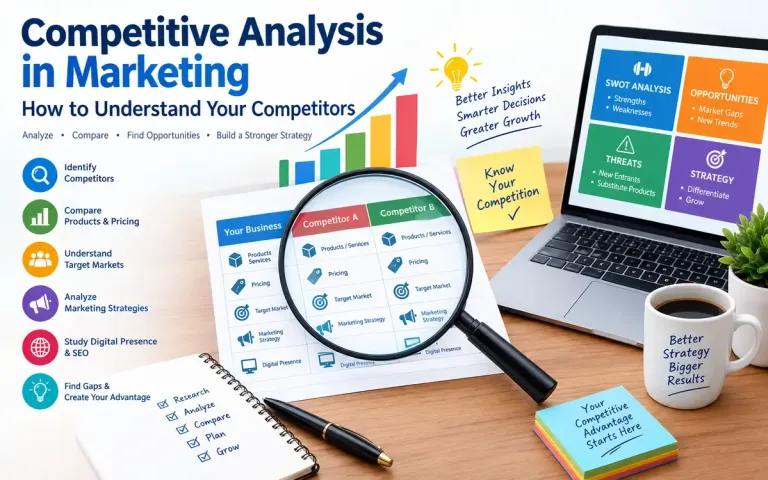
Organize the information in a comparison matrix so that you can evaluate competitors consistently.
The following is an illustrative example for a small web development business. It is not actual market research.
| Evaluation Criteria | Your Business | Competitor A | Competitor B |
|---|---|---|---|
| Pricing | Moderate | Low | High |
| Customization | High | Limited | High |
| Customer support | Personalized | Standard | Formal support system |
| SEO services | Available | Not emphasized | Available |
| Maintenance | Monthly plans | Limited | Premium plans |
| Target customers | Small businesses | Budget customers | Larger businesses |
This comparison may suggest that your business can differentiate itself through customized websites, ongoing maintenance, and personalized support without competing solely on price.
Step 5: Evaluate Competitors' Strengths and Weaknesses
Analyze the information collected to determine where each competitor performs well and where it appears vulnerable.
For example, a competitor may have strong brand recognition but relatively expensive services. Another may offer affordable prices but limited after-sales support.
Compare these observations with your own capabilities. Avoid assuming that a competitor's weakness automatically represents an opportunity; verify that customers care about the issue and that your business can address it profitably.
Step 6: Conduct a SWOT Analysis
SWOT analysis examines strengths, weaknesses, opportunities, and threats.
When applied to competitive analysis, it helps connect information about competitors and the market with your own strategic position.
Strengths: Internal capabilities that provide an advantage.
Weaknesses: Internal limitations that reduce competitiveness.
Opportunities: External conditions that the business could exploit.
Threats: External factors that may harm its performance.
For example, a small digital agency might have strong customer relationships but limited advertising resources. Growing demand for local businesses' online presence could offer an opportunity, while larger agencies offering low-cost packages could represent a threat.
SWOT analysis is most useful when its findings lead to specific decisions rather than remaining a descriptive list.
Step 7: Identify Your Competitive Advantage
A competitive advantage is a factor that enables a business to create greater customer value or perform more effectively than competing alternatives.
Possible sources include:
Superior product quality.
Lower operating costs.
Specialized expertise.
Convenient access or faster delivery.
Strong customer relationships.
Customized services.
Better customer support.
A trusted brand reputation.
Choose an advantage that matters to your target customers and that your business can deliver consistently.
Step 8: Develop an Action Plan
Convert your findings into a practical marketing plan.
For example, if research reveals that customers value ongoing technical support but competitors emphasize one-time website development, you could introduce affordable website maintenance packages.
Your action plan should specify:
The identified market opportunity.
The marketing action required.
The resources and budget needed.
The person responsible for implementation.
The expected result.
The performance indicators used to measure progress.
Step 9: Monitor and Update the Analysis
Competitive analysis is not a one-time activity. Competitors may change their prices, launch new products, adopt new technologies, or modify their marketing strategies.
Review important information periodically. Monitor significant changes in customer reviews, pricing, search visibility, product offerings, and promotional activities.
The review frequency should reflect how quickly your market changes.
Important Frameworks for Competitive Analysis
Several established marketing and strategic management frameworks can help structure competitor research.
1. SWOT Analysis
SWOT analysis evaluates strengths, weaknesses, opportunities, and threats.
It is useful for understanding a company's internal capabilities and external competitive environment.
2. Porter's Five Forces Model
Developed by Michael E. Porter, this framework examines the competitive structure and attractiveness of an industry through five forces:
Competitive rivalry: The intensity of competition among existing businesses.
Threat of new entrants: The possibility that new businesses will enter the market.
Threat of substitutes: The availability of alternative solutions that satisfy similar customer needs.
Bargaining power of buyers: The ability of customers to influence prices and terms.
Bargaining power of suppliers: The ability of suppliers to influence input prices and conditions.
Unlike a comparison of individual competitors, Porter's Five Forces provides a broader analysis of the industry structure.
3. Perceptual Mapping
A perceptual map visually represents how customers perceive competing brands across two selected dimensions, such as price and perceived quality.
For example, a map may show one brand positioned as affordable with basic features and another as premium with extensive features.
Perceptual maps can help marketers identify positioning opportunities, provided the map is based on reliable customer research.
4. Competitive Benchmarking
Competitive benchmarking involves comparing your business's products, processes, or performance indicators with those of competitors or relevant industry standards.
Possible measures include customer satisfaction, response time, product quality, delivery performance, conversion rates, and service costs.
Benchmarking helps identify performance gaps and establish improvement priorities.
5. Competitor Profiling
Competitor profiling involves preparing a structured overview of each important competitor.
A profile may include its target market, product range, pricing approach, positioning, distribution channels, promotional methods, strengths, weaknesses, and likely strategic priorities.
This framework is especially useful when a business faces several significant competitors.
Tools for Competitive Analysis in Marketing
Several tools can support competitor research. The appropriate choice depends on the business objective, available budget, and type of information required.
1. Google Search
Google Search can help identify competing businesses, discover their published offers, compare search results, and examine the content that appears for important keywords.
2. Google Trends
Google Trends helps compare search interest over time and across regions for selected search terms. It can provide context about changing interest in products, brands, or categories.
Search interest is not the same as actual sales or market share.
3. Google Search Console
Google Search Console helps website owners analyze their own search performance, including queries, impressions, clicks, and click-through rates.
It is particularly useful for measuring your website's SEO performance. It does not provide complete private performance data for competitors.
4. SEO Research Tools
Platforms such as Semrush and Ahrefs provide features for researching competitor keywords, backlinks, search visibility, and content opportunities. Available data and functionality depend on the tool and subscription plan.
5. Social Media Platforms
Public business profiles on platforms such as Facebook, Instagram, LinkedIn, and YouTube can help you examine competitors' messaging, content formats, publishing patterns, and visible audience engagement.
Visible engagement should not be treated as a complete measure of business performance.
6. Customer Surveys and Interviews
Direct customer research is valuable because publicly available information cannot fully explain why customers choose one business over another.
Ask customers which alternatives they considered, what influenced their decisions, what they liked, and what problems they experienced.
Combining public research with direct customer feedback produces a more complete picture of the competitive environment.
Practical Example of Competitive Analysis
Consider a hypothetical local business that provides website design and digital marketing services to small businesses.
The business wants to attract more customers but faces competition from freelancers, local agencies, and online website builders.
Its analysis might produce the following observations:
| Observation | Possible Marketing Response |
|---|---|
| Some competitors advertise low-cost websites | Communicate the value and benefits included in your packages |
| Customers are concerned about technical support | Offer clearly defined maintenance and support plans |
| Competitors publish educational content | Develop useful guides answering common customer questions |
| Small businesses need help beyond website design | Bundle website development with SEO and digital marketing services |
| Customers are uncertain about service quality | Present relevant case studies, genuine testimonials, and portfolio examples |
These findings can help the business develop a more focused value proposition.
For example, rather than positioning itself as simply another website designer, it could offer a complete digital presence package that combines website development, basic SEO, and ongoing technical support.
The business should then measure enquiries, conversion rates, customer acquisition costs, and customer retention to determine whether the strategy is effective.
Common Mistakes to Avoid in Competitive Analysis
Competitive analysis can produce misleading conclusions if information is incomplete or interpreted incorrectly.
1. Focusing Only on Price
Price is one competitive factor, not the only one. Customers may value quality, reliability, convenience, reputation, and after-sales support more highly.
2. Ignoring Indirect Competitors
A business may lose customers to alternative solutions even when those alternatives do not offer the same product.
Understanding the customer's underlying need helps reveal these threats.
3. Copying Competitors Without Understanding Their Strategy
A strategy that works for a large company may not work for a small business with different resources, customers, and cost structures.
Learn from competitors, but adapt insights to your own objectives and capabilities.
4. Relying on Unverified Information
Competitor website traffic, sales, conversion rates, and market share may not be publicly available or accurately measurable through third-party tools.
Separate observed facts from estimates and avoid making strategic decisions based on unsupported assumptions.
5. Ignoring Customer Feedback
Competitor websites and promotional messages reveal what businesses communicate, but not necessarily what customers believe.
Combine competitor research with reviews, surveys, interviews, and your own customer data.
6. Failing to Take Action
Collecting information is not the final objective. The real value of competitive analysis comes from using findings to improve products, pricing, positioning, communication, or customer experience.
Best Practices for Effective Competitive Analysis
To improve the quality of your analysis:
Define clear objectives before collecting data.
Focus on competitors relevant to your target market.
Use consistent criteria for comparing businesses.
Collect information from multiple credible sources.
Separate facts from estimates and assumptions.
Evaluate customer needs alongside competitor activities.
Identify specific opportunities for differentiation.
Assign responsibilities and deadlines to the action plan.
Measure the results of implemented strategies.
Update the analysis as the market changes.
Use only lawful and ethical research methods.
Frequently Asked Questions (FAQs)
1. What is competitive analysis in marketing?
Competitive analysis in marketing is the systematic evaluation of competitors' products, prices, target markets, promotional strategies, distribution channels, and positioning to identify opportunities and improve marketing decisions.
2. What is the main purpose of competitive analysis?
Its main purpose is to understand the competitive environment, identify market opportunities and threats, assess relative strengths and weaknesses, and develop strategies that create a meaningful competitive advantage.
3. What is the difference between competitor analysis and market research?
Competitor analysis focuses on rival businesses and their strategies, offerings, and market positions. Market research is broader and examines customers, demand, market size, trends, and other factors that influence a market. Competitor analysis is one component of market research.
4. What are the main types of competitors?
The main categories include direct competitors, indirect competitors, and potential or emerging competitors. For digital content planning, content competitors are also important because they compete for audience attention and search visibility.
5. Which frameworks are used for competitive analysis?
Common frameworks include SWOT analysis, Porter's Five Forces Model, perceptual mapping, competitive benchmarking, and competitor profiling. Each framework addresses a different aspect of competition.
6. How often should a business conduct competitive analysis?
The frequency depends on the industry and the rate of market change. Businesses in rapidly changing markets may need frequent monitoring, while others may conduct a comprehensive review quarterly or twice a year and track important changes between reviews.
7. Can small businesses conduct competitive analysis without expensive tools?
Yes. Small businesses can begin with search engines, competitor websites, public price lists, customer reviews, social media profiles, and direct customer interviews. Paid tools can be introduced when more detailed research is justified.
8. How does competitive analysis improve digital marketing?
It helps identify content gaps, relevant search keywords, competing messages, customer concerns, and opportunities to improve website experience and conversion. These insights can support more focused SEO, content marketing, social media, and paid advertising strategies.
Conclusion
Competitive analysis in marketing is an important process for understanding competitors, evaluating market conditions, and identifying opportunities to create superior customer value.
By systematically examining competitors' products, pricing, target markets, promotional activities, digital presence, and customer feedback, businesses can make more informed decisions about their marketing strategies.
However, the purpose of competitive analysis is not to imitate every successful competitor or win customers solely through lower prices. It is to understand the market, identify unmet customer needs, and develop a distinctive position that the business can sustain.
The key to effective competitive analysis is turning reliable information into practical action. Businesses that consistently learn from the competitive environment and respond to changing customer expectations are better equipped to strengthen their market position and achieve long-term growth.
Related articles:-
01. Marketing Strategy: How to Develop an Effective Marketing Strategy
02. Customer Relationship Management (CRM): Strategies
03. Brand Management: How to Build, Maintain and Strengthen a Brand
04. Promotion Mix: Advertising, Sales Promotion, & Direct Marketing
05. Pricing Strategy: Methods, Objectives & Factors Influencing it
06. Marketing Mix: The 4Ps of Marketing Explained With Examples
07. Market Segmentation: How Businesses Divide the market
08. Target Market Selection: How to Choose the Right Customers
09. Positioning Strategy: How to Create a Strong Position
10. What Is Marketing Management? Definition,, Functions and Process
11. Marketing Environment: Micro and Macro Factors
12.The Complete Guide to Digital Marketing
About BizInfoTech
BizInfoTech provides insights into business management, marketing, digital technologies, SEO, and business growth strategies. Explore our resources to learn how businesses can use technology and effective marketing practices to improve their performance.