Introduction
Marketing is not simply about advertising a product or convincing customers to buy it. Businesses must make several decisions about what to offer, how much to charge, where to make it available, and how to communicate its value to customers.
These decisions are commonly explained through the concept of the Marketing Mix.
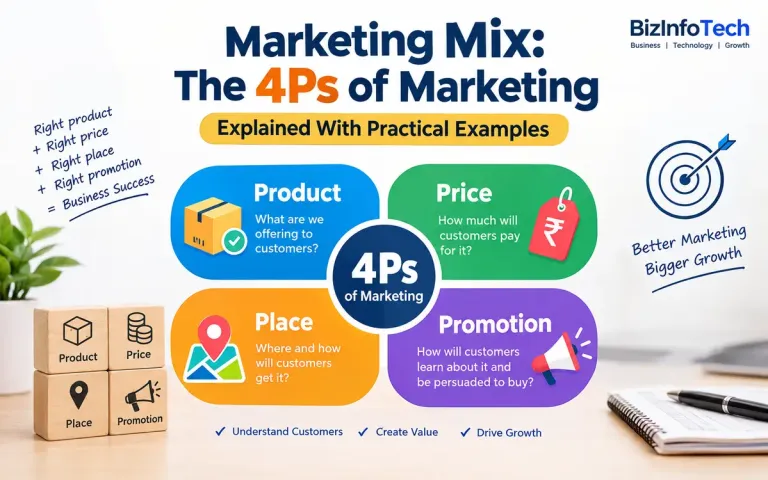
The traditional marketing mix consists of four major elements, known as the 4Ps of Marketing:
Product
Price
Place
Promotion
The 4Ps provide a practical framework that helps businesses design and implement their marketing strategies according to customer needs and market conditions.
In this article, we will understand the meaning of the marketing mix, examine each of the 4Ps in detail, and explore practical examples of how businesses use them.
What Is Marketing Mix?
The marketing mix refers to the combination of controllable marketing variables that a business uses to influence customers and achieve its marketing objectives.
In simple terms, the marketing mix answers four important questions:
Product: What are we offering to customers?
Price: How much will customers pay for it?
Place: Where and how will customers get it?
Promotion: How will customers learn about it and be persuaded to buy it?
The concept is traditionally associated with the 4Ps framework, which provides marketers with a structured way to plan their marketing activities.
For example, suppose a company wants to launch a new healthy snack.
It must decide:
What ingredients and features the snack should have
What price customers will pay
Whether it will be sold through supermarkets, online platforms, or both
How the company will promote it
These decisions together form the company's marketing mix.
The 4Ps of Marketing
The traditional marketing mix consists of four elements:
| 4P | Meaning | Key Question |
|---|---|---|
| Product | The goods or services offered | What will we offer? |
| Price | The amount charged | How much will we charge? |
| Place | Distribution and availability | Where will customers buy it? |
| Promotion | Communication activities | How will customers know about it? |
The effectiveness of the marketing mix depends not only on each individual element but also on how well the four elements work together.
1. Product
Product is the first element of the marketing mix.
A product is anything offered to customers to satisfy a need or want. It can be a physical product, such as a smartphone or automobile, or a service, such as banking, consulting, education, or website development.
Product decisions involve much more than simply deciding what to manufacture.
Businesses must consider:
Product features
Quality
Design
Brand name
Packaging
Size and variations
Product functionality
Warranty
Customer support
Product positioning
Product lifecycle
Example of Product Decisions
Suppose a company wants to launch a smartphone for college students.
The company may decide to provide:
Long battery life
Good camera quality
Large display
Sufficient storage
Affordable design
Fast charging
Student-friendly features
These decisions are part of the product element of the marketing mix.
Practical Example
Consider a fictional company launching a budget smartphone called SmartX Student.
Its product strategy could include:
6.5-inch display
128 GB storage
Long-lasting battery
Good camera
Lightweight design
One-year warranty
The company is designing the product around the needs of its target market: college students.
Important Point
A business should not develop a product only because it is technically possible.
The product should solve a customer problem or satisfy a customer need.
2. Price
Price refers to the amount of money customers must pay to obtain a product or service.
Pricing is an important marketing decision because it directly affects:
Revenue
Profitability
Customer perception
Demand
Market positioning
Competitive position
A company must determine a price that customers are willing to pay while also supporting its business objectives.
Factors Affecting Pricing Decisions
Businesses may consider:
Cost of production
Customer purchasing power
Competitors' prices
Demand
Target market
Product positioning
Distribution costs
Business objectives
Economic conditions
Discounts and offers
Example
Suppose a company launches the SmartX Student smartphone.
It could price the phone at ₹12,999.
The company may have selected this price after considering:
Manufacturing cost
Competitor prices
Target customers' purchasing power
Desired profit margin
Perceived value of the product
If the company wants to position the phone as a premium product, it may choose a higher price and emphasize superior features.
If it wants rapid market penetration, it may initially use a relatively lower price.
Common Pricing Approaches
Businesses can use different pricing approaches depending on their objectives.
Cost-Based Pricing
The company calculates its cost and adds a desired profit margin.
Example:
Cost = ₹800
Profit margin = ₹200
Selling price = ₹1,000
Competition-Based Pricing
The company considers competitors' prices while setting its own price.
For example, if competing products are priced between ₹950 and ₹1,050, a company may position its product around ₹999.
Value-Based Pricing
The price is based primarily on the value customers perceive in the product.
For example, customers may be willing to pay more for a software solution that significantly reduces their business's operating costs.
3. Place
Place refers to the distribution of products and the methods through which customers can access them.
It answers the question:
Where and how will the customer obtain the product?
Place decisions include:
Distribution channels
Retail stores
Wholesalers
Distributors
E-commerce platforms
Company websites
Physical locations
Warehousing
Transportation
Inventory management
Geographic coverage
A good product at the right price may still fail if customers cannot conveniently find or purchase it.
Example of Place
Suppose a company sells organic food products.
It could distribute its products through:
Supermarkets
Local grocery stores
Its own website
E-commerce platforms
Specialty organic stores
If its target customers primarily shop online, the company may give greater importance to digital distribution.
If its target market prefers physical shopping, retail distribution may be more important.
Digital Example
Consider a web development company selling website development services.
Unlike a physical product, the service does not need traditional distribution through wholesalers or retailers.
Customers may access the service through:
Company website
Google Business Profile
Social media
Online consultation
Video meetings
This demonstrates that Place is not limited to physical stores. Distribution methods vary according to the nature of the offering.
4. Promotion
Promotion refers to the communication activities used by a business to inform, persuade, and remind customers about its products or services.
Promotion helps businesses communicate:
What the product is
What benefits it provides
Why customers should consider it
Where it is available
How much it costs
Why it may be different from alternatives
Promotion is often the most visible part of marketing, but it is only one component of the marketing mix.
Major Promotion Tools
Promotion may include:
Advertising
Paid communication through channels such as:
Television
Newspapers
Websites
Search engines
Social media
Outdoor advertising
Sales Promotion
Short-term incentives designed to encourage purchases.
Examples include:
Discounts
Coupons
Limited-time offers
Buy-one-get-one offers
Cashback
Free samples
Public Relations
Activities designed to build relationships and manage public communication.
Examples include:
Press releases
Media coverage
Events
Corporate communication
Community activities
Personal Selling
Direct communication between a salesperson and a prospective customer.
This is particularly important for products and services that require explanation or consultation.
Digital Marketing
Modern promotional activities may include:
Search engine optimization
Social media marketing
Content marketing
Email marketing
Search advertising
Video marketing
Influencer marketing
Practical Example of Promotion
Suppose the SmartX Student smartphone is being launched.
The company could promote it through:
YouTube advertisements
Instagram campaigns
Search advertising
Student-focused social media content
Influencer reviews
Launch offers
Retail displays
The promotional message might focus on:
"Powerful performance and long battery life at a student-friendly price."
The message communicates the product's benefits while connecting them with the target market.
How the 4Ps Work Together
The four Ps should not be treated as completely independent decisions.
They need to support one another.
Consider the following example:
A company wants to launch a premium smartwatch.
Product
The smartwatch offers:
Advanced health and fitness features
Premium design
High-quality materials
Advanced connectivity
Price
The company charges a premium price to reflect its positioning.
Place
The smartwatch is sold through:
Premium electronics stores
The company's website
Selected online retailers
Promotion
The company uses:
Influencer marketing
Digital advertising
Product demonstrations
Premium lifestyle content
Here, the four Ps are aligned around a premium market position.
If the company sold the product at a very low price through discount outlets while promoting it as a luxury product, the marketing mix could become inconsistent.
Therefore, successful marketing requires coordination among the four Ps.
A Complete Example of the 4Ps
Let's consider a fictional coffee brand called Urban Brew.
The company wants to target young professionals in urban areas.
Product
Urban Brew offers:
Premium coffee
Multiple flavors
Ready-to-drink options
Attractive packaging
Convenient sizes
Price
The company uses a moderately premium price to communicate quality while remaining accessible to its target market.
Place
Products are available through:
Cafés
Supermarkets
Online grocery platforms
The company's website
Promotion
The company uses:
Instagram marketing
Short-form videos
Influencer collaborations
Promotional offers
Loyalty programs
The Result
The four elements reinforce the same positioning:
Premium but accessible coffee for modern urban consumers.
This is the essence of an integrated marketing mix.
Why Is the Marketing Mix Important?
The marketing mix is important because it provides a structured framework for making marketing decisions.
1. Helps Understand Customer Needs
Product decisions encourage businesses to think about what customers actually need.
2. Supports Market Positioning
Price, product, place, and promotion can be coordinated to establish a particular market position.
3. Helps Create Customer Value
Businesses can combine product benefits, pricing, availability, and communication to create value for customers.
4. Supports Competitive Strategy
A company can differentiate itself through:
Better product features
Competitive pricing
Wider availability
Stronger customer communication
5. Improves Marketing Coordination
The 4Ps help different marketing activities work toward common objectives.
6. Helps Businesses Plan Marketing Activities
Managers can use the framework to systematically evaluate their marketing decisions.
Marketing Mix and Target Market
The marketing mix should be developed according to the target market.
For example, a company targeting college students may emphasize:
Affordable pricing
Digital promotion
Convenient online purchasing
Youth-oriented product design
A company targeting corporate executives may emphasize:
Premium product features
Professional branding
Higher service quality
Relationship-based selling
Therefore, the same marketing mix does not necessarily work for every customer segment.
Marketing Mix and Segmentation, Targeting, and Positioning
The marketing mix is closely connected with STP marketing:
Segmentation → Targeting → Positioning → Marketing Mix
First, the company identifies different customer segments.
Second, it selects the target segment.
Third, it decides how it wants the product to be perceived.
Finally, it develops an appropriate marketing mix.
Example
Suppose a company identifies three segments:
Students
Working professionals
Senior citizens
If it targets students, its marketing mix may emphasize affordability, convenience, and digital communication.
If it targets working professionals, it may emphasize quality, time-saving features, and professional service.
Thus, the marketing mix should support the company's chosen target market and positioning.
4Ps vs. 4Cs of Marketing
The traditional 4Ps approach is company-oriented, while the 4Cs framework puts greater emphasis on the customer perspective.
| 4Ps | 4Cs |
|---|---|
| Product | Customer Solution |
| Price | Customer Cost |
| Place | Convenience |
| Promotion | Communication |
For example:
Instead of asking:
"What product should we sell?"
a customer-oriented business may ask:
"What problem are our customers trying to solve?"
Similarly, instead of thinking only about price, the business may consider the customer's total cost and perceived value.
Both frameworks can therefore provide useful perspectives for marketing planning.
Is the 4Ps Model Still Relevant?
Yes, the 4Ps remain a useful foundational framework for understanding marketing.
However, modern marketing has become more complex because of:
E-commerce
Social media
Digital advertising
Mobile commerce
Customer reviews
Data analytics
Subscription models
Online services
Global competition
For service businesses, marketers often use an expanded 7Ps model, which adds:
People
Process
Physical Evidence
The 7Ps are particularly useful for service marketing because services involve customer interactions, service delivery processes, and evidence of service quality.
Marketing Mix for a Digital Business
Consider a digital marketing agency.
Product
The agency offers:
SEO
Social media marketing
Website development
Content marketing
Paid advertising
Price
It may use:
Project-based pricing
Monthly retainers
Package pricing
Customized pricing
Place
Customers can access the services through:
Website
Online meetings
Social media
Promotion
The agency can use:
SEO
Blog articles
YouTube
Case studies
Referral marketing
This demonstrates how the 4Ps can be adapted to modern digital businesses.
Common Mistakes in Marketing Mix Decisions
Businesses sometimes make mistakes when developing their marketing mix.
1. Focusing Only on Promotion
A company may invest heavily in advertising while ignoring product quality or customer experience.
Lesson: Promotion cannot compensate indefinitely for an unsuitable product.
2. Setting Price Without Understanding Customers
A price should be evaluated in relation to customer value, competition, costs, and positioning.
3. Ignoring Distribution
A product must be accessible to the target customers.
4. Treating All Customers the Same
Different market segments may have different needs and expectations.
5. Making the 4Ps Inconsistent
The product, price, place, and promotion should support a coherent market position.
How to Develop an Effective Marketing Mix
A business can follow these steps:
Step 1: Understand the Market
Research customer needs, competitors, market trends, and demand.
Step 2: Identify the Target Market
Determine which customer group the business wants to serve.
Step 3: Define the Positioning
Decide how the business wants customers to perceive its offering.
Step 4: Design the Product
Develop features and benefits that address customer needs.
Step 5: Determine the Price
Consider costs, demand, competition, customer value, and business objectives.
Step 6: Select Distribution Channels
Determine where and how customers will purchase the product or service.
Step 7: Develop the Promotion Strategy
Select appropriate communication and promotional tools.
Step 8: Monitor Performance
Measure results and adjust the marketing mix when market conditions or customer needs change.
Marketing Mix: A Simple Real-World Illustration
Imagine a small local bakery launching a new premium cake.
Its marketing mix might look like this:
Product:
Fresh customized cakes with premium ingredients.
Price:
₹800–₹2,000 depending on size and customization.
Place:
Local store, WhatsApp orders, website, and local delivery.
Promotion:
Instagram posts, customer referrals, festival offers, Google Business Profile, and local advertising.
The bakery does not need to use exactly the same marketing mix as a large national brand.
Its marketing decisions should reflect its:
Target customers
Budget
Location
Competition
Business objectives
Product characteristics
Key Takeaways
The Marketing Mix is a fundamental concept in marketing management.
The traditional 4Ps are:
Product
What the business offers to satisfy customer needs.
Price
What customers pay for the offering.
Place
How and where the offering is made available.
Promotion
How the business communicates with and persuades its target customers.
The most important point is that the four elements should work together.
A successful marketing strategy is not simply about having a good product or running attractive advertisements. Businesses need to create an appropriate combination of product, price, place, and promotion based on their target market and marketing objectives.
Frequently Asked Questions (FAQs)
What are the 4Ps of marketing?
The four Ps of marketing are Product, Price, Place, and Promotion.
What is marketing mix?
Marketing mix is the combination of controllable marketing variables that a business uses to satisfy customer needs and achieve marketing objectives.
Why is the marketing mix important?
It helps businesses systematically plan decisions related to their product, pricing, distribution, and promotional activities.
What is an example of the 4Ps?
A smartphone company may design a feature-rich phone (Product), sell it at ₹15,000 (Price), distribute it through retail and online channels (Place), and advertise it through social media and digital advertising (Promotion).
What is the difference between marketing mix and marketing strategy?
Marketing strategy provides the broader direction for how a business intends to create and deliver value to its target market, while the marketing mix translates that direction into specific decisions involving elements such as Product, Price, Place, and Promotion.
What are the 7Ps of marketing?
The 7Ps extend the traditional 4Ps by adding People, Process, and Physical Evidence. They are particularly relevant to service marketing.
Conclusion
The 4Ps of Marketing—Product, Price, Place, and Promotion—provide a simple but powerful framework for understanding marketing decisions.
Businesses can use the framework to evaluate whether they are offering the right product, at an appropriate price, through suitable distribution channels, and with effective communication.
Whether it is a multinational company, a local retailer, a startup, or a digital service provider, the basic principle remains the same:
Understand the customer, create value, make the offering accessible, and communicate that value effectively.
When the four elements of the marketing mix are aligned with the target market and business objectives, they provide a strong foundation for effective marketing planning and implementation.
Related artiles:-
What Is Marketing Management? Definition, Importance, Functions and Process
Marketing Environment: Micro and Macro Factors That Influence Business Decisions
Market Segmentation: How Businesses Divide and Target Different Customer Groups
Target Market Selection: How to Choose the Right Customers
Positioning Strategy: How to Create a Strong Position in the Customer's Mind
Consumer Behaviour: Understanding How Customers Make Buying Decisions