Introduction
Every product has a journey in the marketplace. It is introduced to customers, gains acceptance, experiences increasing demand, reaches a mature stage, and may eventually experience declining sales. This journey is known as the Product Life Cycle (PLC).
The Product Life Cycle is an important concept in marketing management because customer demand, competition, sales, profitability, and marketing priorities can change significantly as a product moves through different stages.
Understanding the Product Life Cycle helps businesses decide when to invest in promotion, how to price products, how to improve products, how to respond to competitors, and when to modify or withdraw a product from the market.
What Is Product Life Cycle?
The Product Life Cycle (PLC) is a marketing framework that describes the different stages a product typically passes through from its introduction into the market to its eventual decline or withdrawal.
The traditional Product Life Cycle consists of four major stages:
Introduction
Growth
Maturity
Decline
Some models also include Development as a pre-launch stage. However, in traditional marketing management, Introduction, Growth, Maturity, and Decline are generally treated as the four core stages.
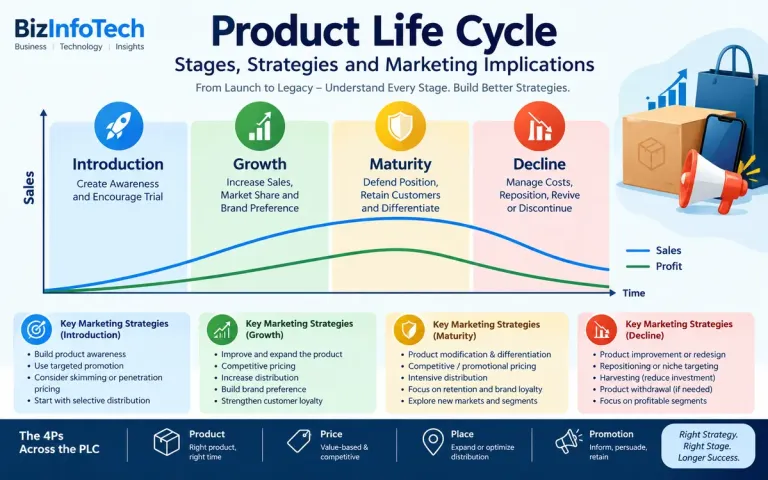
The basic PLC pattern can be represented as:
Introduction → Growth → Maturity → Decline
The sales and profit patterns generally change as the product moves through these stages. However, the duration and shape of the life cycle can differ considerably between products and markets.
Why Is Product Life Cycle Important?
The Product Life Cycle provides marketers with a framework for understanding how a product's market position changes over time.
It helps businesses:
Plan marketing strategies according to the product's stage
Allocate promotional budgets more effectively
Develop appropriate pricing strategies
Understand changing customer behaviour
Respond to increasing competition
Identify opportunities for product modification
Decide whether to expand or reduce distribution
Plan new products and product replacements
Manage declining products
Improve long-term product profitability
The marketing mix should not remain unchanged throughout a product's life. As the product moves through different stages, businesses generally need to revise their product, price, promotion, and distribution decisions.
Stages of Product Life Cycle
1. Introduction Stage
The Introduction Stage begins when a product is launched in the market.
At this stage, customers may have limited awareness of the product. Sales are generally low, while marketing, distribution, product-launch, and other costs can be relatively high. As a result, profits may be low or negative during the early period.
Characteristics of the Introduction Stage
Important characteristics include:
Low initial sales
Limited customer awareness
High promotional expenditure
High cost per customer acquired
Limited distribution
Few direct competitors in some markets
Uncertainty about customer acceptance
Low or negative profitability in many cases
The primary objective is to create awareness, encourage product trial, establish distribution, and communicate the product's value proposition.
Marketing Strategies in the Introduction Stage
Product Strategy
The company should focus on delivering a reliable product and identifying early customer feedback.
Strategies may include:
Establishing the basic product offering
Ensuring acceptable quality
Providing customer support
Collecting customer feedback
Making early product improvements
Pricing Strategy
Two commonly discussed approaches are:
Price Skimming:
The company initially charges a relatively high price and gradually reduces it as the market develops.
Penetration Pricing:
The company introduces the product at a relatively low price to encourage adoption and build market share.
The appropriate choice depends on factors such as customer demand, competition, product differentiation, costs, and the company's objectives.
Promotion Strategy
Promotion is particularly important because customers need to understand:
What the product is
What problem it solves
How it works
Why they should try it
How it differs from alternatives
Businesses may use advertising, demonstrations, digital marketing, social media, public relations, sales promotion, and personal selling.
Distribution Strategy
Distribution may initially be selective because the company is still establishing its market presence.
As demand develops, the business can expand its distribution network.
Example
Suppose a company launches a new smart home security device. Customers may initially be unfamiliar with the product.
The company may therefore focus on:
Demonstrating the product
Educating consumers
Offering introductory promotions
Building online reviews
Establishing distribution through e-commerce and retail channels
The focus is primarily on awareness and trial.
2. Growth Stage
If customers accept the product and demand increases, the product enters the Growth Stage.
Sales increase rapidly, more customers enter the market, distribution expands, and competitors may introduce similar products. Profitability can improve as sales increase and businesses benefit from greater scale.
Characteristics of the Growth Stage
Common characteristics include:
Rapid sales growth
Increasing customer adoption
Growing profitability
Increasing competition
Expansion of distribution
Greater brand awareness
Product improvements
Increasing marketing activity
The marketing objective changes from simply creating awareness to building preference, increasing market share, encouraging repeat purchases, and strengthening the brand.
Marketing Strategies in the Growth Stage
Product Strategy
Companies may improve the product by:
Adding features
Improving quality
Introducing new versions
Improving design
Expanding product variations
Providing better customer service
Pricing Strategy
As competition increases, businesses may need to review pricing carefully.
The company may maintain prices, offer selective discounts, introduce different versions at different price points, or reduce costs to remain competitive.
Promotion Strategy
Promotion increasingly emphasizes brand differentiation.
Instead of simply explaining why customers need the product category, the company communicates why customers should choose its brand.
For example:
"Why should you buy this type of product?"
may gradually become:
"Why should you choose our brand?"
Distribution Strategy
The company generally works to expand distribution and make the product available to more customers.
This may involve:
More retailers
E-commerce platforms
Distributors
Dealers
Regional expansion
New geographic markets
Example
Consider a mobile application that becomes popular after its initial launch.
During the growth stage, the company may:
Add new features
Improve the user experience
Increase advertising
Enter new markets
Introduce premium plans
Build partnerships
Respond to competing applications
The goal is to capture and retain market share while the market is expanding.
3. Maturity Stage
The Maturity Stage occurs when sales growth begins to slow and the product becomes established in the market.
This stage can be long-lasting for successful products. Competition is usually intense because many companies are competing for existing customers.
At maturity, companies often focus on protecting market share, retaining customers, controlling costs, and finding ways to stimulate additional demand.
Characteristics of the Maturity Stage
Typical characteristics include:
Sales growth slows
Market becomes highly competitive
Brand awareness is high
Customer acquisition becomes more difficult
Price competition may increase
Profit margins may face pressure
Product differentiation becomes important
Customer retention becomes critical
Marketing Strategies in the Maturity Stage
Product Modification
Businesses can modify the product to maintain customer interest.
Possible approaches include:
New features
Improved quality
New packaging
New designs
Additional variants
Product-line extensions
New service options
For example, a food company might introduce new flavours, package sizes, or formulations for an established product.
Market Modification
A company may search for new customers or markets.
It can attempt to:
Enter new geographic markets
Target new customer segments
Find new uses for the product
Increase usage frequency
Encourage existing customers to consume more
Promotional Strategies
Promotional communication may focus heavily on:
Brand loyalty
Customer retention
Product benefits
Competitive differentiation
Offers and loyalty programmes
Reminder advertising
Pricing Strategies
Businesses may use:
Competitive pricing
Promotional discounts
Bundling
Loyalty offers
Different price points for different segments
However, excessive price reductions can reduce profitability, so pricing decisions should be linked to costs and customer value.
Example
A well-established packaged food brand may already have high awareness and a large customer base.
Instead of simply telling customers that the product exists, the company may introduce:
New flavours
New packaging
Family-size packs
Smaller trial packs
Promotional offers
New usage occasions
The objective is to defend the brand and extend its maturity period.
4. Decline Stage
The Decline Stage occurs when sales and profitability decrease significantly.
Decline may result from technological changes, changing consumer preferences, new substitutes, stronger competitors, or changes in market conditions.
However, a decline in sales does not necessarily mean that the product should immediately be discontinued. Management needs to understand the cause of the decline before making a decision.
Characteristics of the Decline Stage
Common characteristics include:
Falling sales
Reduced profitability
Declining demand
Increasingly limited customer base
Stronger substitute products
Reduced distribution
Lower promotional investment
Possible product withdrawal
Marketing Strategies in the Decline Stage
1. Product Improvement
The company may attempt to revive the product through:
Product redesign
New features
Quality improvements
New packaging
New applications
If customers respond positively, the product may regain demand.
2. Market Repositioning
The business may identify a smaller but profitable market segment.
For example, an older technology product may still serve customers who need a low-cost or specialized solution.
3. Harvesting
The company may reduce investment while continuing to generate cash from remaining customers.
This can involve:
Reducing promotional spending
Reducing product variations
Controlling operating costs
Focusing on profitable customers
Reducing distribution expenses
4. Product Withdrawal
If the product is no longer commercially viable, the company may discontinue it.
A business may then:
Replace it with a new product
Sell the product line
Transfer production
Serve remaining customers with alternatives
Exit the market
The appropriate strategy depends on market conditions, costs, customer demand, and the company's broader product portfolio.
Product Life Cycle and the Marketing Mix
The Product Life Cycle has important implications for the 4Ps of Marketing: Product, Price, Place, and Promotion.
| PLC Stage | Product | Price | Place | Promotion |
|---|---|---|---|---|
| Introduction | Establish basic offering and quality | Skimming or penetration may be considered | Limited/selective distribution | Create awareness and trial |
| Growth | Improve and expand product | Competitive pricing | Expand distribution | Build brand preference |
| Maturity | Modify and differentiate | Competitive/promotional pricing | Intensive distribution | Retention and differentiation |
| Decline | Simplify, reposition, or discontinue | Adjust according to demand | Reduce unprofitable channels | Reduce or focus promotion |
This illustrates why a single marketing strategy may not remain appropriate throughout the entire life of a product. Businesses need to adapt the marketing mix as market conditions change.
Product Life Cycle and Sales and Profit
Sales and profits do not necessarily follow exactly the same pattern.
During introduction, sales are generally low and promotional and launch costs can be high.
During growth, sales increase rapidly and profitability can improve.
During maturity, sales growth slows, and competitive pressure can affect margins.
During decline, sales and profitability generally decrease.
A simplified pattern can therefore be represented as:
Sales:
Low → Rapid Growth → Slow Growth → Decline
Profit:
Low/Negative → Increasing → High/Stable → Declining
The actual pattern can vary considerably depending on the product, industry, competition, technology, and customer behaviour.
Factors Affecting the Product Life Cycle
The length and shape of a product's life cycle can vary because of several factors.
1. Technological Change
Rapid technological development can shorten the life of existing products.
For example, new technologies may replace older products or make them less attractive.
2. Consumer Preferences
Changes in consumer tastes and preferences can influence product demand.
Fashion products, for example, may experience much shorter cycles than products with stable demand.
3. Competition
New competitors and substitute products can accelerate maturity or decline.
4. Product Innovation
Regular product improvements can help a company maintain customer interest and extend the product's market life.
5. Marketing Strategy
Effective positioning, promotion, distribution, pricing, and customer relationship management can influence how successfully a product performs.
6. Economic and Environmental Conditions
Economic conditions, regulations, demographic changes, and broader market developments can also affect demand.
Strategies for Extending Product Life Cycle
Businesses often attempt to extend the profitable life of established products.
Some common approaches include:
1. Product Modification
Add new features, improve quality, redesign the product, or introduce new variants.
2. Market Development
Enter new geographic markets or target new customer segments.
3. New Uses
Encourage customers to use the product in additional ways.
4. Increased Usage
Encourage existing customers to use the product more frequently.
5. Repositioning
Change the way customers perceive the product by emphasizing different benefits or targeting a different segment.
6. Packaging Changes
New packaging can refresh the product's appearance and create renewed customer interest.
7. Promotional Campaigns
New campaigns can communicate new benefits, applications, or usage occasions.
These strategies are particularly relevant during maturity when companies are trying to maintain demand and extend the product's market presence.
Example of Product Life Cycle
Consider the hypothetical example of a smartphone model.
Introduction
The smartphone is launched with a new design and features.
The company invests heavily in:
Advertising
Product demonstrations
Influencer marketing
Retail distribution
Customer education
Sales are initially limited.
Growth
Customers increasingly adopt the smartphone.
The company:
Expands distribution
Increases production
Improves software
Adds accessories
Expands advertising
Competitors introduce similar devices.
Maturity
The smartphone becomes an established product.
Sales growth slows because most interested customers already have similar devices.
The company may introduce:
New colours
Storage variants
Camera improvements
Promotional offers
Bundled accessories
Decline
New technologies and newer models reduce demand for the older smartphone.
The company may:
Reduce production
Lower the price
Target budget-conscious customers
Focus on remaining profitable markets
Eventually discontinue the model
This example illustrates how the marketing strategy changes as the product moves through its life cycle.
Advantages of Product Life Cycle Analysis
Product Life Cycle analysis can help managers:
Better Marketing Planning
Managers can develop strategies according to the product's market position.
Better Resource Allocation
Marketing and investment resources can be directed toward products with appropriate growth opportunities.
Competitive Planning
Understanding the stage of a product can help businesses anticipate changing competitive conditions.
Product Development
Declining products can signal the need for new products or product improvements.
Pricing Decisions
Different stages may require different approaches to pricing.
Promotional Planning
Marketing communication can change from customer education to brand differentiation and eventually retention or selective promotion.
Limitations of Product Life Cycle
Although PLC is useful, managers should not treat it as an exact prediction model.
1. Products Do Not Always Follow the Same Pattern
Some products may grow rapidly and then decline quickly, while others may remain mature for decades.
2. Stage Identification Can Be Difficult
A temporary decline in sales does not necessarily mean that a product has entered the decline stage. OpenStax specifically cautions that managers should distinguish temporary sales fluctuations from a genuine transition to decline.
3. External Factors Can Change the Cycle
Technology, regulation, economic conditions, consumer preferences, and competition can alter the expected trajectory.
4. Product Categories and Individual Brands May Differ
The life cycle of a product category may not be identical to the life cycle of an individual brand within that category.
5. Marketing Strategy Can Influence the Cycle
The PLC is not simply something that happens to a product. Product improvements, repositioning, market expansion, and other strategic decisions can influence its performance.
Therefore, managers should use PLC as a strategic planning framework rather than a rigid forecasting formula.
Product Life Cycle vs. Product Development Life Cycle
These two concepts are related but different.
Product Development Life Cycle focuses primarily on how a product is researched, designed, developed, tested, and prepared for launch.
Product Life Cycle focuses on how the product performs in the market after introduction and how its sales and profitability change over time.
In simple terms:
Product Development:
Idea → Research → Design → Development → Testing → Launch
Product Life Cycle:
Introduction → Growth → Maturity → Decline
Some modern PLC frameworks include development as a fifth stage, but traditional marketing textbooks generally use the four-stage market model.
Key Takeaways
The Product Life Cycle is an important concept in marketing management that explains how products typically move through different market stages.
The four traditional stages are:
Introduction – Build awareness and encourage trial.
Growth – Increase sales, distribution, and market share.
Maturity – Defend market position, retain customers, and differentiate.
Decline – Reduce costs, reposition, revive, or discontinue the product.
The most important lesson is that marketing strategy should evolve with the product's market situation.
A strategy that works during introduction may not be appropriate during maturity, and a mature product may require a completely different approach when demand begins to decline.
For marketing managers, understanding the Product Life Cycle provides a useful framework for making decisions about product development, pricing, promotion, distribution, customer retention, competition, and product portfolio management.
Frequently Asked Questions (FAQs)
What is Product Life Cycle?
Product Life Cycle is a marketing concept that describes the stages a product typically passes through from its market introduction to growth, maturity, and eventual decline.
What are the four stages of Product Life Cycle?
The four traditional stages are Introduction, Growth, Maturity, and Decline.
Which stage has the highest competition?
Competition often becomes particularly intense during the Growth and Maturity stages, although the level of competition varies by industry and product category.
What happens during the maturity stage?
During maturity, sales growth slows, competition becomes intense, and companies focus on customer retention, differentiation, product modification, market development, and profitability.
How can a company extend a product's life cycle?
A company can attempt to extend the product life cycle through product modification, market development, repositioning, new uses, increased usage, new packaging, and promotional campaigns.
Does every product follow the same life cycle?
No. Products can have very different life-cycle patterns. Some products may fail shortly after introduction, while others can remain mature for many years.
Why is Product Life Cycle important in marketing management?
It helps marketers understand changing market conditions and adapt decisions related to product, price, place, promotion, customer retention, competition, and investment.
Conclusion
The Product Life Cycle provides marketers with a structured way to understand how a product's market performance changes over time.
From creating awareness during Introduction to capturing market opportunities during Growth, defending market position during Maturity, and managing declining demand during Decline, each stage requires different managerial priorities.
However, the Product Life Cycle should not be viewed as a fixed rule. Real markets are influenced by innovation, competition, consumer behaviour, technology, and strategic decisions. Therefore, successful marketing management requires continuous market analysis and timely adaptation.
Understanding the Product Life Cycle enables businesses to make more informed decisions and develop marketing strategies that are appropriate for the product's current market situation.
Related articles:-
Marketing Mix: The 4Ps of Marketing Explained With Examples
What Is Marketing Management? Definition, Importance, Functions and Process
Market Segmentation: How Businesses Divide and Target Different Customer Groups
Target Market Selection: How to Choose the Right Customers
Positioning Strategy: How to Create a Strong Position in the Customer's Mind
Marketing Environment: Micro and Macro Factors That Influence Business Decisions