Introduction
When people need a product or service, they increasingly use search engines to find businesses near them. A person searching for "best restaurant near me," "web designer in Delhi," or "accountant near me" is not simply looking for information—they may be looking for a business they can contact or visit immediately.
This makes Local SEO an important part of digital marketing for businesses that serve customers in a particular geographic area.
Local SEO helps businesses improve their visibility when people search for products, services, or businesses associated with a specific location. It combines website optimization with local business information, online reputation, relevant content, and other signals that help search engines understand where a business operates and what it offers.
Unlike general SEO, which can target users from anywhere, Local SEO focuses on connecting businesses with potential customers in their relevant geographic markets.
For example, a web development company may want to reach customers searching for "website development company in Patna", while a restaurant may want to appear when people search for "restaurants near me."
In this guide, we will explore the fundamentals of Local SEO and the key practices businesses can use to improve their visibility in local search.
What Is Local SEO?
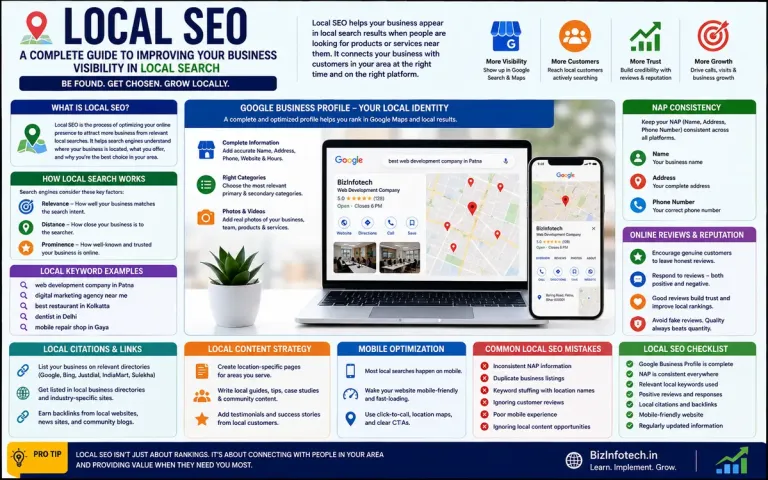
Local SEO is the process of optimizing a business's online presence to improve its visibility in search results associated with a specific geographic location.
The primary objective is to help search engines understand three important things:
- What the business offers
- Where the business operates
- Why it may be relevant to a particular local search
Local SEO is especially important for businesses that have a physical location or serve customers within a defined geographic area.
Examples include:
- Restaurants
- Retail stores
- Educational institutions
- Healthcare providers
- Hotels
- Repair services
- Professional services
- Local agencies
- Web development companies
An online business serving customers globally may rely primarily on traditional SEO, whereas a local service provider may benefit substantially from Local SEO.
Local SEO vs Traditional SEO
Local SEO and traditional SEO share many principles, including keyword optimization, high-quality content, technical optimization, and links. However, their primary targeting differs.
| Traditional SEO | Local SEO |
|---|---|
| Targets broader search audiences | Targets users in specific geographic areas |
| Focuses heavily on organic search visibility | Focuses on local search visibility |
| Useful for global or national websites | Particularly useful for local businesses |
| May not require a physical location | Often involves a physical location or service area |
| Geographic relevance may be less important | Geographic relevance is central |
For example, "how to perform keyword research" is a broad informational query, while "SEO consultant in Patna" has a strong local intent.
How Local Search Works
When a user performs a local search, search engines attempt to provide results that are relevant to both the query and the user's location.
Three important concepts commonly associated with local search are relevance, distance, and prominence.
Relevance
Relevance refers to how closely a business matches what the user is searching for.
A business that accurately describes its products, services, and category is more likely to be considered relevant to appropriate searches.
Distance
Distance refers to how close the business is to the location associated with the search.
For example, when someone searches for a coffee shop nearby, businesses located closer to the relevant area may be more useful to that user.
Prominence
Prominence relates to how well-known or established a business appears to be based on available information and signals across the web.
This is one reason why maintaining accurate business information, earning genuine reviews, developing useful content, and building legitimate online references can be valuable.
Google Business Profile
One of the most important components of Local SEO for eligible businesses is a Google Business Profile.
A Business Profile allows a business to provide important information such as:
- Business name
- Category
- Address
- Phone number
- Website
- Opening hours
- Services
- Photos
- Customer reviews
Keeping this information accurate and up to date makes it easier for potential customers to understand the business and take action.
Businesses should provide complete and truthful information rather than attempting to manipulate their listings with excessive keywords or inaccurate details.
Local Keyword Research
Keyword research remains important in Local SEO, but geographic intent becomes an additional consideration.
Instead of targeting only:
web development services
a local business might target:
web development services in Patna
Similarly:
digital marketing agency in Delhi
or:
best restaurant in Kolkata
Location-based keywords can help identify the language potential customers use when searching for local products and services.
However, businesses should avoid forcing location names into every sentence. Keywords should be incorporated naturally and should reflect the actual areas the business serves.
NAP Consistency
NAP stands for:
- Name
- Address
- Phone number
Consistent business information across the website, business profiles, directories, and other legitimate online references helps reduce confusion about the identity and location of a business.
For example, if a business uses different names, addresses, or phone numbers across important online listings, customers may become confused and search engines may have difficulty associating all the information with the same business.
Therefore, businesses should regularly check important listings and correct outdated information.
Local Business Reviews
Customer reviews are an important part of online reputation and can influence how potential customers perceive a local business.
Businesses should encourage genuine customers to provide honest feedback and should respond professionally to both positive and negative reviews.
A good review strategy focuses on:
- Providing excellent service
- Encouraging authentic customer feedback
- Responding professionally
- Addressing legitimate complaints
- Avoiding fake or manipulated reviews
The objective should be to build genuine trust rather than simply collect a large number of reviews.
Local Citations and Links
Local SEO does not depend only on a business's own website and Business Profile. Information about a business may also appear on relevant directories, industry websites, local publications, social platforms, and other legitimate sources.
These references are often called local citations. They can contain information such as the business name, address, phone number, website, and category.
Businesses should focus on maintaining accurate information on relevant and trustworthy platforms rather than submitting their details indiscriminately to hundreds of low-quality directories.
Local links can also support visibility. For example, a local business may earn a link from a chamber of commerce, industry association, local publication, educational institution, or community organization when there is a genuine reason for the reference.
The emphasis should always be on relevance and legitimacy rather than quantity.
Create Useful Local Content
A business website can strengthen its local presence by creating content that is genuinely useful to people in the areas it serves.
Examples include:
- Local buying guides
- Location-specific service pages
- Frequently asked local questions
- Community-related articles
- Local case studies
- Guides to products or services available in a particular area
For example, a web development company serving several cities could create useful pages explaining the website requirements of businesses in those markets.
However, creating dozens of nearly identical pages simply by replacing one city name with another can result in low-value content. Each location page should provide genuine, useful information relevant to that location.
Mobile Optimization and Local Search
Local searches frequently occur when people are away from home or ready to take immediate action. A potential customer may search for a business on a smartphone and then want to call, visit the website, obtain directions, or check opening hours.
Therefore, mobile usability is an important part of Local SEO.
A local business website should:
- Work well on smartphones and tablets
- Load quickly
- Display contact information clearly
- Make phone numbers easy to tap
- Provide clear navigation
- Use readable text and appropriately sized buttons
- Make important business information easy to find
A technically sound and mobile-friendly website provides a better experience after a user discovers the business through search.
Common Local SEO Mistakes
Businesses often undermine their Local SEO efforts by using shortcuts or neglecting basic information.
1. Inconsistent Business Information
Different names, addresses, or phone numbers across important platforms can create confusion.
2. Keyword Stuffing
Adding location names repeatedly to business names, headings, or content can make the website appear unnatural and reduce readability.
3. Fake Reviews
Purchasing or creating fake reviews can damage trust and may violate platform policies. Businesses should focus on genuine customer experiences.
4. Duplicate Location Pages
Creating multiple pages with almost identical content for different locations provides little value unless the business genuinely serves those areas and each page offers useful local information.
5. Ignoring Customer Reviews
Reviews are part of a business's online reputation. Ignoring legitimate customer feedback can create a poor impression.
6. Neglecting Mobile Users
A website that is difficult to use on a smartphone can lose potential customers even when the business appears in search results.
Local SEO Checklist
Before considering your Local SEO strategy complete, check the following:
- ✔ Business information is accurate and consistent
- ✔ Google Business Profile is complete and maintained
- ✔ Correct business category is selected
- ✔ Website clearly identifies the services offered
- ✔ Relevant local keywords are used naturally
- ✔ Important location information is easy to find
- ✔ Customers can easily contact the business
- ✔ Genuine customer reviews are encouraged
- ✔ Reviews are responded to professionally
- ✔ Relevant local citations are accurate
- ✔ Website is mobile-friendly
- ✔ Location-based content provides genuine value
- ✔ Important local pages are internally linked
- ✔ Broken or outdated information is corrected regularly
Practical Example: Local SEO for BizInfotech
Consider a web development company that wants to attract businesses from a particular city.
Instead of relying only on a general service page titled "Website Development Services," the company could create useful content around relevant local search needs, provided it genuinely serves that market.
For example:
Website Development Services for Small Businesses in Patna
The page could explain:
- Types of websites offered
- Services included
- Typical requirements of local businesses
- Website development process
- Relevant examples or case studies
- Contact and enquiry options
The company could then connect this page with its broader articles about SEO, website development, digital marketing, and Technical SEO through internal links.
This creates a relationship between service pages, informational content, and location-specific content, making the website more useful to both potential customers and search engines.
Local SEO Is More Than Ranking on Google
Local SEO should not be viewed simply as an attempt to appear at the top of local search results. Its broader purpose is to make a business easy to discover, understand, evaluate, and contact.
A potential customer who finds a business through local search may want to know:
- What does the business offer?
- Where is it located?
- When is it open?
- Can I contact it?
- Is it trustworthy?
- What do previous customers say?
- Can I visit its website?
A successful Local SEO strategy should help answer these questions quickly and accurately.
Conclusion
Local SEO helps businesses connect their online presence with customers in the geographic areas they serve. While traditional SEO focuses broadly on improving search visibility, Local SEO adds an important dimension: geographic relevance.
A successful strategy begins with accurate business information and a well-maintained Google Business Profile. It can then be strengthened through relevant local keywords, genuine customer reviews, consistent citations, useful location-based content, legitimate local links, and a mobile-friendly website.
However, Local SEO should not be approached as a collection of tricks designed to manipulate search rankings. The most sustainable approach is to provide accurate information, create useful content, build genuine relationships, and deliver a positive customer experience.
Ultimately, the goal is not simply to be found locally, but to help the right customers find the business and confidently take the next step.
Frequently Asked Questions
1. What is Local SEO?
Local SEO is the process of optimizing a business's online presence to improve its visibility for searches associated with a specific geographic area.
2. Is Local SEO only for businesses with physical stores?
No. It can also benefit businesses that travel to customers or serve particular geographic areas, provided their business model and eligibility support a local presence.
3. What is a Google Business Profile?
It is Google's business listing system that allows eligible businesses to provide information such as their name, category, location, hours, website, and other details to customers.
4. Are online reviews important for Local SEO?
Genuine reviews are important for a business's online reputation and can help potential customers evaluate the business. Businesses should seek authentic feedback rather than manipulate reviews.
5. Should every business create a separate page for every city?
Not necessarily. Location pages should be created only when they provide genuine value and correspond to areas the business actually serves. Creating large numbers of near-identical pages can result in low-value content.