Introduction
Content is at the heart of every successful SEO strategy. While technical optimization helps search engines crawl and index a website, and off-page SEO builds authority through external recognition, it is the content itself that answers users' questions, solves their problems, and provides value. Without useful and well-structured content, even a technically optimized website with high-quality backlinks may struggle to achieve sustainable organic visibility.
This is where SEO Content Writing becomes essential.
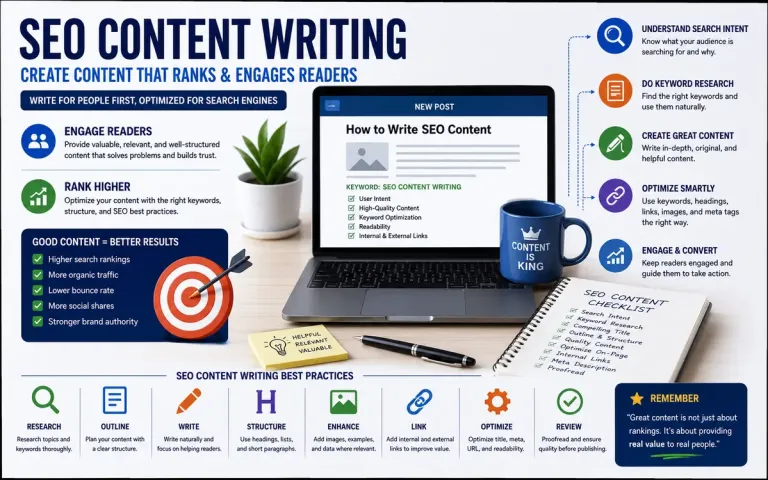
SEO content writing is the process of creating informative, engaging, and search-friendly content that satisfies the needs of both users and search engines. It is not simply about inserting keywords into an article; rather, it involves understanding what users are searching for, organizing information logically, and presenting it in a way that is easy to read and useful.
Modern search engines prioritize content that demonstrates relevance, accuracy, and usefulness. Therefore, successful SEO writing requires a balance between optimization techniques and a user-first approach. The objective is to create content that answers search queries comprehensively while maintaining clarity, originality, and credibility.
In this guide, you will learn the fundamental principles of SEO content writing, from understanding search intent and selecting appropriate keywords to organizing content effectively and creating articles that provide long-term value for readers.
What Is SEO Content Writing?
SEO Content Writing is the practice of creating content that is optimized to improve its visibility in search engine results while delivering meaningful information to readers. It combines the principles of search engine optimization with effective writing techniques to produce content that is both discoverable and valuable.
Unlike traditional writing, which may focus primarily on creativity or personal expression, SEO content writing begins by understanding what users are searching for and why they are searching for it. The content is then structured to answer those questions clearly and comprehensively while incorporating relevant keywords naturally.
For example, if someone searches for "What is Technical SEO?", they expect a clear explanation of the concept, its importance, and practical guidance. An effective SEO article should satisfy this expectation by providing accurate information in a logical sequence rather than simply repeating the phrase "Technical SEO" throughout the page.
SEO content writing therefore aims to achieve two objectives simultaneously:
- Provide valuable and relevant information that satisfies user intent.
- Help search engines understand the topic and relevance of the content.
When these objectives are successfully balanced, content is more likely to engage readers and perform well in organic search results.
Understand Search Intent Before Writing
One of the most important principles of SEO content writing is understanding search intent, which refers to the reason behind a user's search query. Before writing an article, it is essential to identify what information or solution the user expects to find.
Search intent is commonly categorized into four types:
Informational Intent
Users seek knowledge or answers to specific questions.
Examples include:
- What is SEO?
- How does keyword research work?
- What is digital marketing?
Articles targeting informational intent should provide clear explanations, practical examples, and comprehensive coverage of the topic.
Navigational Intent
Users are looking for a specific website, brand, or webpage.
Examples include:
- Google Search Console
- BizInfotech
- HubSpot Blog
These searches indicate that users already know where they want to go.
Commercial Investigation
Users are comparing products, services, or solutions before making a decision.
Examples include:
- Best SEO tools
- WordPress vs Shopify
- Best web hosting for beginners
Content addressing commercial intent should present balanced comparisons and objective evaluations to help users make informed choices.
Transactional Intent
Users intend to complete an action, such as purchasing a product or registering for a service.
Examples include:
- Buy SEO course
- Hire SEO consultant
- Download SEO checklist
Content targeting transactional intent should provide clear calls to action and relevant information that supports the user's decision-making process.
Understanding search intent enables writers to produce content that aligns with users' expectations, increasing the likelihood of both reader satisfaction and improved search visibility.
Conduct Keyword Research Before Writing
Keyword research forms the foundation of SEO content writing because it helps identify the words and phrases that users enter into search engines when looking for information. Rather than selecting keywords based solely on popularity, writers should choose terms that are relevant to the topic, align with user intent, and match the objectives of the content.
Most articles are built around a primary keyword, which represents the main topic of the page. Supporting this primary keyword are secondary keywords and related terms, which help broaden the coverage of the topic and provide additional context.
For example, in this article the primary keyword is SEO Content Writing, while related terms may include content optimization, search intent, keyword research, content readability, and SEO-friendly content. Using these terms naturally throughout the article helps search engines understand the subject without making the writing repetitive.
However, keyword optimization should never compromise readability. Repeating the same keyword excessively, a practice known as keyword stuffing, creates an unnatural reading experience and may negatively affect both user engagement and search performance. Instead, keywords should be integrated naturally within headings, introductions, body paragraphs, and conclusions while ensuring that the content remains informative and easy to read.
Create a Logical Content Structure
A well-organized article improves both readability and search engine understanding. Visitors should be able to quickly locate the information they need, while search engines should easily identify the main topic and supporting sections. A logical structure also encourages users to spend more time on the page, reducing bounce rates and improving engagement.
When creating SEO content, consider the following structural elements:
- Write a clear and compelling title that accurately reflects the topic.
- Begin with an engaging introduction that explains the purpose of the article.
- Use descriptive headings (H2 and H3) to divide the content into logical sections.
- Keep paragraphs concise and focused on a single idea.
- Use bullet points or numbered lists where appropriate to improve readability.
- Conclude with a summary or actionable recommendations that reinforce the key message.
A clear structure not only enhances the user experience but also helps search engines understand the hierarchy and relevance of the information presented.
Write High-Quality and Helpful Content
Search engines aim to deliver content that best satisfies users' needs. Consequently, high-quality content should prioritize usefulness, accuracy, and originality rather than simply targeting keywords.
Effective SEO content should:
- Answer the user's question comprehensively.
- Be factually accurate and up to date.
- Present information in a logical and easy-to-follow manner.
- Include practical examples, illustrations, or case studies where relevant.
- Use simple and precise language suitable for the target audience.
For example, when explaining On-Page SEO, instead of merely defining the concept, demonstrate how optimizing title tags, headings, and internal links can improve both user experience and search visibility. Practical explanations help readers apply what they learn and increase the perceived value of the content.
Rather than asking, "How can I include more keywords?", a better question is, "How can I provide the most useful answer to the user's query?" This user-first approach aligns with modern search engine expectations.
Optimize Content Without Over-Optimizing
SEO optimization should enhance the content without compromising its readability or natural flow. Keywords remain important because they help search engines understand the topic of a page, but excessive repetition may reduce content quality and negatively affect user experience.
To optimize content effectively:
- Include the primary keyword naturally in the title, introduction, headings, and conclusion.
- Use related keywords and synonyms to provide additional context.
- Write a concise and descriptive meta title and meta description.
- Add descriptive alt text to images.
- Include internal links to related articles and external links to authoritative sources when appropriate.
- Create short, descriptive URLs that accurately represent the page content.
The objective is to help search engines understand the topic while ensuring that the content remains engaging and informative for readers.
Improve Readability and User Experience
Even the most informative article may fail to engage readers if it is difficult to read. Readability plays a significant role in keeping visitors engaged and encouraging them to continue exploring your website.
To improve readability:
- Use short sentences and paragraphs.
- Avoid unnecessary technical jargon unless it is explained.
- Highlight important concepts using headings and formatting.
- Maintain consistent font styles and spacing.
- Use relevant images, diagrams, or infographics to support explanations.
- Ensure the content is mobile-friendly and easy to navigate on all devices.
A positive reading experience encourages visitors to spend more time on your website, increasing the likelihood that they will explore additional content.
Common SEO Content Writing Mistakes
Writers often make mistakes that reduce both the effectiveness of their content and its ability to perform well in search results. Avoiding these common issues can significantly improve content quality.
Common mistakes include:
- Writing without understanding user search intent.
- Excessively repeating keywords (keyword stuffing).
- Publishing thin or superficial content.
- Using misleading or clickbait titles.
- Neglecting internal linking.
- Ignoring readability and mobile users.
- Publishing outdated or inaccurate information.
- Failing to proofread for grammatical and spelling errors.
Focusing on quality, relevance, and user satisfaction helps prevent these mistakes and contributes to long-term SEO success.
SEO Content Writing Checklist
Before publishing your content, review the following checklist:
✔ Does the article satisfy the user's search intent?
✔ Is the primary keyword used naturally throughout the content?
✔ Are headings clear and logically organized?
✔ Is the content original, accurate, and valuable?
✔ Have images been optimized with descriptive alt text?
✔ Are internal links included where appropriate?
✔ Is the meta title and meta description optimized?
✔ Is the article easy to read on both desktop and mobile devices?
✔ Have grammar, spelling, and formatting been carefully reviewed?
Following this checklist helps ensure that your content is both user-friendly and search-engine friendly.
Conclusion
SEO content writing is more than incorporating keywords into an article. It is a strategic process that combines an understanding of user intent, thoughtful keyword research, logical content organization, and high-quality writing to create content that serves both readers and search engines.
By focusing on relevance, originality, readability, and practical value, businesses and content creators can develop articles that not only improve organic visibility but also build trust and authority over time. Effective SEO content is ultimately measured by its ability to answer users' questions, solve their problems, and encourage meaningful engagement.
As search engine algorithms continue to evolve, the fundamental principle remains unchanged: create content for people first, then optimize it to help search engines understand its value.
Frequently Asked Questions
1. What is SEO content writing?
SEO content writing is the process of creating valuable, well-structured content that is optimized to improve its visibility in search engine results while satisfying user intent.
2. How is SEO content writing different from ordinary writing?
Traditional writing may focus primarily on communication or creativity, whereas SEO content writing combines effective writing with search engine optimization techniques to improve discoverability and user engagement.
3. How often should keywords be used?
Keywords should be incorporated naturally throughout the content. Excessive repetition, known as keyword stuffing, should be avoided as it may negatively affect readability and search performance.
4. Is long-form content better for SEO?
Long-form content often performs well because it can address topics in greater depth. However, quality, relevance, and user satisfaction are more important than word count alone.
5. Can AI be used for SEO content writing?
AI can assist with brainstorming, drafting, and improving content efficiency. However, human review remains essential to ensure accuracy, originality, relevance, and alignment with user needs.
Suggested Readings
- What Is SEO? A Complete Guide to Search Engine Optimization
- How Do Search Engines Work? Crawling, Indexing, and Ranking Explained
- Keyword Research: A Complete Beginner's Guide
- On-Page SEO: A Complete Guide to Optimizing Your Web Pages
- Off-Page SEO: A Complete Guide to Building Website Authority and Trust
- Technical SEO: A Complete Guide to Improving Your Website's Technical Foundation