Introduction
In today's digital environment, having a website is only the beginning of building an online presence. A business, educational institution, professional, or content creator may have an attractive and informative website, but it will not achieve its full potential if people cannot find it.
This is where Search Engine Optimization (SEO) becomes important.
When people need information, products, services, or solutions, they often begin their journey by using a search engine. They enter a query, review the results, and usually visit websites that appear relevant and trustworthy.
SEO is the collection of practices used to help search engines understand website content and help users discover valuable information through organic search results.
For example, if someone searches for "digital marketing strategies for small businesses," hundreds or thousands of pages may potentially be relevant. Search engines use complex systems to determine which results are most useful for the user's query.
SEO helps a website improve its ability to appear prominently in these organic search results.
This guide explains the fundamentals of SEO, how search engines work, the major types of SEO, important optimization techniques, common mistakes, and the role of SEO in long-term digital marketing.
Also read this article :- The Complete Guide to Digital Marketing: Channels, Benifits, Strategies and Future Trends (2026)
What Is SEO?
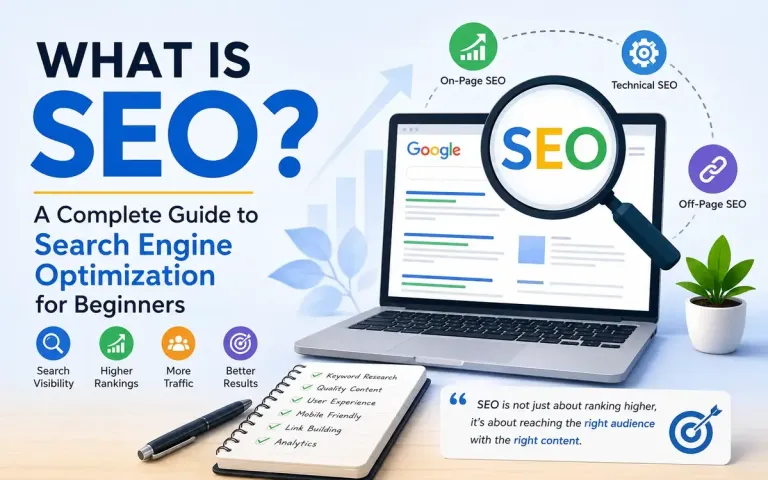
Search Engine Optimization (SEO) is the process of improving a website and its content to increase its visibility in unpaid, or organic, search engine results.
SEO involves optimizing different aspects of a website, including:
- Content
- Keywords
- Page titles
- Headings
- URLs
- Internal links
- Images
- Website structure
- Page speed
- Mobile usability
- Technical accessibility
- External links and references
The ultimate objective of SEO is not simply to achieve a higher ranking. The broader goal is to help the right users discover useful content at the right time.
A successful SEO strategy therefore focuses on both search engines and people.
How Do Search Engines Work?
To understand SEO, it is important to understand how search engines discover, organize, and rank web pages.
Although search engines use sophisticated algorithms, the basic process can be understood through three major stages:
- Crawling
- Indexing
- Ranking
1. Crawling
Crawling is the process through which search engine systems discover web pages.
Search engines use automated programs, commonly called crawlers, bots, or spiders, to explore websites and follow links from one page to another.
For example, a search engine may discover a new blog post through:
- An internal link
- An external backlink
- An XML sitemap
- Other known URLs
If a website publishes a new article, search engines need to discover and access that page before it can potentially appear in search results.
2. Indexing
After discovering a page, the search engine analyzes and stores information about it.
This process is known as indexing.
The search engine may analyze:
- Page content
- Text
- Images
- Titles
- Metadata
- Structured data
- Links
- Page relationships
If a page is eligible for indexing, it may become part of the search engine's index.
However, being indexed does not guarantee that a page will rank highly.
A website owner should therefore monitor whether important pages have been successfully indexed.
3. Ranking
When a user enters a search query, the search engine evaluates relevant pages and determines which results should be displayed.
Search engines consider many signals when generating results.
These may include:
- Relevance to the query
- Content quality
- User intent
- Website accessibility
- Page experience
- Authority and reputation
- Links and references
- Freshness, where relevant
The exact algorithms used by search engines are complex and continuously evolving.
Therefore, SEO should not be viewed as a method for manipulating search rankings. Instead, it should focus on creating useful content and making websites easy for both users and search engines to understand.
Why Is SEO Important?
SEO is an important part of digital marketing because search engines can be a major source of website traffic.
A well-executed SEO strategy can help organizations:
Increase Organic Traffic
Organic traffic refers to visitors who reach a website through unpaid search results.
Unlike paid advertising, organic search traffic does not require payment for every click.
Improve Online Visibility
SEO helps websites become more discoverable when users search for relevant topics, products, or services.
Build Credibility
Websites that consistently provide valuable, accurate, and useful content can build trust with their audience.
Generate Leads
Businesses can attract potential customers who are actively searching for their products or services.
Support Long-Term Growth
Paid advertising can produce immediate visibility, but SEO can create a sustainable source of traffic when supported by high-quality content and ongoing optimization.
Improve User Experience
Many SEO practices also improve the experience of website visitors.
For example:
- Faster pages
- Clear navigation
- Mobile-friendly design
- Well-structured content
- Descriptive links
These improvements benefit both users and search visibility.
The Major Types of SEO
SEO is a broad discipline. It can be divided into several major areas.
The most commonly discussed categories are:
- On-Page SEO
- Off-Page SEO
- Technical SEO
- Local SEO
Let's examine each one.
1. On-Page SEO
On-page SEO refers to optimization activities performed directly on a webpage and its content.
The objective is to make content useful, relevant, understandable, and accessible.
Important elements include:
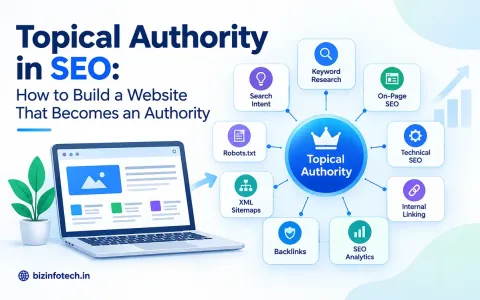
- Keyword research
- Search intent
- Page titles
- Headings
- Content quality
- Meta descriptions
- URL structure
- Internal linking
- Image optimization
Keyword Research
Keyword research involves identifying the words and phrases people use when searching for information.
For example, a user interested in SEO might search for:
- What is SEO?
- SEO for beginners
- How does SEO work?
- On-page SEO
- Technical SEO
Understanding these search queries helps content creators develop articles that address real information needs.
However, modern SEO is not simply about repeating a keyword multiple times.
Instead, content should naturally cover the topic and address the user's underlying search intent.
Related article What is Keyword Research
Search Intent
Search intent refers to the reason behind a user's search query.
Common types include:
Informational Intent
The user wants to learn something.
Example:
What is digital marketing?
Navigational Intent
The user wants to find a specific website or page.
Example:
Google Search Console
Transactional Intent
The user intends to purchase or complete a transaction.
Example:
Buy SEO software
Commercial Investigation
The user is researching options before making a decision.
Example:
Best SEO tools for small businesses
Understanding search intent helps content creators provide the type of information users actually need.
Title Tags
The page title is an important element because it helps communicate the subject of a webpage.
A good title should be:
- Clear
- Relevant
- Descriptive
- Concise
- Appealing to users
For example:
What Is SEO? A Complete Guide to Search Engine Optimization
is more informative than:
SEO Guide
The title should accurately represent the content rather than making exaggerated claims.
Headings
Headings help organize content into logical sections.
A typical structure may include:
- H1: Main page title
- H2: Major sections
- H3: Subsections
For example:
H1: What Is SEO?
H2: How Do Search Engines Work?
H3: Crawling
H3: Indexing
H3: Ranking
A clear heading structure improves readability and helps users navigate long articles.
Meta Descriptions
A meta description is a short summary that may be displayed in search results.
Although it is not generally considered a direct ranking factor, a well-written description can help users understand what a page offers and may influence whether they choose to visit it.
A good meta description should:
- Accurately summarize the page
- Include relevant terms naturally
- Encourage the right audience to click
URL Structure
A clean URL helps users and search engines understand the subject of a page.
For example:
example.com/what-is-seo
is clearer than:
example.com/page.php?id=234
A good URL should generally be:
- Short
- Descriptive
- Readable
- Relevant to the page
Internal Linking
Internal linking means linking one page on your website to another page on the same website.
For example, an article about digital marketing can link to another article about SEO.
Internal links can help:
- Users discover related content
- Search engines discover pages
- Establish relationships between topics
- Distribute internal authority
- Improve website navigation
A strong internal linking structure is particularly important for websites with many related articles.
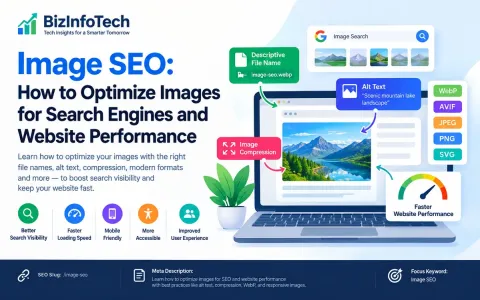
Image Optimization
Images can improve the visual quality of an article, but poorly optimized images can negatively affect performance.
SEO-friendly image practices include:
- Using descriptive filenames
- Adding meaningful alt text
- Compressing images
- Using modern formats such as WebP where appropriate
- Providing responsive images
- Using appropriate dimensions
For example:
seo-strategy.webp
is more descriptive than:
IMG_12345.webp
2. Off-Page SEO
Off-page SEO refers to activities that take place outside your website and can influence how your website is perceived and discovered.
One of the most important elements is link building.
Backlinks
A backlink is a link from another website to your website.
For example, if an educational website references a useful article on BizInfotech and links to it, that link is a backlink.
High-quality backlinks can contribute to a website's authority and visibility.
However, not all backlinks are equally valuable.
A relevant link from a trustworthy website is generally more valuable than large numbers of irrelevant or low-quality links.
Digital PR
Digital PR involves creating content or stories that earn attention and mentions from online publications, industry websites, and other relevant sources.
Examples include:
- Original research
- Surveys
- Industry reports
- Expert commentary
- Useful resources
- Data-driven articles
This approach can naturally generate references and links.
Brand Mentions
Even when another website mentions a brand without linking to it, the mention can contribute to overall online visibility and brand awareness.
The primary focus should remain on building a credible brand and producing content that people genuinely want to reference.
3. Technical SEO
Technical SEO focuses on improving the technical foundation of a website so that search engines can efficiently access, understand, and process its content.
Important technical SEO elements include:
Website Speed
Slow websites can frustrate visitors.
Improving performance may involve:
- Compressing images
- Reducing unnecessary JavaScript
- Optimizing CSS
- Using caching
- Improving server response times
Mobile Usability
Many users access websites through smartphones.
A website should therefore provide a good experience across different screen sizes.
HTTPS
HTTPS helps protect data transferred between a user's browser and a website.
A secure website is an important component of modern web standards.
XML Sitemap
An XML sitemap provides search engines with information about important URLs on a website.
It can help search engines discover content, especially on larger or frequently updated websites.
Robots.txt
The robots.txt file provides instructions to crawlers about which areas of a website they may or may not access.
It should be configured carefully because incorrect rules can unintentionally restrict search engine access.
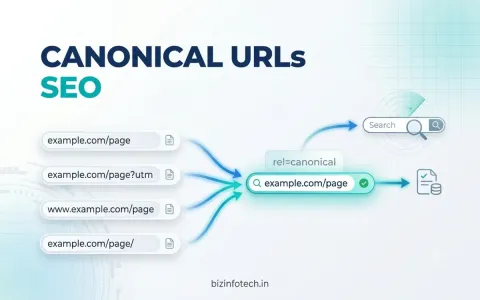
Canonical URLs
Canonical tags help indicate the preferred version of a page when multiple URLs contain substantially similar content.
This can help reduce confusion about which URL should be treated as the primary version.
Core Web Vitals
Core Web Vitals are metrics associated with aspects of page experience, such as loading performance, responsiveness, and visual stability.
Website owners should monitor performance and address significant usability problems.
4. Local SEO
Local SEO focuses on improving visibility for searches connected to a specific geographical location.
It is particularly important for:
- Restaurants
- Hotels
- Clinics
- Local retailers
- Educational institutions
- Professional services
For example, a user searching for "digital marketing agency near me" has a strong local intent.
Important local SEO activities include:
- Maintaining accurate business information
- Managing business listings
- Collecting genuine customer reviews
- Creating location-relevant content
- Maintaining consistent contact details
Common SEO Mistakes to Avoid
Keyword Stuffing
Keyword stuffing means excessively repeating keywords in an unnatural way.
This can reduce readability and create a poor user experience.
Better approach:
Use keywords naturally while focusing on the overall topic and user intent.
Creating Low-Quality Content
Publishing large quantities of thin or unhelpful content does not automatically improve SEO.
Focus on:
- Originality
- Accuracy
- Depth
- Usefulness
- Clear presentation
Ignoring Internal Links
A website may have excellent articles, but users and search engines may struggle to discover them if the pages are poorly connected.
Create logical links between related topics.
Ignoring Technical Issues
Content alone is not enough.
Technical problems such as broken links, poor mobile usability, slow performance, or incorrect indexing directives can affect website accessibility.
Buying Low-Quality Backlinks
Purchasing large quantities of manipulative links can create risks.
Focus instead on earning relevant links through valuable content, relationships, digital PR, and genuine references.
Expecting Immediate Results
SEO is generally a long-term strategy.
The time required to see meaningful results varies depending on factors such as:
- Website age
- Competition
- Content quality
- Technical condition
- Industry
- Search demand
- Authority
Therefore, SEO requires patience, consistency, and continuous improvement.
How Long Does SEO Take to Show Results?
There is no universal timeline for SEO success.
Some pages may begin receiving impressions relatively quickly, while competitive keywords may require significantly more time.
The results of SEO depend on many variables, including the website's existing authority, competition, technical health, content quality, and consistency.
Instead of focusing only on rankings, website owners should monitor multiple indicators:
- Organic impressions
- Organic clicks
- Search queries
- Average position
- Organic traffic
- Engagement
- Leads
- Conversions
This provides a more complete picture of SEO performance.
SEO and Artificial Intelligence
Artificial intelligence is changing the digital marketing landscape.
AI can assist marketers and website owners with:
- Keyword research
- Content planning
- Topic clustering
- Content ideation
- Data analysis
- Customer segmentation
- Personalization
- Workflow automation
However, AI-generated content should not be treated as a replacement for human expertise.
The most valuable content should demonstrate:
- Accuracy
- Originality
- Experience
- Expertise
- Clear reasoning
- Genuine usefulness
AI can help improve productivity, but human judgment remains essential for creating trustworthy and valuable content.
A Beginner's SEO Checklist
If you are starting SEO for a new website, use this basic checklist:
Website Foundation
- Use HTTPS
- Ensure the website is mobile-friendly
- Improve page performance
- Create a logical site structure
- Fix broken links
Content
- Research relevant topics
- Understand search intent
- Create original and useful content
- Use descriptive titles
- Organize content with headings
- Add relevant internal links
Technical SEO
- Create an XML sitemap
- Check robots.txt
- Use canonical URLs where appropriate
- Monitor indexing
- Fix important technical errors
Images
- Compress images
- Use appropriate formats
- Add descriptive alt text
- Use responsive images
Monitoring
- Monitor search impressions
- Track organic clicks
- Review search queries
- Analyze traffic
- Monitor conversions
How to Start SEO for Your Website
If you are a beginner, do not try to optimize everything at once.
Start with these steps:
Step 1: Understand Your Audience
Identify who you want to reach.
Step 2: Identify Topics
Find questions and problems your audience is searching for.
Step 3: Create High-Quality Content
Develop comprehensive articles that genuinely answer those questions.
Step 4: Optimize Your Pages
Improve titles, headings, URLs, images, and internal links.
Step 5: Fix Technical Problems
Ensure that search engines can access and understand your website.
Step 6: Promote Your Content
Share useful content through relevant social and professional platforms.
Step 7: Monitor Results
Use analytics and search performance data to understand what works.
Step 8: Improve Continuously
Update important content and improve pages based on user needs and performance data.
The Future of SEO
SEO is continuously evolving.
The future of search is likely to involve increasing integration between:
- Artificial intelligence
- Search engines
- Conversational interfaces
- Voice search
- Visual search
- Structured data
- Personalized experiences
However, one principle is likely to remain important: creating genuinely useful information for users.
Search technology may change, but websites that provide accurate, relevant, accessible, and trustworthy content will continue to have opportunities to attract audiences.
The role of SEO is therefore moving beyond simply "ranking on Google." It is increasingly about building a strong digital presence that can be discovered across multiple search and information environments.
Conclusion
Search Engine Optimization is a fundamental component of modern digital marketing.
It helps websites improve their visibility, attract relevant organic traffic, and connect with people who are actively searching for information, products, and services.
A successful SEO strategy combines multiple elements, including:
- High-quality content
- Search intent
- Keyword research
- On-page optimization
- Internal linking
- Technical SEO
- Website performance
- Mobile usability
- Off-page authority
- Continuous monitoring
SEO is not a one-time activity. Search behavior, technology, competition, and websites constantly change. Therefore, successful SEO requires continuous learning, testing, measurement, and improvement.
For beginners, the best approach is to start with the fundamentals: understand your audience, create useful content, build a technically sound website, and make it easy for both users and search engines to navigate your content.
Ultimately, SEO is not simply about getting more visitors. It is about attracting the right visitors and providing them with the information or experience they are looking for.
Get more on SEO:- How I Achieved a 100/100 SEO Score on Google PageSpeed Insights
Related article: How Information Technology Helps Businesses Earn More Money
Frequently Asked Questions (FAQs)
1. What does SEO stand for?
SEO stands for Search Engine Optimization. It is the practice of improving websites and content to increase visibility in organic search results.
2. Is SEO free?
Organic SEO does not require paying a search engine for every click. However, SEO requires investment in content creation, technical optimization, tools, expertise, and time.
3. How long does SEO take?
SEO results vary from website to website. New websites may take time to build visibility and authority, while established websites may see improvements more quickly.
4. What are the main types of SEO?
The major areas include on-page SEO, off-page SEO, technical SEO, and local SEO.
5. Is SEO still important with AI?
Yes. AI is changing how people search and how marketers create content, but the need for useful, accurate, discoverable information remains important.
6. Can I do SEO myself?
Yes. Beginners can learn the fundamentals of SEO and implement many practices themselves. More complex technical issues may require professional assistance.
7. What is the difference between SEO and digital marketing?
SEO is one component of digital marketing. Digital marketing includes SEO as well as social media marketing, email marketing, content marketing, paid advertising, affiliate marketing, and other digital channels.