Introduction
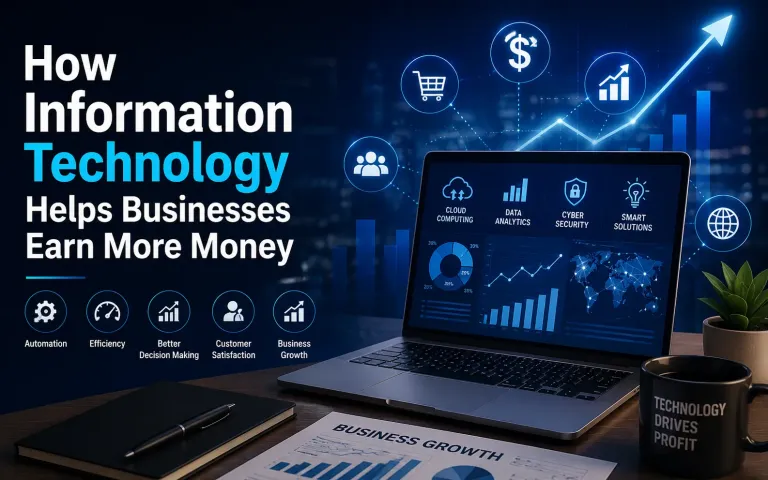
In today's digital age, businesses that effectively leverage Information Technology (IT) are gaining a significant competitive advantage. IT has transformed traditional business models by helping organizations reach wider audiences, streamline operations, reduce costs, and increase revenue.
From establishing an online presence to implementing artificial intelligence and automation, businesses can use technology at different stages of digital transformation to improve efficiency and maximize profitability.
In this article, we explore how Information Technology helps businesses increase earnings and achieve sustainable growth.
1. Challenges of Traditional Businesses
Traditional businesses often depend on physical stores, manual processes, and local customer networks. While these models can be successful, they may face several limitations in an increasingly digital economy.
Limited Market Reach
Businesses without an online presence are often restricted to customers in their local area. This limits their ability to expand into new markets and attract customers from different regions.
High Operational Costs
Manual bookkeeping, paper-based record management, traditional advertising, and other offline processes can consume significant time and resources. These processes may also increase the risk of errors and inefficiencies.
Limited Revenue Potential
When sales depend primarily on physical visits, local advertising, and word-of-mouth referrals, businesses may find it difficult to scale rapidly. Their growth is often constrained by geographical boundaries and operating hours.
For many small and medium-sized businesses, adopting digital technologies is therefore becoming an important part of remaining competitive and achieving long-term growth.
2. Benefits of Digital Transformation
Digital transformation enables businesses to integrate technology into their operations, marketing, sales, and customer service. When implemented strategically, these technologies can create new revenue opportunities while reducing operating costs. Related reading: https://bizinfotech.in/post/how-digital-transformation-is-changing-traditional-business-models
Establishing an Online Presence
A professional website, social media presence, and business listings allow companies to reach potential customers beyond their local markets.
A strong digital presence also helps businesses build credibility, communicate their value proposition, and generate leads around the clock.
Expanding Through E-Commerce
E-commerce enables businesses to sell products and services beyond geographical boundaries. Unlike a physical store that operates during specific hours, an online store can accept orders 24/7.
For example, a local retailer that adds an e-commerce channel can potentially serve customers across an entire country rather than relying solely on local foot traffic.
Enabling Digital Payments
Digital payment solutions make transactions faster and more convenient. Customers can pay using credit and debit cards, mobile wallets, internet banking, and other digital payment methods.
By offering convenient payment options, businesses can improve the customer experience and reduce friction during the purchasing process.
Reducing Operational Costs
Cloud computing, digital documentation, automation, and online collaboration tools can reduce the need for manual processes and physical infrastructure.
For example, cloud-based software can help businesses manage accounting, customer relationships, inventory, and communication more efficiently.
The result can be lower operational costs, improved productivity, and better resource utilization.
3. Achieving Success with IT-Driven Automation
Once a business has established its digital foundation, advanced IT solutions can further improve efficiency and profitability.
Artificial Intelligence and Automation
Artificial Intelligence (AI) and automation are increasingly being used to improve business processes.
Examples include:
- AI-powered chatbots for customer support
- Automated email marketing
- Inventory management systems
- AI-assisted content creation
- Automated invoice and payment processing
- Predictive analytics for demand forecasting
By automating repetitive tasks, businesses can save time, reduce errors, and allow employees to focus on higher-value activities.
Read also: https://bizinfotech.in/post/how-generative-ai-is-transforming-digital-marketing-strategies
Data-Driven Decision-Making
Modern businesses generate large amounts of data from websites, social media, customer interactions, and sales transactions.
Business intelligence and analytics tools can convert this data into actionable insights. Businesses can use these insights to identify profitable products, understand customer behavior, optimize pricing, and improve marketing campaigns.
Instead of relying entirely on assumptions, entrepreneurs can make decisions based on measurable evidence.
Read also: Leveraging Data for Strategic Decision Making
Cloud Computing and Scalability
Cloud-based technologies allow businesses to access computing resources and software without making large investments in physical infrastructure.
As a business grows, cloud solutions can make it easier to scale operations, add users, manage data, and support new business activities.
This flexibility is particularly valuable for startups and small businesses that want to grow without incurring substantial upfront technology costs.
Digital Marketing
Digital marketing allows businesses to reach highly targeted audiences through channels such as:
- Search Engine Optimization (SEO)
- Pay-Per-Click (PPC) advertising
- Social media marketing
- Email marketing
- Content marketing
Compared with many traditional advertising methods, digital marketing also provides measurable data about impressions, clicks, leads, conversions, and customer behavior.
Businesses can therefore continuously optimize their campaigns and allocate marketing budgets to channels that deliver better results.
Read also: The Complete Guide to Digital Marketing
4. The Connection Between IT and Business Profitability
The impact of IT on profitability can be understood through three major outcomes:
More Customers → Higher Revenue
Digital channels enable businesses to reach new markets and acquire more customers.
Lower Costs → Higher Margins
Automation and digital processes can reduce operational expenses and improve productivity.
Better Decisions → Sustainable Growth
Data analytics and business intelligence enable organizations to make more informed strategic and operational decisions.
When these three elements work together, IT becomes more than a support function—it becomes a strategic driver of business growth.
Final Thoughts
Information Technology is no longer simply an optional tool for modern businesses. It has become a fundamental driver of efficiency, customer reach, innovation, and profitability.
Businesses can begin with simple steps such as creating a professional website, adopting digital payments, and using social media. As they mature digitally, they can move toward e-commerce, cloud computing, data analytics, AI, and automation.
The key is not to adopt technology simply because it is new. Businesses should identify their specific challenges and select technologies that generate measurable value.
Ultimately, the businesses that strategically integrate IT into their operations are better positioned to reduce costs, increase revenue, improve customer experiences, and remain competitive in an increasingly digital economy.
Are you ready to integrate IT into your business? Start with one digital improvement today and build from there.
Related Reading: How to Build a Tech-Driven Business Strategy in 2025