Introduction
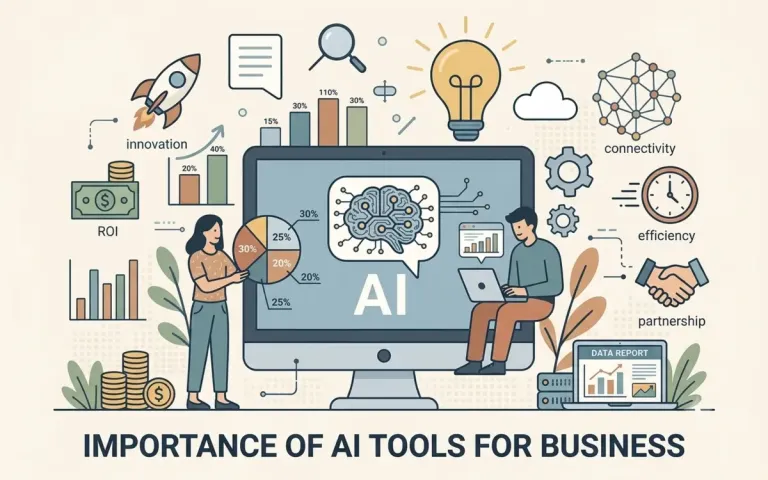
In today’s fast-paced digital economy, Artificial Intelligence has evolved from a futuristic concept into a practical business necessity. Organisations of every size are using AI to automate repetitive work, analyse large volumes of data, improve decision-making, and create more personalised customer experiences.
However, AI delivers the greatest value when it supports human expertise rather than operating without supervision. Businesses must therefore combine the right tools with clear objectives, quality data, employee training, privacy safeguards, and human review. Current business research also identifies misinformation, data leakage, cybersecurity, intellectual-property concerns, and overreliance on automation as important risks. [ajg](https://www.ajg.com/news-and-insights/features/ai-adoption-and-risk-benchmarking-2026/)
The following AI tools are among the most useful platforms for content creation, workplace productivity, research, software development, sales, and customer engagement.
1. Content Creation & Marketing
ChatGPT by OpenAI
ChatGPT is a versatile conversational AI assistant that supports a wide range of business activities. Marketing teams can use it to generate campaign ideas, write social-media captions, prepare email drafts, develop content calendars, and create customer-support responses.
It can also assist with business reports, market-research summaries, presentations, strategic brainstorming, and code generation. For web developers, it can help explain PHP, HTML, JavaScript, SQL, and server-configuration concepts, although all code should be tested carefully before deployment.
Businesses can improve consistency by using custom instructions, reusable prompt templates, knowledge bases, and specialised AI assistants. For example, a digital-marketing agency could create a workflow that instructs ChatGPT to use a specific tone, follow SEO guidelines, include suitable calls to action, and write for a clearly defined audience.
ChatGPT is particularly valuable for:
- - Blog outlines and first drafts.
- SEO title and meta-description ideas.
- Social-media campaigns.
- Proposal and quotation writing.
- Customer-service FAQs.
- Coding assistance and technical documentation.
- Internal knowledge management.
AI-generated content should still be checked for accuracy, originality, tone, and compliance before publication.
Jasper
Jasper is an AI content-generation platform designed primarily for marketing teams. It can assist with advertising copy, landing pages, blog content, product descriptions, email campaigns, and social-media posts.
One of its key advantages is the ability to apply brand guidelines across multiple content formats. Businesses can define their preferred tone, vocabulary, audience, messaging principles, and prohibited claims. This helps marketing departments maintain a consistent brand identity when several employees or agencies are producing content.
Jasper is most useful when the business already has a clear marketing strategy. AI can produce variations quickly, but it cannot replace decisions about customer positioning, pricing, differentiation, or campaign objectives.
Canva
Canva has made professional visual design accessible to individuals, educators, freelancers, and small businesses. Its AI-powered Magic Studio provides features such as background removal, text-to-image generation, resizing, template recommendations, image editing, and presentation assistance.
A small business can use Canva to create:
- Website banners.
- Facebook and LinkedIn posts.
- Promotional posters.
- YouTube thumbnails.
- Presentation slides.
- Infographics.
- Course materials.
- Service brochures and advertisements.
For a freelance web developer, Canva can also support client acquisition by making it easier to prepare portfolio graphics, before-and-after website visuals, SEO service posts, and educational content. Nevertheless, users should review AI-generated images for distorted text, unrealistic objects, cultural errors, and potential copyright concerns.
AI-Assisted SEO and Content Optimisation
AI can support SEO by identifying search intent, suggesting topic clusters, grouping keywords, improving headings, generating FAQ ideas, and reviewing content structure. It may also help diagnose technical issues such as missing metadata, inconsistent canonical URLs, broken internal links, and redirect problems.
AI should be treated as an assistant rather than an automatic SEO decision-maker. Website owners must verify search demand, competition, factual claims, indexing status, page experience, and user intent through reliable SEO tools and actual website data.
2. Productivity & Workplace Operations
Claude
Developed by Anthropic, Claude is well suited to tasks involving long documents, structured reasoning, and detailed analysis. Organisations can use it to review business proposals, summarise research, compare policies, analyse contracts, and transform unstructured information into organised reports.
For academic and management professionals, Claude can help:
- Summarise lengthy research papers.
- Compare management theories.
- Prepare lecture notes.
- Create case-study questions.
- Organise survey responses.
- Develop a first draft of a research framework.
As with any generative AI system, confidential legal, financial, employee, or client information should not be entered unless the organisation has verified the relevant privacy and data-handling arrangements.
Notion AI
Notion AI brings writing and information-management features into the Notion workspace. It can help teams summarise pages, rewrite documents, extract action items, generate meeting agendas, and answer questions based on internal information.
This makes Notion AI useful for companies that maintain project documentation, operating procedures, content calendars, client records, and internal knowledge bases. Instead of searching through multiple pages manually, employees can use natural-language prompts to locate and reorganise information.
To obtain reliable results, teams should maintain clean page structures, consistent naming conventions, updated documentation, and appropriate access permissions. Poorly organised information can produce incomplete or misleading answers.
Fireflies.ai
Fireflies.ai functions as an AI meeting assistant. It can record, transcribe, summarise, and organise online conversations held through platforms such as Zoom and Google Meet.
Its practical value extends beyond transcription. It can identify decisions, extract action items, assign follow-ups, and make conversations searchable. This is especially useful for sales calls, project meetings, training sessions, interviews, and client consultations.
Before recording meetings, businesses should inform participants and follow applicable privacy, consent, and organisational policies. Human review is also important because automated transcripts may misinterpret names, technical terms, accents, or context.
Workflow Automation Platforms
Businesses can combine AI tools with automation platforms to connect forms, email, CRMs, spreadsheets, websites, and messaging systems. For example, a website enquiry could be classified by AI, entered into a CRM, assigned to a salesperson, and followed by an automatically generated response.
Automation should begin with stable, repetitive workflows. Processes involving legal commitments, refunds, sensitive personal data, employment decisions, or major financial consequences should include approval checkpoints.
3. Research, Language & Global Communication
Perplexity AI
Perplexity AI supports research by combining conversational answers with source citations. It can help executives, students, consultants, marketers, and researchers investigate industries, competitors, technologies, regulations, and academic topics.
Useful applications include:
- Preparing an initial market overview.
- Comparing competitors.
- Finding primary reports and government publications.
- Identifying recent industry developments.
- Generating research questions.
- Locating supporting references for a business article.
Citations do not automatically guarantee that every statement is correct. Users should open important sources, check publication dates, distinguish primary from secondary evidence, and verify statistics before using them in reports or public content.
DeepL
DeepL is a neural machine-translation platform designed to produce natural, context-sensitive translations. It can help international businesses translate emails, product information, marketing material, technical documentation, and internal communications.
Translation quality depends on the source text, terminology, language pair, and subject area. Legal agreements, medical information, financial disclosures, and official documents should be reviewed by a qualified human translator or subject-matter expert.
Businesses can improve consistency by creating terminology lists and translation guidelines. This is particularly important when translating brand names, technical phrases, educational material, and region-specific expressions.
AI for Academic and Business Research
AI can accelerate research by helping users define a topic, develop an outline, classify information, generate interview questions, and compare theoretical perspectives. It can also assist with qualitative coding and the initial organisation of survey data.
However, AI should not fabricate references, replace original analysis, or be used to submit unverified material as independent academic work. Researchers should preserve source records, disclose AI assistance where required, and verify every citation.
4. Development & IT Operations
Microsoft Copilot
Microsoft Copilot connects AI assistance with parts of the Microsoft ecosystem, including Windows, Microsoft 365, GitHub, and related business workflows. Its capabilities vary according to the specific Copilot product and subscription.
For software developers, GitHub Copilot can assist with code completion, explanations, documentation, test generation, and debugging suggestions. For office users, Microsoft Copilot can help draft documents, summarise meetings, analyse spreadsheets, and prepare presentation content.
AI coding tools can reduce time spent on routine development, but they do not remove the need for programming knowledge. Developers must review generated code for:
- Security vulnerabilities.
- Incorrect business logic.
- Performance problems.
- Insecure database queries.
- Compatibility issues.
- Licensing and intellectual-property concerns.
- Exposure of credentials or confidential information.
For PHP and JavaScript developers, a productive workflow is to ask AI for an explanation or initial implementation, run the code in a controlled environment, test edge cases, inspect security implications, and then adapt it to the project’s architecture.
AI-Powered IT Support
AI can assist IT teams by classifying support tickets, suggesting troubleshooting steps, monitoring unusual activity, and generating technical documentation. It can also help identify patterns in server logs and explain common configuration errors.
Sensitive infrastructure decisions should remain under the control of authorised technical staff. AI-generated commands should never be executed directly on production systems without review, testing, backups, and an appropriate rollback plan.
Cybersecurity and Quality Control
AI can help detect suspicious patterns, identify possible vulnerabilities, and prioritise alerts. At the same time, attackers can also use AI to create more convincing phishing messages and automate attacks.
A responsible IT strategy therefore combines AI with strong passwords, multi-factor authentication, access controls, secure backups, software updates, code review, vulnerability testing, and employee awareness training.
5. Sales, CRM & Customer Engagement
HubSpot
HubSpot is a customer relationship management platform with AI capabilities for marketing, sales, service, and content operations. Its tools can assist with lead management, email drafting, chatbot interactions, customer segmentation, sales follow-ups, and reporting.
HubSpot’s AI features can help teams identify promising prospects, organise customer information, personalise communication, and reduce repetitive administrative work. Newer integrations also allow customer context to be accessed through tools such as ChatGPT, Claude, and Microsoft Copilot, subject to permissions and configuration. [hubspot](https://www.hubspot.com/ai-tools)
For a web-development business, a CRM workflow might capture enquiries from a website, classify them according to service type, record the prospect’s requirements, schedule a follow-up, and provide a dashboard showing conversion rates.
AI should not send aggressive or unsuitable messages automatically. Businesses must maintain permission-based communication, accurate customer records, transparent chatbot disclosures, and a clear option for customers to speak with a human representative.
AI Chatbots and Customer Service
AI chatbots can answer routine questions about prices, services, operating hours, delivery, documentation, and appointment availability. They are most effective when trained on current, approved information.
A high-quality chatbot should:
- Clearly indicate that the customer is interacting with AI.
- Provide direct answers in simple language.
- Avoid inventing policies or promises.
- Escalate difficult or sensitive cases to a human.
- Protect personal and payment information.
- Record unanswered questions for future improvement.
Personalisation Without Intrusion
Personalisation can improve customer experience when it is relevant and transparent. However, excessive tracking or unexplained automated decisions may reduce trust. Organisations should collect only the data they need, secure it appropriately, and communicate how customer information is used.
6. Choosing AI Tools Based on Business Needs
The most appropriate AI tool is not necessarily the most popular one. Businesses should select AI tools according to their specific objectives, workflows, available resources, and expected business outcomes. Different tools are designed for different tasks, and therefore tool selection should begin with identifying the problem the organization wants to solve.
| Business Need | Suitable AI Tools | Primary Benefit |
|---|---|---|
| General writing, ideation, and analysis | ChatGPT, Claude | Faster knowledge work and content generation |
| Marketing content and brand consistency | Jasper, ChatGPT | Scalable content and campaign production |
| Graphics and promotional materials | Canva | Faster visual content creation |
| Meeting documentation and knowledge management | Fireflies.ai, Notion AI | Automated notes, summaries, and action tracking |
| Research and source discovery | Perplexity AI | Faster information and evidence gathering |
| Multilingual communication | DeepL | Efficient translation and cross-language communication |
| Coding and technical support | Microsoft Copilot, ChatGPT | Faster development, debugging, and technical problem-solving |
| CRM and customer engagement | HubSpot | Centralized customer management and workflow automation |
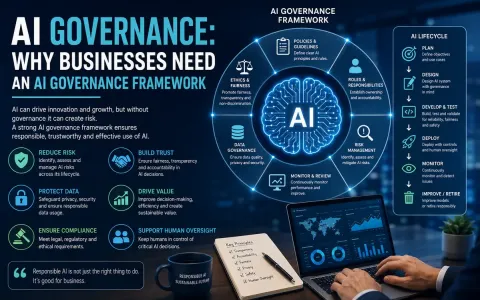
7. Building a Responsible AI Workflow
Successful AI adoption requires more than purchasing subscriptions. A practical implementation process includes the following steps:
1. Identify a specific business bottleneck, such as slow content production, missed sales follow-ups, or repetitive reporting.
2. Establish a baseline by recording the current time, cost, error rate, or conversion rate.
3. Select a tool that fits the workflow and the organisation’s data-security requirements.
4. Create approved prompts, templates, brand guidelines, and operating procedures.
5. Train employees to check accuracy, bias, privacy, originality, and tone.
6. Introduce human approval for legal, financial, customer-sensitive, and reputation-critical outputs.
7. Test the workflow with a small group before expanding it across the organisation.
8. Measure results and revise the process regularly.
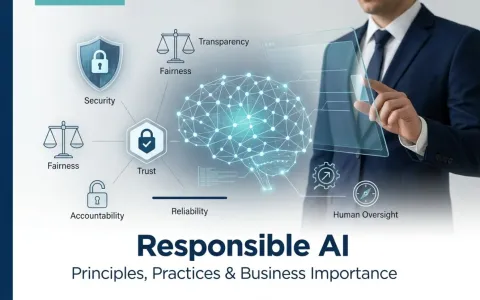
Human oversight is particularly important because many organisations recognise AI risks but have not yet established effective governance systems. One recent analysis reported that only 13% of companies had a policy ensuring human oversight of AI systems. [trust](https://www.trust.org/resource/ai-company-data-initiative-2025-insights/)
8. Common Mistakes to Avoid
Businesses often struggle with AI when they focus on novelty instead of outcomes. Common mistakes include:
Using several tools without a clear workflow.
Publishing AI-generated content without fact-checking.
Entering confidential client or employee information into unapproved tools.
Treating AI suggestions as professional legal, medical, financial, or academic advice.
Automating customer communication without escalation procedures.
Ignoring copyright, licensing, and content-ownership issues.
Measuring the number of AI-generated outputs instead of business results.
Failing to train employees and document approved usage.
Allowing outdated internal information to remain connected to AI systems.
A useful rule is simple: automate low-risk repetition, assist with medium-risk analysis, and retain human control over high-impact decisions.
Conclusion: Choosing the Right AI Stack
The true transformation lies not in adopting a single AI tool, but in strategically integrating platforms that address specific business bottlenecks. Jasper and Canva can accelerate marketing production, Perplexity AI can support research, DeepL can improve multilingual communication, Microsoft Copilot can assist development and office work, and HubSpot can connect AI with sales and customer-service operations.
For a freelancer, small business, or educational organisation, the most effective approach is to begin with a small, affordable stack. For example, ChatGPT can support writing and planning, Canva can produce promotional designs, a CRM can organise leads, and an analytics tool can measure which activities generate enquiries.
As AI technology continues to evolve, the most successful businesses will be those that remain agile while maintaining discipline. They will regularly audit workflows, protect sensitive information, verify important claims, train employees, and measure whether AI is improving productivity, quality, customer satisfaction, or revenue.
The goal is not to replace human capability. It is to combine human judgement, creativity, experience, and accountability with the speed and scale of intelligent tools.
Related articles:-
How AI Agents Work: Architecture, Capabilities and Applications
AI Agents vs AI Chatbots: What Is the Difference?
AI and Cybersecurity: How Artificial Intelligence Is Changing Digital Security
AI Hallucinations: Why AI Can Generate Incorrect Information and How to Verify It