Introduction
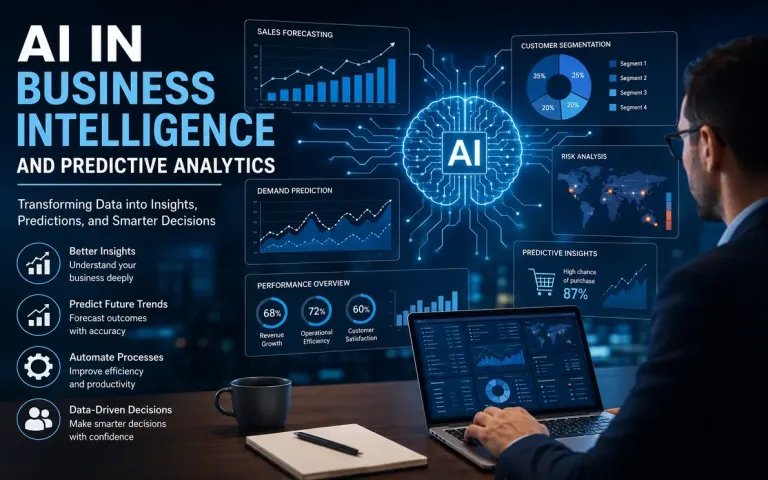
Artificial Intelligence (AI) is transforming the way organizations collect, analyze, and use business data. Traditionally, Business Intelligence (BI) focused primarily on understanding what happened in the past by using reports, dashboards, and descriptive analytics. Predictive analytics extended this capability by using statistical techniques and historical data to estimate what might happen in the future. Today, AI is taking these capabilities further by enabling organizations to analyze large and complex datasets, identify hidden patterns, automate analytical processes, and generate predictions with greater speed and sophistication.
The integration of AI, Business Intelligence, and Predictive Analytics enables organizations to move from simply asking “What happened?” to asking “Why did it happen?”, “What is likely to happen next?”, and “What should we do about it?”
AI-powered BI can support decision-making across marketing, finance, human resource management, operations, supply chain management, customer service, and strategic management. However, successful implementation requires more than sophisticated algorithms. Organizations must also address data quality, privacy, cybersecurity, ethical concerns, employee skills, and the explainability of AI-generated decisions.
1. Understanding Business Intelligence
Business Intelligence (BI) refers to the technologies, processes, and practices used by organizations to collect, integrate, analyze, and present business information to support decision-making.
Traditional BI systems typically collect information from sources such as:
Enterprise Resource Planning (ERP) systems
Customer Relationship Management (CRM) systems
Sales databases
Financial systems
Websites and applications
Social media platforms
Supply-chain systems
Customer feedback
Operational databases
This information is then transformed into reports, dashboards, charts, and key performance indicators (KPIs).
For example, a retail company may use a BI dashboard to determine:
Monthly sales revenue
Best-selling products
Sales by geographic region
Customer acquisition cost
Inventory levels
Profit margins
Employee productivity
Traditional BI is highly useful, but much of it is descriptive in nature. It tells managers what has already happened.
2. From Traditional BI to AI-Powered BI
The development of AI has significantly expanded the capabilities of Business Intelligence.
Traditional BI generally requires users to interact with predefined dashboards and reports. AI-powered BI can make the analytical process more dynamic by identifying patterns automatically and allowing users to interact with data using natural language.
For example, instead of manually examining several reports, a manager could ask:
“Why did sales decline in the eastern region during the last quarter?”
An AI-enabled BI system could analyze sales data, customer behavior, pricing changes, promotional campaigns, inventory levels, and regional trends to identify possible explanations.
AI can therefore transform BI from a primarily reporting-oriented system into an intelligent decision-support system.
Traditional BI vs. AI-Powered BI
| Traditional BI | AI-Powered BI |
|---|---|
| Primarily analyzes historical data | Analyzes historical and real-time data |
| Relies heavily on predefined reports | Can automatically identify patterns |
| Dashboard-oriented | Dashboard + conversational + automated |
| Requires structured queries and reports | Can use natural-language queries |
| Limited automation | High level of analytical automation |
| Mainly descriptive and diagnostic | Descriptive, diagnostic, predictive, and increasingly prescriptive |
| Human-driven analysis | Human-AI collaborative analysis |
3. What Is Predictive Analytics?
Predictive analytics involves using historical and current data, statistical techniques, machine learning, and mathematical models to estimate future outcomes.
The objective is not to predict the future with absolute certainty. Rather, predictive analytics identifies probabilities, patterns, and relationships that can help organizations prepare for possible future scenarios.
For example:
A telecommunications company may analyze customer usage patterns, complaints, payment behavior, and contract information to estimate which customers are likely to leave.
Similarly, an e-commerce company may predict:
Which customers are likely to purchase
Which products may become popular
Expected future demand
Customers who may stop purchasing
Potential revenue
Inventory requirements
4. Role of AI in Predictive Analytics
AI significantly enhances predictive analytics because modern AI and machine-learning systems can process large datasets and identify complex relationships that may be difficult to detect using traditional analytical techniques.
Machine learning models can learn from historical data and improve their predictions as new data becomes available.
Common techniques include:
4.1 Regression
Regression models estimate relationships between variables.
For example, a company may use regression to estimate sales based on:
Advertising expenditure
Product price
Seasonality
Customer demand
Economic conditions
4.2 Classification
Classification models assign observations to predefined categories.
For example:
Customer → Likely to Churn / Unlikely to Churn
or
Transaction → Potentially Fraudulent / Normal
4.3 Clustering
Clustering groups similar observations without requiring predefined categories.
A business may use clustering to identify customer segments based on:
Purchasing behavior
Spending
Frequency of purchases
Product preferences
Digital engagement
4.4 Time-Series Forecasting
Time-series models analyze data over time to forecast future values.
Applications include:
Sales forecasting
Demand forecasting
Revenue forecasting
Website traffic forecasting
Inventory planning
4.5 Neural Networks and Deep Learning
Neural networks can identify complex nonlinear patterns in large datasets.
They are particularly useful for applications involving:
Images
Text
Speech
Complex customer behavior
High-dimensional datasets
5. AI and the Four Levels of Business Analytics
AI helps organizations progress through different levels of analytics.
5.1 Descriptive Analytics — What Happened?
Descriptive analytics summarizes historical data.
Example:
Sales increased by 12% during the previous quarter.
5.2 Diagnostic Analytics — Why Did It Happen?
Diagnostic analytics investigates the causes behind an outcome.
Example:
Sales increased because online traffic and conversion rates improved.
5.3 Predictive Analytics — What Is Likely to Happen?
Predictive analytics estimates future outcomes.
Example:
Based on current trends, sales are expected to increase by approximately 8% next quarter.
5.4 Prescriptive Analytics — What Should We Do?
Prescriptive analytics recommends possible actions based on predictions and business objectives.
Example:
The company should increase inventory for high-demand products and increase digital advertising in high-conversion regions.
Thus, AI can help organizations move from:
Data → Information → Insight → Prediction → Decision → Action
6. Major Applications of AI in Business Intelligence and Predictive Analytics
6.1 Sales Forecasting
AI can analyze historical sales, seasonal patterns, customer behavior, market conditions, and other variables to forecast future sales.
For example, a retailer can estimate expected demand for a product during a festival season.
This can help organizations:
Plan inventory
Allocate sales targets
Manage cash flow
Plan production
Optimize marketing expenditure
6.2 Customer Churn Prediction
Customer churn is a major challenge for subscription-based businesses.
AI can analyze:
Purchase frequency
Customer complaints
Login activity
Subscription usage
Payment history
Customer-service interactions
The system can identify customers who have a high probability of leaving.
The company can then implement retention strategies such as personalized offers or improved customer support.
6.3 Marketing Intelligence
AI-powered BI can help marketers understand customer behavior and campaign performance.
Organizations can analyze:
Website traffic
Click-through rates
Conversion rates
Customer demographics
Campaign performance
Social media engagement
Purchase history
Predictive models can then estimate which customers are most likely to respond to a particular campaign.
This enables data-driven marketing decisions rather than relying entirely on intuition.
6.4 Customer Segmentation
AI can identify groups of customers with similar characteristics.
For example:
Segment A: High-value frequent buyers
Segment B: Occasional buyers
Segment C: Price-sensitive customers
Segment D: New customers
Segment E: Customers at risk of churn
Businesses can develop different strategies for each segment.
This supports more effective targeting and personalization.
6.5 Fraud Detection
Financial institutions, payment platforms, and e-commerce businesses can use AI to detect unusual transactions.
AI models can analyze:
Transaction amount
Location
Transaction frequency
Device information
Historical behavior
Timing patterns
An unusual transaction can be flagged for further investigation.
AI is particularly valuable because fraud patterns can change rapidly, making static rules less effective in some environments.
6.6 Financial Forecasting and Risk Management
AI can support financial decision-making by analyzing:
Revenue
Expenses
Cash flows
Market indicators
Customer payment behavior
Historical financial performance
Predictive models can assist in:
Revenue forecasting
Credit-risk assessment
Cash-flow forecasting
Financial planning
Scenario analysis
However, financial predictions should be treated as decision-support outputs rather than guaranteed outcomes.
6.7 Supply Chain and Inventory Management
Supply-chain disruptions can create significant financial losses.
AI-powered predictive analytics can forecast demand and identify potential supply-chain problems.
Businesses can use AI to optimize:
Inventory levels
Procurement
Delivery schedules
Warehouse operations
Supplier management
Logistics
For example, if an AI system predicts increased demand for a product, the company can increase inventory before demand reaches its peak.
6.8 Human Resource Analytics
AI-powered HR analytics can help organizations understand workforce patterns.
Applications include:
Employee turnover prediction
Workforce planning
Recruitment analytics
Skill-gap identification
Employee engagement analysis
Training-needs analysis
For example, predictive analytics may identify factors associated with employee turnover.
However, HR applications require particular attention to fairness, privacy, transparency, and discrimination risks.
6.9 Predictive Maintenance
Manufacturing companies can use AI to predict equipment failures before they occur.
Sensors can continuously collect information about:
Temperature
Vibration
Pressure
Energy consumption
Operating speed
AI models can identify unusual patterns and estimate the probability of equipment failure.
This enables companies to move from:
Reactive maintenance → Preventive maintenance → Predictive maintenance
The result can be reduced downtime and improved asset utilization.
6.10 Customer Service Intelligence
AI can analyze customer interactions from:
Chat
Call transcripts
Reviews
Support tickets
Social media
Natural-language processing can identify customer sentiment, recurring complaints, and emerging problems.
Organizations can use these insights to improve:
Product quality
Customer service
Response time
Customer satisfaction
7. Generative AI and Business Intelligence
A significant recent development is the integration of Generative AI with Business Intelligence platforms.
Generative AI can allow managers and employees to interact with organizational data using natural language.
For example, a manager might ask:
“Show me the products with declining sales and explain the possible reasons.”
Instead of manually constructing complex queries, the system may translate the request into analytical operations and present the findings in a conversational format.
Generative AI can also assist with:
Automatic report generation
Executive summaries
Data explanations
Natural-language querying
Dashboard interpretation
Business recommendations
Automated presentation of insights
This makes analytics more accessible to non-technical users.
However, organizations should validate AI-generated insights because generative AI systems can produce incorrect or unsupported conclusions.
8. Benefits of AI in Business Intelligence and Predictive Analytics
8.1 Faster Decision-Making
AI can process large amounts of data much faster than manual analysis.
Managers can therefore obtain insights more quickly.
8.2 Better Forecasting
AI can identify complex relationships and patterns that may improve forecasting performance.
8.3 Improved Customer Understanding
AI helps organizations understand customer preferences, behavior, and potential future actions.
8.4 Operational Efficiency
Automation reduces repetitive analytical tasks and allows employees to focus on higher-value activities.
8.5 Cost Reduction
Predictive analytics can help organizations reduce:
Inventory costs
Maintenance costs
Marketing wastage
Operational inefficiencies
8.6 Risk Management
Organizations can identify potential risks earlier and develop appropriate responses.
8.7 Personalization
AI can support personalized:
Product recommendations
Marketing campaigns
Offers
Customer experiences
8.8 Competitive Advantage
Organizations capable of converting data into actionable intelligence may respond more effectively to changing markets.
9. Challenges of AI-Powered Business Intelligence
Despite its advantages, AI-powered BI introduces several challenges.
9.1 Data Quality
AI systems depend heavily on data quality.
Poor-quality data can result in poor predictions.
This is often summarized as:
“Garbage in, garbage out.”
Organizations therefore need strong data governance and data-cleaning processes.
9.2 Data Privacy
Organizations may process sensitive customer, employee, and financial information.
They must ensure that data is collected, stored, processed, and shared responsibly and in accordance with applicable laws and policies.
9.3 Algorithmic Bias
AI systems can reproduce or amplify biases present in historical data.
For example, an AI-based recruitment system trained on biased historical hiring decisions may produce biased recommendations.
Therefore, organizations need mechanisms for:
Bias detection
Model testing
Human oversight
Regular auditing
9.4 Explainability
Some sophisticated AI models can be difficult to interpret.
A manager may ask:
“Why did the system classify this customer as high risk?”
If the organization cannot provide a meaningful explanation, trust in the system may decline.
This makes Explainable AI (XAI) increasingly important in high-impact business applications.
9.5 Cybersecurity
AI-powered BI systems can become attractive targets for cyberattacks.
Organizations need to protect:
Data
Models
APIs
User accounts
Business intelligence platforms
Security must therefore be integrated into AI implementation from the beginning.
9.6 Skills Gap
Organizations may lack employees who understand both business and AI.
Successful implementation requires a combination of:
Business knowledge
Data analytics
Statistics
Machine learning
Data engineering
Domain expertise
9.7 Overdependence on AI
AI should support managerial decision-making rather than automatically replace managerial judgment in every situation.
Business decisions often involve:
Ethics
Organizational culture
Human relationships
Strategic considerations
Uncertain external factors
Human judgment therefore remains important.
10. AI-Powered BI Implementation Framework
Organizations can follow a systematic approach when implementing AI-powered Business Intelligence.
Step 1: Define the Business Problem
Start with a specific business objective.
For example:
“Why are customers leaving our subscription service?”
rather than simply:
“We want to implement AI.”
Step 2: Identify Data Sources
Determine where relevant data exists.
Sources may include:
CRM
ERP
Website
Mobile application
Social media
Financial systems
Customer-support platforms
Step 3: Clean and Integrate Data
Remove:
Duplicate records
Incorrect values
Missing information
Inconsistent formats
Then integrate relevant datasets.
Step 4: Select the Analytical Approach
Depending on the problem, organizations may use:
Statistical analysis
Machine learning
Classification
Regression
Clustering
Time-series forecasting
Natural-language processing
Step 5: Develop and Validate the Model
The model should be trained and evaluated using appropriate performance measures.
Examples include:
Accuracy
Precision
Recall
F1-score
Mean Absolute Error (MAE)
Root Mean Square Error (RMSE)
The appropriate metric depends on the business problem.
Step 6: Integrate with BI
Predictions and insights should be incorporated into dashboards, reports, alerts, or business applications.
Step 7: Human Review
Managers and domain experts should evaluate important AI-generated recommendations.
Step 8: Monitor and Improve
AI models should be continuously monitored because customer behavior, market conditions, and business environments change over time.
11. Practical Example: AI-Powered Retail Business Intelligence
Consider an online retailer that has several years of customer and transaction data.
The company integrates:
Sales Data + Customer Data + Website Data + Marketing Data + Inventory Data
AI analyzes these datasets to identify patterns.
The system predicts:
Expected demand for each product
Customers likely to purchase
Customers likely to churn
Products likely to become popular
Inventory requirements
The BI dashboard then presents managers with actionable insights.
For example:
Prediction: Product A demand is likely to increase.
BI Insight: Search traffic and product-page engagement have increased significantly.
Recommended Action: Increase inventory and promotional activity.
This illustrates the movement from:
Data → AI Analysis → Prediction → Business Insight → Managerial Action
12. AI, BI, and Strategic Decision-Making
AI-powered BI is particularly valuable for strategic management.
Senior managers can use predictive intelligence to evaluate different scenarios.
For example:
Scenario 1: Increase advertising expenditure by 20%.
Scenario 2: Reduce product price by 5%.
Scenario 3: Enter a new geographic market.
AI and predictive models can help estimate possible outcomes under different assumptions.
However, strategic decisions should not be based solely on historical patterns because future market conditions may differ significantly from the past.
Therefore, AI should be viewed as a strategic decision-support capability, not as a substitute for strategic thinking.
13. The Future of AI in Business Intelligence
The future of AI-powered BI is likely to involve increasingly integrated and intelligent analytical systems.
Several developments are particularly important.
13.1 Conversational Analytics
Managers will increasingly interact with business data through natural-language conversations rather than complex analytical interfaces.
13.2 Real-Time Intelligence
Organizations will increasingly analyze data as events occur rather than relying only on periodic reports.
13.3 Automated Insight Generation
AI systems will increasingly identify important changes and proactively alert managers.
13.4 Predictive and Prescriptive Analytics
BI platforms will increasingly move beyond reporting toward prediction and recommendations.
13.5 AI Agents for Business Analytics
AI agents may increasingly perform multi-step analytical tasks, such as collecting relevant data, analyzing trends, generating reports, and presenting recommendations subject to organizational controls.
13.6 Human-AI Collaboration
The most effective organizations are likely to combine machine capabilities with human judgment.
AI can provide:
Speed + Scale + Pattern Recognition
while humans contribute:
Context + Ethics + Judgment + Strategic Vision
Conclusion
Artificial Intelligence is transforming Business Intelligence and Predictive Analytics from primarily historical reporting systems into more intelligent, predictive, and increasingly proactive decision-support environments.
Traditional BI helps organizations understand what happened. Diagnostic analytics helps explain why it happened. Predictive analytics estimates what may happen next, while prescriptive approaches increasingly help organizations consider what actions could be taken.
AI strengthens each of these capabilities by processing large datasets, recognizing complex patterns, automating analytical processes, and enabling natural-language interaction with business information.
The applications are extensive, ranging from sales forecasting and customer segmentation to fraud detection, predictive maintenance, financial risk management, supply-chain optimization, marketing intelligence, and human resource analytics.
Nevertheless, AI-powered BI is not automatically successful. Data quality, privacy, cybersecurity, algorithmic bias, explainability, employee skills, and human oversight are critical factors in determining whether AI creates genuine business value.
Ultimately, the competitive advantage does not come simply from possessing AI technology. It comes from an organization's ability to convert reliable data into meaningful insights, meaningful insights into informed decisions, and informed decisions into effective action.
Related articles:-
AI in Human Resource Management: Applications and Challenges
AI-Powered Business Automation
AI in Customer Service: Applications and Benefits
AI in Business: Applications Across Modern Organizations
AI Integration in Business: Opportunities and Challenges