Introduction
Artificial Intelligence (AI) is rapidly becoming part of everyday business operations. Organizations are using AI for customer service, marketing, recruitment, fraud detection, financial analysis, software development, content creation, forecasting, and strategic decision-making.
The benefits are significant, but AI also introduces a new category of organizational risks. An AI system can produce inaccurate information, discriminate against certain groups, expose confidential data, infringe intellectual property rights, make decisions that are difficult to explain, or be used in ways that were never anticipated when it was deployed.
This creates an important management question:
Who is responsible for ensuring that AI is used safely, ethically, legally, and effectively within an organization?
The answer is AI governance.
AI governance is the collection of policies, processes, roles, controls, and oversight mechanisms that guide how an organization develops, acquires, deploys, monitors, and retires AI systems.
AI governance should not be viewed simply as a compliance exercise. A well-designed governance framework can help organizations manage risk, build stakeholder trust, improve accountability, and capture business value from AI while supporting responsible innovation.
1. What Is AI Governance?
AI governance refers to the organizational structures, policies, processes, standards, and controls used to ensure that artificial intelligence is developed and used responsibly.
It answers questions such as:
Which AI systems can the organization use?
Who is responsible for each AI system?
What data can be used?
What risks does an AI system create?
How should AI decisions be monitored?
When should human intervention be required?
How should AI-generated content be identified?
How should customers' and employees' data be protected?
What happens when an AI system produces an incorrect or harmful result?
When should an AI system be modified, suspended, or retired?
In simple terms:
AI governance = Rules + Responsibilities + Risk Management + Monitoring + Accountability
It provides a structured approach for managing AI throughout its lifecycle.
2. Why AI Governance Has Become Important
The rapid adoption of generative AI has made AI governance particularly important.
Employees can now access powerful AI tools with minimal technical knowledge. A marketing employee may use an AI system to create advertising content. A developer may use an AI coding assistant. An HR department may use AI for recruitment analysis. A customer-service team may deploy an AI chatbot.
The problem is that AI adoption can sometimes occur faster than organizational governance.
An employee may unknowingly:
Upload confidential business information to an external AI service
Use copyrighted material improperly
Share personal information with an AI system
Publish inaccurate AI-generated content
Make an important decision based entirely on an AI recommendation
Use an AI model that has not been properly tested
Therefore, organizations need governance mechanisms that enable employees to use AI productively while establishing clear boundaries.
3. AI Governance vs. AI Ethics
AI governance and AI ethics are closely related but not identical.
AI Ethics
AI ethics focuses on principles such as:
Fairness
Transparency
Accountability
Human dignity
Privacy
Non-discrimination
Responsible use
AI Governance
AI governance converts these principles into organizational policies and operational controls.
For example:
Ethical principle: AI should be fair.
Governance mechanism: AI systems used in recruitment must undergo bias testing before deployment and at defined intervals afterward.
Thus:
AI ethics defines what responsible AI should mean.
AI governance establishes how the organization will implement and enforce it.
4. Major Components of an AI Governance Framework
A comprehensive AI governance framework should cover the entire AI lifecycle.
4.1 AI Governance Policy
The organization should establish an overarching AI policy.
It should define:
Purpose of AI adoption
Acceptable and unacceptable AI uses
Responsibilities
Risk-management requirements
Data requirements
Security expectations
Human oversight
Monitoring requirements
Incident reporting procedures
The policy should apply to both AI developed internally and AI obtained from external vendors, where appropriate.
4.2 AI Governance Leadership and Accountability
AI governance requires clear ownership.
Depending on the organization's size, responsibility may involve:
Board of directors
Senior management
Chief Information Officer
Chief Technology Officer
Chief Data Officer
Chief Information Security Officer
Legal and compliance teams
Risk-management teams
Data scientists
IT teams
Business-unit managers
The exact structure will vary according to organizational size and complexity.
The key principle is:
AI systems should have clearly defined human accountability.
An organization should never be in a position where nobody knows who is responsible for an AI system.
5. AI Inventory and Classification
Organizations should know where AI is being used.
This sounds simple, but it can become difficult when employees independently adopt AI tools.
An AI inventory can record:
Information Example
AI system Customer-service chatbot
Business owner Customer Service Department
Technology provider External AI vendor
Purpose Customer support
Data used Customer queries
Risk level Medium
Human oversight Required
Deployment date January 2026
Review frequency Quarterly
Organizations can also classify AI systems according to risk.
Low-Risk AI
Examples:
Grammar assistance
Internal brainstorming
Routine summarization
Medium-Risk AI
Examples:
Marketing personalization
Demand forecasting
Customer scoring
High-Risk AI
Examples may include systems that significantly influence:
Employment decisions
Credit decisions
Access to important services
Safety-critical operations
The classification determines how much testing, documentation, human oversight, and monitoring are required.
6. Data Governance
AI is fundamentally dependent on data.
Poor-quality or inappropriate data can produce unreliable outcomes.
AI governance should therefore address:
Data quality
Data accuracy
Data provenance
Data ownership
Data security
Data retention
Privacy
Access control
Consent and lawful processing where applicable
Organizations should also determine whether sensitive information is permitted to enter a particular AI system.
For example, employees should not automatically upload:
Customer personal information
Employee records
Confidential financial information
Proprietary source code
Trade secrets
into public or externally hosted AI tools without appropriate organizational authorization and safeguards.
7. Privacy and AI Governance
AI systems frequently process large amounts of personal information.
Examples include:
Names
Email addresses
Purchase history
Location information
Employee information
Customer communications
Behavioral data
This makes privacy a central component of AI governance.
Organizations should establish rules for:
1. What personal data AI systems can access
2. Why the data is being processed
3. Who can access it
4. How long it should be retained
5. Where it is stored
6. How it is protected
7. How individuals' rights are addressed
In India, organizations also need to consider the Digital Personal Data Protection Act, 2023 and the Digital Personal Data Protection Rules, 2025, depending on whether and how their activities fall within the applicable requirements. The Rules were notified in November 2025, with different provisions having different commencement timelines.
Therefore, AI governance and data-protection governance should not operate as completely separate systems.
8. AI Risk Assessment
Before deploying an AI system, organizations should assess its potential risks.
A basic AI risk assessment can examine:
Technical Risk
Model errors
Reliability problems
Security vulnerabilities
Model drift
Business Risk
Financial losses
Operational disruption
Incorrect decisions
Reputation damage
Legal and Regulatory Risk
Privacy violations
Discrimination
Intellectual property issues
Regulatory non-compliance
Ethical Risk
Bias
Lack of transparency
Unfair treatment
Excessive automation
Societal Risk
Misinformation
Manipulation
Harm to vulnerable groups
The higher the potential impact, the stronger the governance controls should be.
9. Transparency and Explainability
Organizations should understand how AI systems produce important outputs.
For example, if an AI system recommends rejecting a customer's loan application, the organization may need to understand the factors influencing that recommendation.
Similarly, if AI is used in recruitment, managers should be able to determine:
What information influenced the recommendation?
Was the system tested for bias?
Was human review conducted?
Can an applicant challenge the outcome?
Explainability is especially important when AI affects people's rights, opportunities, finances, employment, or access to services.
10. Human Oversight
One of the most important principles of AI governance is human oversight.
AI should not automatically make every important decision.
Human oversight can take different forms.
Human-in-the-Loop
A human reviews the AI recommendation before a decision is finalized.
Human-on-the-Loop
AI operates automatically, but humans continuously monitor the system and can intervene.
Human-in-Command
Humans retain ultimate authority over whether and how the AI system operates.
The appropriate model depends on the risk and consequences of the application.
For example, an AI tool that corrects grammar may require minimal human oversight.
An AI system influencing employee hiring or financial decisions requires considerably stronger oversight.
11. AI Testing and Validation
AI systems should be tested before deployment.
Testing may examine:
Accuracy
Reliability
Bias
Security
Robustness
Privacy
Explainability
Performance under unusual conditions
Generative AI systems require additional testing because they may produce:
Hallucinated information
Inaccurate statements
Biased content
Unsafe recommendations
Confidential information leakage
Testing should not end after deployment.
AI systems should be continuously evaluated because models, data, users, and business environments can change.
12. AI Vendor Management
Many organizations do not develop AI systems themselves. Instead, they purchase AI-enabled products or use third-party AI services.
This creates another governance challenge.
Before adopting an external AI solution, organizations should evaluate:
Vendor reputation
Data-processing practices
Security controls
Model limitations
Data retention
Intellectual property provisions
Service availability
Contractual responsibilities
Incident-response procedures
Compliance requirements
Organizations should avoid assuming that:
“The vendor provides the AI, so the vendor carries all the risk.”
Responsibility may be shared between the AI provider, deploying organization, and other parties depending on the system and applicable laws.
13. AI Security
AI governance must include cybersecurity.
AI systems can face risks such as:
Prompt injection
Data leakage
Unauthorized access
Model manipulation
Adversarial attacks
Malicious use
Supply-chain vulnerabilities
Organizations should therefore apply appropriate security controls such as:
Authentication
Authorization
Encryption
Access controls
Logging
Monitoring
Security testing
Incident response
AI security should be treated as part of the organization's broader cybersecurity strategy.
14. Monitoring AI After Deployment
AI governance does not end when a system goes live.
Organizations should continuously monitor:
Model performance
Accuracy
Bias
User feedback
Security events
Data changes
Unexpected outputs
Business outcomes
One important concept is model drift.
A model trained using historical customer behavior may become less accurate when customer behavior changes.
For example, a demand-forecasting model trained on pre-pandemic purchasing patterns may perform differently after major changes in consumer behavior.
Continuous monitoring therefore helps organizations determine when a model needs:
Retraining
Reconfiguration
Additional testing
Replacement
Retirement
15. AI Incident Management
Organizations should establish procedures for dealing with AI failures.
An AI incident could involve:
Incorrect automated decisions
Privacy breaches
Biased outcomes
Security attacks
Harmful AI-generated content
Confidential information leakage
System malfunction
A governance framework should specify:
Detect → Report → Investigate → Contain → Correct → Document → Learn
This creates organizational learning rather than treating every AI failure as an isolated event.
16. AI Literacy and Employee Training
Technology alone cannot create responsible AI adoption.
Employees need to understand:
What AI can and cannot do
How AI systems generate outputs
Common AI limitations
Privacy requirements
Security risks
Appropriate use of generative AI
Bias and fairness
When human verification is necessary
This is especially important because AI is increasingly being used outside traditional IT departments.
A marketing executive, HR professional, financial analyst, teacher, or manager may now interact with AI without being an AI specialist.
Therefore:
AI governance must be accompanied by AI literacy.
17. AI Governance Frameworks and Standards
Organizations do not necessarily need to create every governance practice from scratch.
Several established frameworks and standards can provide useful guidance.
NIST AI Risk Management Framework
The U.S. National Institute of Standards and Technology (NIST) developed the AI Risk Management Framework (AI RMF) to help organizations manage AI risks and promote trustworthy and responsible AI. It is designed as a voluntary, flexible framework.
Its core functions are:
Govern → Map → Measure → Manage
The framework can be applied throughout the AI lifecycle.
NIST has also published a Generative AI Profile addressing risks associated specifically with generative AI.
ISO/IEC 42001
ISO/IEC 42001:2023 is an international standard for establishing, implementing, maintaining, and continually improving an Artificial Intelligence Management System (AIMS). It is applicable to organizations that develop, provide, or use AI systems.
The standard provides a structured management-system approach to AI governance, including risk management, accountability, transparency, and continual improvement.
This makes ISO/IEC 42001 particularly relevant for organizations seeking to formalize AI governance within their existing management systems.
18. AI Regulation and the Growing Need for Governance
AI governance is becoming increasingly important because governments and regulators are developing AI-related rules.
The European Union AI Act uses a risk-based regulatory approach. As of August 2026, certain transparency obligations under Article 50 apply, including requirements relating to informing people when they interact directly with certain AI systems and marking certain AI-generated or manipulated content.
The broader implementation of high-risk AI provisions follows later timelines, including provisions applying in 2027 and 2028 under the current implementation schedule.
This illustrates an important business principle:
AI governance should be proactive rather than reactive.
Organizations should not wait for a regulatory requirement, customer complaint, security incident, or reputational crisis before establishing controls.
19. A Practical AI Governance Framework for Businesses
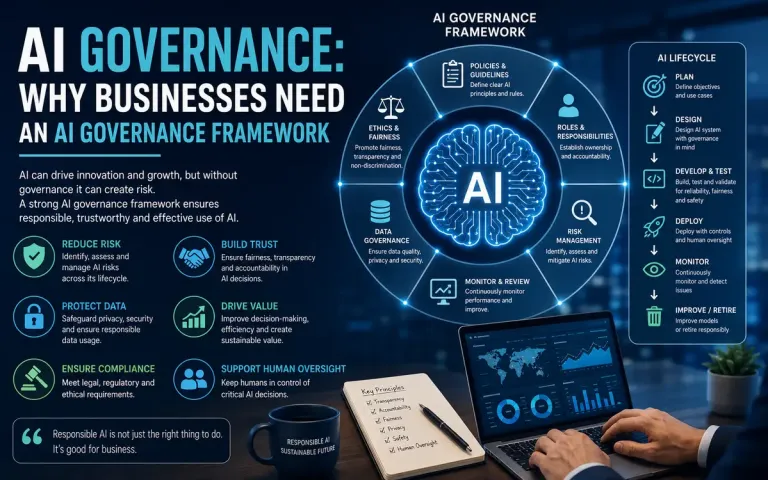
A business can develop a practical governance framework around eight pillars:
Pillar 1: Governance and Leadership
Establish ownership, responsibilities, policies, and decision-making authority.
Pillar 2: AI Inventory
Identify all AI systems being developed, purchased, or used.
Pillar 3: Risk Classification
Classify AI systems according to their potential impact and risk.
Pillar 4: Data Governance
Control data quality, privacy, security, access, and provenance.
Pillar 5: Responsible AI
Address fairness, transparency, explainability, accountability, and human oversight.
Pillar 6: Security and Compliance
Integrate AI into cybersecurity, legal, regulatory, and compliance processes.
Pillar 7: Monitoring and Incident Management
Continuously evaluate AI performance and establish procedures for handling failures.
Pillar 8: AI Literacy
Train employees to use AI responsibly and effectively.
Together, these pillars create an organizational system for managing AI rather than treating each AI project as an isolated technology initiative.
20. AI Governance Lifecycle
AI governance can be visualized as a continuous lifecycle:
Identify → Assess → Approve → Develop/Acquire → Test → Deploy → Monitor → Review → Improve/Retire
Identify
Determine where AI is being used.
Assess
Evaluate risks, benefits, data, and stakeholders.
Approve
Determine whether the AI application meets organizational requirements.
Develop or Acquire
Build the system internally or select an appropriate vendor.
Test
Evaluate performance, safety, security, fairness, and reliability.
Deploy
Introduce the system with appropriate controls and human oversight.
Monitor
Continuously evaluate performance and emerging risks.
Review
Conduct periodic governance reviews.
Improve or Retire
Modify, retrain, replace, or discontinue the system when necessary.
This lifecycle approach prevents AI governance from becoming a one-time compliance exercise.
21. Benefits of an AI Governance Framework
A properly designed AI governance framework can provide several business benefits.
21.1 Reduced Risk
Governance helps identify problems before they become major incidents.
21.2 Improved Trust
Customers, employees, investors, and business partners are more likely to trust organizations that demonstrate responsible AI practices.
21.3 Better Decision-Making
Clear accountability and human oversight can reduce inappropriate reliance on AI outputs.
21.4 Regulatory Readiness
A governance structure can help organizations respond more effectively to evolving legal and regulatory requirements.
21.5 Improved AI Quality
Testing, monitoring, and data governance can improve the reliability of AI systems.
21.6 Responsible Innovation
Governance does not have to stop innovation. Instead, it can create a controlled environment in which organizations can experiment while managing risk.
21.7 Competitive Advantage
Organizations that successfully combine AI innovation with responsible governance may gain a stronger reputation and greater long-term resilience.
22. Challenges in Implementing AI Governance
Despite its importance, implementing AI governance is not easy.
22.1 Rapid Technological Change
AI technologies evolve extremely quickly. Governance policies must therefore be flexible enough to adapt.
22.2 Lack of Expertise
Many organizations do not have sufficient AI, data, legal, and risk-management expertise.
22.3 Shadow AI
Employees may independently adopt AI tools without informing IT or management.
22.4 Cost
Testing, monitoring, auditing, security, and compliance can require additional investment.
22.5 Organizational Resistance
Employees may perceive governance as a restriction on innovation.
22.6 Fragmented Responsibility
AI often crosses organizational boundaries, making ownership difficult to establish.
These challenges reinforce the need for a risk-based and proportionate governance model rather than excessive bureaucracy.
23. How Small Businesses Can Implement AI Governance
AI governance is not only for large corporations.
A small business can begin with a simple framework.
Step 1: Create an AI Usage Policy
Define what employees can and cannot do with AI.
Step 2: Create an AI Tool Register
Maintain a list of approved AI tools.
Step 3: Protect Confidential Data
Clearly identify information that employees cannot upload to external AI systems.
Step 4: Require Human Verification
Require employees to review important AI-generated content before publication or business use.
Step 5: Establish Basic Risk Categories
Classify AI use as low, medium, or high risk.
Step 6: Train Employees
Provide basic AI literacy and responsible-use training.
Step 7: Review Regularly
Review AI tools and policies periodically as technology and regulations change.
A small business does not need a large AI governance department to begin governing AI responsibly.
24. Example: AI Governance in a Marketing Department
Consider a company using generative AI to create marketing content.
Without governance, employees may:
Upload customer information
Publish inaccurate claims
Generate copyrighted material
Produce biased advertising
Publish AI-generated content without verification
With an AI governance framework, the organization can establish:
Policy: Confidential customer data cannot be entered into public AI tools.
Process: AI-generated marketing content must be reviewed by an employee.
Control: Marketing claims must be verified against approved sources.
Monitoring: Periodic audits check how AI tools are being used.
Accountability: A marketing manager remains responsible for published content.
The result is not the elimination of AI.
Instead, the organization creates a controlled environment for productive AI use.
25. AI Governance and Competitive Advantage
AI governance is sometimes perceived as a barrier to innovation.
This is a misconception.
Poor governance can create:
Risk → Incidents → Loss of Trust → Financial and Reputational Costs
Effective governance can create:
Responsible Innovation → Trust → Sustainable AI Adoption → Long-Term Value
Organizations need both AI innovation and AI governance.
The objective should not be:
> “Use as much AI as possible.”
Instead, the objective should be:
> “Use AI where it creates meaningful value while managing the risks it introduces.”
26. The Future of AI Governance
AI governance will become increasingly important as AI systems become more autonomous and integrated into business processes.
Future governance is likely to focus increasingly on:
AI agents
Autonomous decision-making
Generative AI
Synthetic data
AI-generated media
Algorithmic accountability
AI cybersecurity
Model transparency
Continuous AI monitoring
Human-AI collaboration
The emergence of AI agents is particularly important because an AI system that can independently execute multiple tasks creates different governance requirements from a system that merely provides information.
Organizations may therefore need governance mechanisms that monitor not only what an AI system predicts, but also what actions an AI system is authorized to take.
Conclusion
Artificial Intelligence offers organizations enormous opportunities to improve productivity, innovation, customer experience, forecasting, and decision-making. However, the increasing use of AI also creates risks involving privacy, cybersecurity, bias, inaccurate information, accountability, intellectual property, and regulatory compliance.
This is why AI governance is becoming a strategic management requirement rather than merely an IT concern.
An effective AI governance framework establishes clear responsibilities, classifies AI risks, protects data, promotes transparency, requires appropriate human oversight, manages vendors, monitors AI performance, and provides mechanisms for handling incidents.
Frameworks such as the NIST AI Risk Management Framework and ISO/IEC 42001 provide organizations with useful foundations for developing structured AI governance practices.
Ultimately, responsible AI does not mean avoiding AI. It means creating the organizational capability to innovate with AI while understanding, managing, and continuously monitoring its risks.
The organizations most likely to benefit from AI in the long term will not necessarily be those that adopt AI the fastest. They will be those that learn to combine innovation, governance, accountability, and human judgment.
Related articles:-
Responsible AI: Principles, Practices and Business Importance
AI Bias: Causes, Examples, Risks and How to Reduce It
AI and Cybersecurity: How Artificial Intelligence Is Changing Digital Security
AI Hallucinations: Why AI Can Generate Incorrect Information and How to Verify It