Introduction
Artificial Intelligence (AI) is rapidly transforming the way businesses operate, compete, and make decisions. From chatbots and personalized marketing to predictive analytics, recruitment, fraud detection, and automated business processes, AI is becoming an integral part of modern organizations. However, as businesses increasingly depend on AI, a critical question is emerging: How can organizations use AI responsibly while maximizing its benefits and minimizing its risks?
AI systems can improve efficiency, reduce costs, analyze large volumes of data, and support better decision-making. At the same time, poorly designed or improperly used AI can create serious challenges, including biased decisions, privacy violations, security vulnerabilities, inaccurate information, lack of transparency, and reputational damage. These challenges make it necessary for organizations to consider not only what AI can do, but also what it should do.
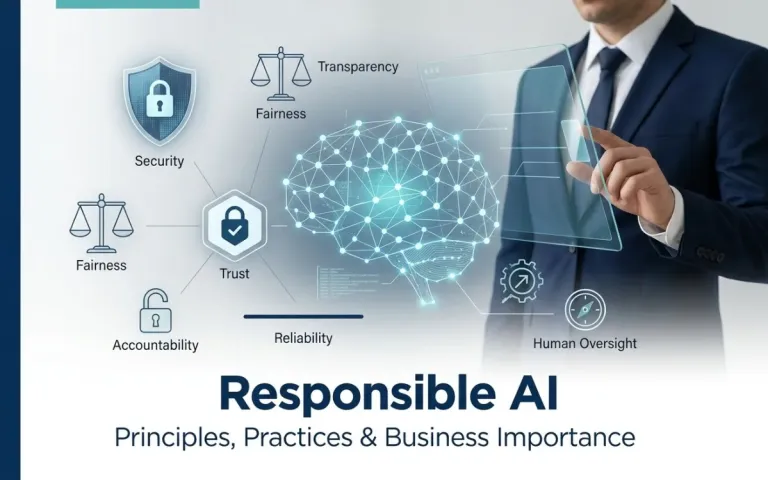
This is where Responsible AI becomes important. Responsible AI refers to the development, deployment, and use of artificial intelligence in a manner that promotes fairness, transparency, accountability, privacy, security, reliability, human oversight, and respect for individuals and society. It shifts the focus from AI innovation alone toward trustworthy and sustainable AI adoption.
For businesses, Responsible AI should not be viewed simply as an ethical concern or a compliance requirement. It is increasingly becoming a strategic business issue. Organizations that establish appropriate governance, risk-management practices, human oversight, and responsible data practices can build greater trust among customers, employees, and other stakeholders while reducing potential AI-related risks.
As AI continues to evolve, responsible adoption will become increasingly important for businesses of every size. Understanding the principles, practices, and business importance of Responsible AI can help organizations use artificial intelligence not only more effectively, but also more safely and sustainably.
A Practical Guide to Responsible AI
To understand Responsible AI from both a business and technology perspective, this article covers:
What Responsible AI means
Why Responsible AI matters
Key principles of Responsible AI
Responsible AI throughout the AI lifecycle
Practical Responsible AI practices
Responsible AI and Generative AI
Business importance and benefits
Responsible AI for small businesses
Challenges in implementation
The future of Responsible AI
The objective is not simply to understand the concept but to provide a practical framework that businesses can use when adopting AI.
What Is Responsible AI?
Responsible AI is the practice of developing, deploying, and using artificial intelligence in ways that are trustworthy, fair, secure, transparent, accountable, and aligned with human and organizational values.
It considers the potential impact of AI throughout its lifecycle rather than focusing only on technical performance.
Responsible AI asks businesses to consider questions such as:
Is the AI system accurate enough for its intended purpose?
Could it produce biased or discriminatory outcomes?
Is personal or confidential information protected?
Can users understand how the system is being used?
Who is responsible when something goes wrong?
Is human oversight necessary?
Can the system be monitored and controlled?
What happens when the AI produces an incorrect result?
Therefore, Responsible AI is broader than simply building an AI model.
It involves technology, people, processes, governance, and business responsibility.
Why Does Responsible AI Matter?
AI can provide significant benefits, but it can also introduce new forms of risk.
Consider an organization using AI to screen job applications. If the system learns from historical data containing biased hiring patterns, it may reproduce those patterns.
Similarly, a generative AI tool could produce convincing but inaccurate information. An employee could unintentionally expose confidential business information by entering it into an unauthorized AI platform.
These examples show that AI risks can extend beyond technical problems.
They may affect:
Customers
Employees
Business partners
Company reputation
Data privacy
Cybersecurity
Intellectual property
Regulatory compliance
Financial performance
Responsible AI provides a structured way for organizations to identify and manage these risks while continuing to benefit from AI technology.
Key Principles of Responsible AI
Responsible AI is based on several interconnected principles.
1. Fairness
AI systems should be designed and evaluated to reduce unjustified bias and discriminatory outcomes.
AI learns from data. If the data contains historical or systemic bias, an AI system may reproduce or amplify it.
Businesses should therefore:
Examine datasets for potential bias
Test AI systems across relevant groups
Monitor outcomes after deployment
Investigate unexpected disparities
Correct problems when they are identified
Fairness is particularly important in areas such as recruitment, lending, insurance, education, and employee management.
2. Transparency
People should have appropriate information about the use of AI.
For example, businesses may need to communicate when:
A customer is interacting with an AI chatbot
AI is being used to generate content
AI is influencing a business decision
Automated systems are evaluating applications
Transparency helps stakeholders understand the role AI plays in a process and can strengthen trust.
3. Explainability
AI systems sometimes produce results that are difficult for people to understand.
Consider an AI system that recommends rejecting a loan application.
The affected customer may reasonably ask:
Why was my application rejected?
For low-risk applications, a simple explanation may be sufficient. For high-impact decisions, organizations may need stronger explanations and human review.
Explainability should therefore be appropriate to the risk and context of the AI application.
4. Accountability
Organizations should not treat AI as an independent decision-maker that carries responsibility for its own actions.
A business remains responsible for how it designs, selects, deploys, and manages AI systems.
Organizations should clearly establish:
Who owns the AI system?
Who approved its deployment?
Who monitors it?
Who handles complaints?
Who investigates failures?
Who can override the system?
Who can stop the system when necessary?
Clear accountability is essential for effective AI governance.
5. Privacy
AI systems often depend on large amounts of data.
This may include:
Customer information
Employee information
Financial information
Business documents
Communication records
Behavioral data
Personal information
Businesses should understand what data is being collected, why it is being used, who can access it, and how it is protected.
Employees should also receive clear guidance about what information they are permitted to enter into external AI tools.
6. Security
AI systems must be protected against unauthorized access, manipulation, and misuse.
Potential security risks include:
Data leakage
Unauthorized access
Prompt injection
Malicious inputs
Model manipulation
Supply-chain vulnerabilities
Exposure of confidential information
Security should therefore be considered throughout the AI lifecycle rather than added after the system has already been deployed.
7. Safety and Reliability
AI systems should perform reliably within their intended environment.
Organizations should test:
Accuracy
Reliability
Failure conditions
Unusual inputs
Model limitations
Performance over time
This is particularly important when AI outputs influence important business decisions.
For example, a generative AI system may provide an answer that sounds convincing but is factually incorrect. Businesses must therefore distinguish between confidence of presentation and accuracy of information.
8. Human Oversight
Responsible AI does not mean removing humans from every process.
In many situations, AI should support human decision-making rather than replace human responsibility.
A useful approach for higher-risk decisions is:
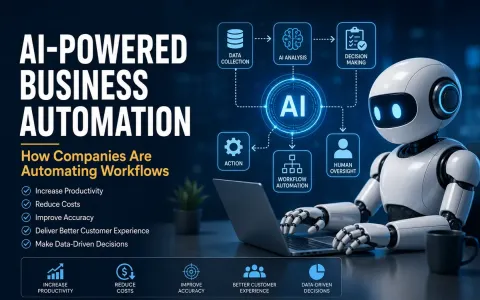
AI Recommendation → Human Review → Final Decision
Human oversight can be particularly important in:
Recruitment
Financial services
Healthcare
Education
Insurance
Legal services
Employee evaluation
The appropriate level of human involvement depends on the potential impact of the AI system.
9. Inclusiveness and Accessibility
AI should be designed to serve diverse users.
Organizations should consider whether their systems work effectively for people with different:
Languages
Abilities
Cultural backgrounds
Levels of digital literacy
User requirements
A system that works well for one group but poorly for another may unintentionally create exclusion.
10. Sustainability
Responsible AI also involves considering the environmental and resource implications of AI.
Large AI models can require significant computing resources.
Businesses can consider:
Computational efficiency
Model size
Infrastructure requirements
Energy consumption
Hardware utilization
The objective is to achieve useful AI outcomes while using resources efficiently.
Responsible AI Throughout the AI Lifecycle
Responsible AI should not be treated as a one-time activity.
It should be incorporated throughout the AI lifecycle.
Stage 1: Identify the Business Problem
Before implementing AI, organizations should ask:
Do we actually need AI?
Not every business problem requires artificial intelligence.
Sometimes a traditional software application, database, workflow automation, or analytical solution may be more appropriate.
Stage 2: Collect and Prepare Data
Organizations should evaluate:
Data quality
Data sources
Data permissions
Privacy
Bias
Completeness
Relevance
The principle is simple:
Poor-quality or inappropriate data can lead to poor AI outcomes.
Stage 3: Select or Develop the AI System
At this stage, businesses should evaluate:
Accuracy
Security
Explainability
Bias
Privacy
Vendor reliability
Integration risks
Intended use
When using third-party AI services, businesses should also understand the provider's responsibilities and limitations.
Stage 4: Test the AI System
Before deployment, organizations should test the system in realistic conditions.
Testing may include:
Accuracy testing
Bias testing
Security testing
Privacy testing
Stress testing
Adversarial testing
Human evaluation
Testing should reflect real-world business scenarios.
Stage 5: Deploy With Appropriate Controls
Deployment should include safeguards appropriate to the risk.
These may include:
Access controls
Human approval
Logging
Monitoring
Data protection
Error handling
Escalation procedures
Stage 6: Monitor Continuously
AI systems can change in performance as data, users, business conditions, or models change.
Therefore, organizations should continuously monitor:
Accuracy
Reliability
Bias
Security
User feedback
Unexpected behavior
AI-related incidents
Responsible AI is therefore an ongoing process rather than a one-time project.
Practical Responsible AI Practices for Businesses
Businesses can convert Responsible AI principles into practical processes.
1. Create an AI Governance Policy
An AI policy should define how employees can use AI.
It may address:
Approved AI tools
Prohibited uses
Confidential data
Personal information
AI-generated content
Human verification
Security
Accountability
Even small businesses can begin with a simple internal policy.
2. Maintain an AI Inventory
Organizations should know where AI is being used.
For example:
| AI Application | Department | Purpose | Risk Level | Human Oversight |
|---|---|---|---|---|
| Customer chatbot | Customer Service | Support | Medium | Yes |
| Content assistant | Marketing | Content creation | Low | Yes |
| Recruitment system | HR | Candidate screening | High | Required |
| Sales forecasting | Sales | Demand prediction | Medium | Yes |
An AI inventory makes AI usage easier to manage and govern.
3. Conduct AI Risk Assessments
Before deploying an AI application, businesses should evaluate:
Data Risk: Could confidential or personal information be exposed?
Bias Risk: Could the system create unfair outcomes?
Accuracy Risk: What happens if the AI is wrong?
Security Risk: Could the system be manipulated?
Legal Risk: Could the application create legal or intellectual-property concerns?
Reputation Risk: Could inappropriate AI output damage the brand?
Human Impact: Who could be negatively affected?
4. Establish Human Review
For high-impact applications, AI should generally provide recommendations rather than automatically making irreversible decisions.
A human should have the ability to review the output and intervene when necessary.
5. Document AI Systems
Important AI applications should have basic documentation covering:
Purpose
Data sources
AI model or vendor
Intended users
Known limitations
Risk assessment
Testing results
Human oversight
Monitoring procedures
Incident history
Documentation improves both accountability and organizational learning.
6. Train Employees
Responsible AI is not only an IT responsibility.
Employees across departments should understand:
AI capabilities
AI limitations
Privacy risks
Security risks
AI hallucinations
Bias
Appropriate AI usage
Human verification
Confidential information handling
AI literacy is therefore an important foundation for responsible AI adoption.
7. Establish an AI Incident Response Process
Organizations should have a process for dealing with AI-related problems.
A simple process could be:
Detect → Report → Investigate → Contain → Correct → Document → Monitor
Potential incidents may include:
Serious inaccurate output
Data leakage
Biased outcomes
Security incidents
Unauthorized AI usage
Harmful automated decisions
Responsible AI and Generative AI
Generative AI has made Responsible AI even more important.
Generative AI can produce:
Text
Images
Audio
Video
Software code
Reports
Marketing content
However, it can also generate inaccurate or misleading information.
Businesses should therefore establish clear guidelines for generative AI use.
Employees Should:
Verify important AI-generated information
Review generated content before publication
Protect confidential information
Follow organizational AI policies
Use human judgment
Disclose AI use where appropriate
Employees Should Not:
Upload confidential information into unauthorized AI services
Assume AI-generated information is automatically correct
Allow AI to make sensitive decisions without appropriate oversight
Publish unverified AI-generated claims
Use AI to bypass organizational security controls
Business Importance of Responsible AI
Responsible AI can provide significant business value.
1. Builds Customer Trust
Customers want to know how organizations use their information and AI technologies.
Responsible practices can increase confidence in AI-enabled products and services.
2. Reduces Risk
AI governance can help organizations identify and manage:
Privacy risks
Security risks
Operational risks
Compliance risks
Reputation risks
3. Improves Decision-Making
AI can process large amounts of information quickly.
When AI is combined with reliable data, appropriate models, and human expertise, it can support better decision-making.
4. Protects Brand Reputation
AI-related incidents can quickly damage customer confidence.
Examples include:
Offensive chatbot responses
Incorrect automated decisions
Discriminatory recommendations
Customer-data exposure
False AI-generated claims
Responsible AI practices can reduce the likelihood and impact of such incidents.
5. Supports Sustainable AI Adoption
Organizations with appropriate governance can experiment with and scale AI more confidently.
Instead of asking only:
“Can we deploy this AI system?”
responsible organizations ask:
“Can we deploy this AI system safely, appropriately, and sustainably?”
That is an important shift in business thinking.
Responsible AI for Small Businesses
Responsible AI is not only relevant to large corporations.
Small and medium-sized businesses can start with simple measures.
A Small Business Can:
Create an internal AI usage policy.
Identify the AI tools employees are using.
Restrict confidential information from being entered into unauthorized AI tools.
Require human verification of important AI-generated information.
Assess privacy, security, and bias risks.
Maintain basic documentation.
Train employees in responsible AI use.
Review the AI policy periodically.
These steps can create a basic AI governance foundation without requiring a large dedicated team.
Responsible AI vs Traditional AI Adoption
The difference can be summarized as follows:
| Traditional AI Adoption | Responsible AI Adoption |
|---|---|
| Focuses primarily on performance | Focuses on performance and trust |
| Asks, "Can we build it?" | Asks, "Should we build and deploy it?" |
| Data is primarily treated as an asset | Data is treated as both an asset and responsibility |
| Human involvement may be limited | Human oversight is considered according to risk |
| Risks may be addressed after problems occur | Risks are assessed throughout the lifecycle |
| Focuses heavily on automation | Focuses on responsible automation and augmentation |
| Success = technical performance | Success = value + trust + risk management |
Challenges in Implementing Responsible AI
Implementing Responsible AI is not always easy.
Lack of Expertise
Many businesses do not have specialists in AI governance, cybersecurity, privacy, and AI ethics.
Rapid Technological Change
AI technology is evolving quickly, making it difficult for organizational policies to remain current.
Balancing Different Objectives
Organizations may have to balance accuracy, transparency, privacy, security, fairness, cost, and performance.
There may not always be a perfect solution.
Vendor Dependence
Businesses increasingly rely on external AI providers. This makes vendor evaluation and contractual responsibilities important components of AI governance.
Measuring Responsibility
Concepts such as fairness, trust, and explainability can be difficult to reduce to a single numerical measurement.
Therefore, Responsible AI should be viewed as a continuous management and governance process.
A Simple Responsible AI Framework
Businesses looking for a practical starting point can use the following five-step framework:
1. Govern
Establish policies, responsibilities, ownership, and accountability.
2. Review
Examine the proposed AI application and its intended purpose.
3. Assess
Evaluate data, privacy, security, fairness, accuracy, and potential impact.
4. Implement
Deploy appropriate safeguards, controls, and human oversight.
5. Monitor
Continuously evaluate performance, incidents, risks, and changing conditions.
The Framework
Govern → Review → Assess → Implement → Monitor
This simple framework can help businesses move from AI experimentation to responsible AI adoption.
The Future of Responsible AI
As artificial intelligence becomes increasingly embedded in business processes, Responsible AI is likely to become an important part of organizational governance.
Businesses may increasingly establish:
AI governance committees
AI inventories
AI risk assessments
AI policies
Model monitoring systems
AI audits
Employee AI training
AI incident-response processes
Vendor AI assessments
The importance of Responsible AI is also reflected in major international and national frameworks. NIST's AI Risk Management Framework provides organizations with a structured approach to managing AI risks, while the OECD AI Principles emphasize trustworthy and human-centered AI. UNESCO's Recommendation on the Ethics of Artificial Intelligence places human rights and human dignity at the center of AI ethics.
The direction is clear: AI adoption is moving beyond experimentation toward governance, accountability, and trust.
Conclusion
Responsible AI is about making artificial intelligence useful without losing sight of responsibility.
Businesses should not view Responsible AI as an obstacle to innovation. Instead, it can provide the foundation for trustworthy, secure, and sustainable AI adoption.
The objective is not to eliminate every possible AI risk. Rather, organizations should develop processes to:
Identify risks → Reduce risks → Monitor risks → Maintain human accountability.
As AI becomes an essential business capability, organizations that combine technological innovation with fairness, transparency, privacy, security, human oversight, and accountability will be better positioned to build long-term trust.
Ultimately, the competitive advantage of the future may not come simply from who uses AI first, but from who uses AI responsibly and effectively.
Frequently Asked Questions
What is Responsible AI?
Responsible AI is the development, deployment, and use of artificial intelligence in ways that promote trustworthy outcomes while addressing issues such as fairness, transparency, privacy, security, accountability, safety, and human oversight.
What are the main principles of Responsible AI?
The major principles include fairness, transparency, explainability, accountability, privacy, security, safety, reliability, human oversight, inclusiveness, and sustainability.
Why is Responsible AI important for businesses?
Responsible AI helps organizations manage AI-related risks while building trust, protecting their reputation, improving decision-making, and supporting sustainable AI adoption.
Is Responsible AI only for large companies?
No. Small businesses can also implement basic Responsible AI practices through AI policies, employee training, risk assessments, human review, and responsible data management.
What is the relationship between Responsible AI and AI governance?
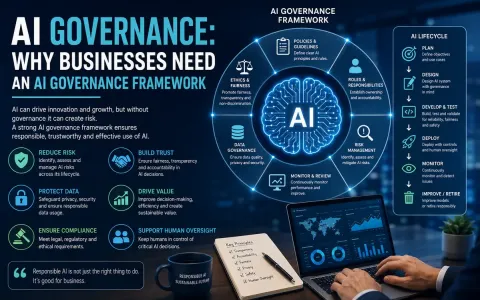
AI governance provides the organizational structures, policies, responsibilities, and controls through which Responsible AI principles can be implemented and managed.
Is Responsible AI the same as AI ethics?
They overlap but are not exactly the same. AI ethics focuses strongly on values, rights, fairness, and societal impacts, while Responsible AI also emphasizes practical governance, risk management, technical controls, monitoring, and accountability.
Related articles:-
AI Governance: Why Businesses Need an AI Governance Framework
AI in Business Intelligence and Predictive Analytics
AI Bias: Causes, Examples, Risks and How to Reduce It
AI Hallucinations: Why AI Can Generate Incorrect Information and How to Verify It
AI and Cybersecurity: How Artificial Intelligence Is Changing Digital Security