Introduction
Artificial Intelligence has become an increasingly important part of education, business, research, software development, marketing, and everyday decision-making. AI tools can write articles, answer questions, summarize documents, generate code, analyze data, and assist with problem-solving. However, one of the most important limitations of generative AI is that it can sometimes produce information that sounds convincing but is inaccurate, misleading, unsupported, or completely fabricated.
This phenomenon is commonly known as AI hallucination.
Understanding why hallucinations occur—and learning how to verify AI-generated information—is essential for anyone using AI responsibly. AI should be treated as a powerful assistant, not as an unquestionable source of truth.
What Is an AI Hallucination?
An AI hallucination occurs when an artificial intelligence system generates information that is false, fabricated, unsupported, or inconsistent with reliable evidence while presenting it as if it were correct.
For example, an AI system may:
Invent a book, research paper, or website that does not exist.
Provide a false statistic.
Attribute a quotation to the wrong person.
Create fictional references or citations.
Give an incorrect explanation of an event.
Confuse two people, companies, places, or concepts.
Produce computer code that looks correct but does not work.
Give a confident answer to a question when it does not actually have sufficient information.
The term hallucination is widely used, although some organizations use terms such as confabulation or fabrication. NIST describes confabulation as a situation in which generative AI produces and confidently presents erroneous or false content, including content that may contradict the user's input or the model's own earlier statements.
The important point is that AI does not need to be intentionally deceptive to produce a hallucination. In many cases, it is simply generating the most plausible continuation of text based on patterns it has learned.
A Simple Example of AI Hallucination
Imagine asking an AI:
“Who wrote the book The Future of Quantum Marketing, published in 2018?”
Suppose no such book actually exists. Instead of saying, “I cannot find evidence that this book exists,” an AI might generate something like:
“The book was written by Dr. John Smith and published in 2018 by Global Business Press.”
The answer may sound professional and believable. It may even include a detailed biography of the fictional author.
However, the entire answer could be fabricated.
This is a key danger of AI hallucinations: fluency is not the same as factual accuracy.
Why Do AI Systems Hallucinate?
To understand AI hallucinations, it is important to understand how large language models work.
Generative AI models do not function exactly like databases that simply retrieve verified facts. A language model is designed to recognize patterns in enormous amounts of data and generate a probable continuation based on the context it receives.
In simplified terms, a language model repeatedly predicts:
What is the most likely next word or token given the words that came before it?
This process can produce highly useful and accurate responses. However, predicting a plausible sequence of words is not identical to determining whether every statement is true.
OpenAI's research explains that hallucinations can arise from the statistical nature of next-word prediction, particularly for arbitrary or low-frequency facts that cannot be reliably inferred from general linguistic patterns. It also argues that evaluation systems can unintentionally encourage models to guess rather than acknowledge uncertainty.
Several important factors contribute to AI hallucinations.
1. AI Is Designed to Generate Plausible Responses
A generative AI model is fundamentally optimized to produce a response that fits the context of the conversation.
Suppose you ask:
“Provide five research studies proving that Company X will dominate the global market by 2030.”
If reliable studies supporting this claim do not exist, the AI may still attempt to satisfy the request by generating plausible-looking studies, researchers, or statistics.
The system is responding to the pattern and structure of the request. Without adequate grounding in reliable, current sources, generating a fluent answer can sometimes lead to generating an incorrect one.
This is why a well-written AI response should never be judged only by its confidence or level of detail.
A detailed answer can still be wrong.
2. Incomplete or Limited Information
No AI model has perfect knowledge of everything.
Some information may be:
Rare or poorly documented.
Missing from the model's training data.
Too recent to be included in its underlying knowledge.
Ambiguous or difficult to interpret.
Available only in private documents or specialized databases.
Changed after the model acquired its knowledge.
When information is incomplete, the model may attempt to fill the gap with a statistically plausible answer.
For example, if asked about an obscure researcher, a small local company, or a newly announced product, the AI may combine fragments of related information and produce an answer that sounds reasonable but is inaccurate.
3. Outdated Information
The world changes continuously.
Company CEOs change. Government policies change. Product specifications change. Prices change. Research findings evolve. Websites disappear or are updated.
An AI model that does not have access to current information may provide an answer that was once accurate but is no longer correct.
For example, asking:
Who is the current CEO of a company?
What is the latest government policy?
What is the current market price?
Who won a recent election?
What are the latest features of a software product?
can require current verification.
This is why time-sensitive information should be checked against recent and authoritative sources rather than accepted solely from an AI-generated response.
4. Poor or Inaccurate Training Data
AI systems learn patterns from large amounts of data. If the underlying information contains errors, bias, contradictions, or misinformation, these problems can influence the model's output.
Research into knowledge-grounded conversational models has also found that problems in datasets can contribute to and amplify hallucinated responses.
Therefore, a model can sometimes reproduce or recombine inaccurate information rather than independently determining the truth.
AI does not automatically know which statement in its training data was historically correct, misleading, outdated, or controversial.
5. Ambiguous or Poorly Written Prompts
Sometimes the problem is not entirely the AI model. An unclear prompt can increase the possibility of an incorrect answer.
For example:
“Tell me about the best strategy.”
This question is ambiguous.
Best strategy for what?
Marketing?
Business growth?
SEO?
Investment?
Competitive advantage?
Without sufficient context, the AI must make assumptions. If those assumptions are incorrect, the response may become irrelevant or misleading.
A more specific prompt would be:
“Explain three digital marketing strategies suitable for a small e-commerce business selling affordable consumer products in India.”
The second prompt provides clearer context and reduces the amount of guessing required.
6. Pressure to Provide an Answer
Language models are often expected to answer questions helpfully. However, there is an important difference between:
“I know the answer.”
and
“I can generate something that sounds like an answer.”
Research has highlighted that some traditional evaluation approaches can reward answering correctly when possible without sufficiently penalizing guessing when the model is uncertain. This creates an incentive for systems to attempt an answer rather than abstain. OpenAI argues that incorrect confident answers should be treated as more problematic than an appropriate admission of uncertainty.
A responsible AI system should sometimes say:
“I am not certain.”
or:
“I could not verify this information.”
In many situations, an honest admission of uncertainty is more valuable than a confident but false answer.
7. Complex Reasoning and Calculation Errors
AI hallucinations are not limited to factual information.
An AI may also make mistakes in:
Mathematical calculations.
Logical reasoning.
Data interpretation.
Legal analysis.
Financial analysis.
Scientific explanations.
Programming.
A response may begin with correct information but make an incorrect assumption halfway through the reasoning process.
For this reason, complex calculations and important analytical conclusions should be independently checked.
Common Types of AI Hallucinations
AI hallucinations can appear in several forms.
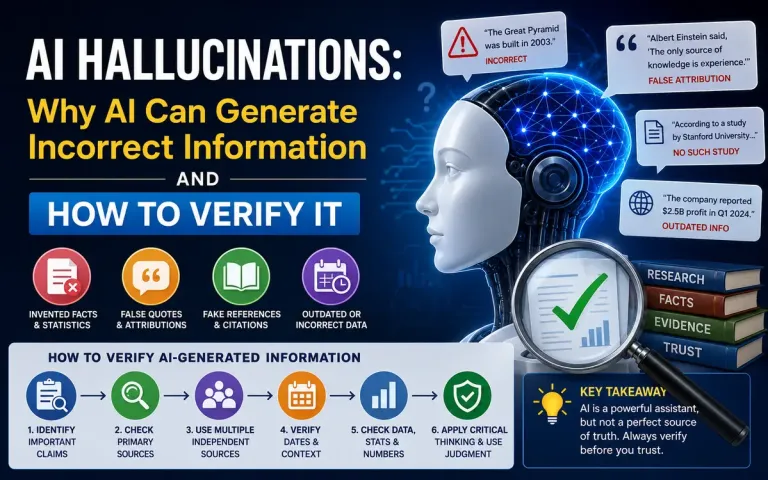
1. Fabricated Facts
The AI invents information that is presented as a real fact.
Example:
“The company was founded in 1987.”
The actual founding year may be completely different.
2. Fake References and Citations
This is particularly dangerous for students, researchers, and academics.
An AI may generate:
A nonexistent journal article.
A fictional book.
An incorrect DOI.
A fake author.
A citation that combines details from several real sources.
The reference may look academically correct while being entirely fabricated.
3. Incorrect Attribution
AI may attribute a quotation, theory, or concept to the wrong person.
For example, it may state:
“Peter Drucker developed this concept.”
when the concept was actually developed by another scholar.
4. Incorrect Statistics
AI can generate highly specific numbers that appear authoritative.
For example:
“According to a 2025 survey, 78.4% of companies use AI.”
Unless the source, methodology, sample size, and publication can be verified, such a statistic should not automatically be trusted.
Specificity does not guarantee accuracy.
5. Entity Confusion
AI may confuse:
Two people with similar names.
Different companies.
Similar products.
Universities or organizations with similar titles.
Events that occurred in different years.
For example, information about one organization may accidentally be attributed to another.
6. Contradictory Information
An AI may provide one answer and later provide a conflicting answer when asked the same question differently.
This can happen because the model generates responses dynamically rather than simply retrieving a fixed answer from a database.
7. Hallucinated Code
AI-generated programming code can look technically correct while containing:
Nonexistent functions.
Incorrect parameters.
Outdated library methods.
Security vulnerabilities.
Logical errors.
References to packages that do not exist.
Developers should test AI-generated code rather than deploying it without review.
Why AI Hallucinations Can Be Dangerous
The consequences depend on how AI is being used.
A hallucination in a creative story may not be a serious problem. A hallucination in a medical, legal, financial, academic, or business decision can have much more serious consequences.
Potential risks include:
Academic Risk
A student may submit fake references generated by AI.
Business Risk
A manager may make a decision based on incorrect market information.
Legal Risk
Incorrect legal information may lead to poor decisions or compliance problems.
Financial Risk
False financial data or investment information can result in financial losses.
Technical Risk
Incorrect AI-generated code may introduce software failures or security vulnerabilities.
Reputational Risk
Publishing AI-generated misinformation can damage the credibility of an individual or organization.
Because of these risks, higher-stakes applications require stronger verification and human oversight. OpenAI has similarly noted that language model outputs should be handled with particular care in high-stakes contexts and may require human review or grounding with additional information.
How to Verify AI-Generated Information
The best defense against AI hallucinations is verification.
AI can be extremely useful for generating ideas, explanations, drafts, summaries, and starting points for research. However, important factual claims should be checked.
Here is a practical verification process.
Step 1: Identify the Important Claims
Do not try to verify every ordinary sentence.
Instead, identify claims that could materially affect your decision or publication.
Pay particular attention to:
Names.
Dates.
Statistics.
Research findings.
Quotations.
Laws and regulations.
Financial information.
Historical events.
Technical specifications.
References and citations.
For example, in the sentence:
“A 2024 study by XYZ University found that AI increased employee productivity by 47%.”
There are several claims to verify:
Did the study actually exist?
Was it published in 2024?
Was it conducted by XYZ University?
Did it actually report a 47% increase?
What methodology was used?
Breaking a statement into smaller claims makes verification easier.
Step 2: Ask AI to Provide Sources
Instead of asking:
“Explain the impact of AI on employment.”
Try:
“Explain the impact of AI on employment and provide reliable sources for each major factual claim.”
However, this does not mean that AI-generated citations should automatically be trusted.
You should independently verify that:
The source exists.
The author is correct.
The publication is genuine.
The cited source actually supports the claim.
The information has not been misrepresented.
A citation is evidence only when the underlying source is real and relevant.
Step 3: Check Primary Sources
Whenever possible, verify information from the original or primary source.
For example:
| Information | Preferred Source |
|---|---|
| Research finding | Original research paper |
| Government policy | Official government website |
| Company information | Official company website or filing |
| Financial results | Official financial report |
| Software documentation | Official documentation |
| Product specifications | Manufacturer's official website |
| Academic statistics | Original dataset or research report |
Primary sources generally provide stronger evidence than an unsupported summary copied across multiple websites.
Step 4: Use Multiple Independent Sources
Do not rely entirely on a single source, especially for important claims.
Compare information across multiple reliable and independent sources.
For example, if AI states that a government introduced a new policy, verify it through:
The official government source.
A reputable news organization.
An official notification, document, or publication.
If all reliable sources support the same conclusion, confidence in the information increases.
However, simply finding the same claim repeated across many websites is not always sufficient. Multiple websites may be repeating the same original error.
Step 5: Verify Numbers Carefully
Statistics can be particularly misleading because precise numbers often appear trustworthy.
Whenever AI provides a statistic, ask:
Who collected the data?
When was the data collected?
How large was the sample?
What population was studied?
What methodology was used?
Does the original source actually report this number?
For example:
“75% of consumers prefer AI-powered customer service.”
This statement is incomplete without knowing:
Which consumers?
In which country?
How many people participated?
When was the survey conducted?
What exactly does “prefer” mean?
Numbers require context.
Step 6: Check Dates and Current Information
Information about current events can quickly become outdated.
Before using information containing terms such as:
Current
Latest
Today
Recently
New
This year
check a recent and authoritative source.
This is particularly important for:
Government policies.
Technology products.
Company leadership.
Market prices.
Elections.
Laws and regulations.
Software updates.
Economic data.
Step 7: Test AI-Generated Code and Calculations
Never assume that code works simply because it looks professional.
For AI-generated code:
Run the code.
Test expected outputs.
Check error handling.
Review security implications.
Consult official documentation.
Verify library and API functions.
For calculations:
Perform the calculation independently.
Use a calculator or spreadsheet.
Check formulas and units.
Review assumptions.
AI-generated reasoning should be treated as something to evaluate, not automatically accept.
Step 8: Look for Warning Signs
Certain characteristics should make you more cautious.
Warning signs include:
Extremely specific information without a source.
A citation that cannot be found.
A quotation without a verifiable origin.
Unusual or suspiciously perfect statistics.
A confident answer to an obscure question.
Contradictory information.
Sources with vague names.
A claim that appears nowhere else.
A response that refuses to acknowledge uncertainty.
When something sounds impressive but cannot be verified, treat it with caution.
A Practical Framework: The VERIFY Method
A simple framework for evaluating AI-generated information is VERIFY.
V – Verify the source
Check whether the original source actually exists.
E – Examine the evidence
Read the source rather than trusting the AI's summary.
R – Review the date
Make sure the information is current and relevant.
I – Identify important claims
Separate major facts, statistics, quotations, and conclusions.
F – Find independent confirmation
Check whether other reliable sources support the information.
Y – Yield to uncertainty
If reliable verification is not available, do not present the claim as an established fact.
This approach is particularly useful for students, researchers, bloggers, managers, and professionals using AI-generated content.
How to Use AI More Responsibly
AI hallucinations do not mean that AI is useless. Instead, they demonstrate the importance of using AI appropriately.
A better approach is to divide tasks into two categories.
Tasks Where AI Can Be Used More Freely
AI can be highly useful for:
Brainstorming ideas.
Creating outlines.
Improving writing.
Explaining concepts.
Generating examples.
Summarizing provided material.
Creating first drafts.
Developing alternative perspectives.
Generating practice questions.
Even in these situations, the final output should be reviewed.
Tasks That Require Strong Verification
Greater caution is required when AI is used for:
Academic research.
Medical information.
Legal advice.
Financial decisions.
Government policies.
News and current events.
Scientific claims.
Technical implementation.
Business decisions involving significant investment.
The higher the consequences of an error, the stronger the verification process should be.
Better Prompting Can Reduce Hallucinations
The way a question is asked can influence the quality of the response.
Instead of writing:
“Give me statistics about AI adoption.”
Try:
“Provide recent statistics about AI adoption. For each statistic, identify the original source and publication date. If you cannot verify a statistic, clearly state that you are uncertain.”
Similarly, instead of:
“Write references for this topic.”
Try:
“Suggest real, verifiable academic sources for this topic. Do not create or guess citations. If you are uncertain whether a source exists, say so.”
These instructions encourage the AI to distinguish between verified information and uncertainty.
Clear prompts do not eliminate hallucinations, but they can reduce unnecessary assumptions and guessing.
Can AI Hallucinations Be Completely Eliminated?
At present, hallucinations remain a fundamental challenge for generative AI systems.
Researchers and AI organizations are developing several approaches to reduce them, including:
Retrieval-Augmented Generation (RAG).
Grounding responses in reliable documents.
Web and database retrieval.
Improved training data.
Better factuality evaluation.
Uncertainty detection.
Human review.
Fact-checking systems.
Model monitoring and testing.
NIST research, for example, continues to investigate techniques for detecting hallucinations and estimating uncertainty in large language model outputs.
However, reducing hallucinations is not the same as eliminating them completely.
Even advanced AI systems can produce errors. Improvements in model capability may reduce hallucination rates, but users should not assume that a newer or more advanced model is automatically correct in every situation.
The safest approach is therefore to combine AI capability with human judgment and reliable evidence.
AI Hallucination vs Human Error
It is useful to distinguish between an AI hallucination and an ordinary human mistake.
A human may make an error because of:
Lack of knowledge.
Misunderstanding.
Carelessness.
Bias.
Incorrect reasoning.
AI can also produce incorrect information, but its errors often have a distinctive characteristic: it may generate an answer that is linguistically fluent, coherent, and highly confident despite lacking a reliable factual basis.
This makes AI hallucinations particularly difficult to detect.
A poorly written answer naturally encourages skepticism. A polished, detailed, and professional-sounding answer may not.
Therefore, users should remember an important principle:
Confidence is not evidence.
The quality of the writing does not prove the accuracy of the information.
The Role of Human Judgment
The future of AI is unlikely to involve humans simply accepting everything AI generates. A more effective model is human-AI collaboration.
AI can:
Process information quickly.
Generate multiple ideas.
Summarize large amounts of content.
Assist with writing and analysis.
Automate repetitive tasks.
Humans can:
Evaluate evidence.
Apply contextual knowledge.
Recognize consequences.
Exercise ethical judgment.
Verify critical information.
Make final decisions.
The goal should not be to replace human judgment with AI. Instead, AI should enhance human capability while humans remain responsible for evaluating important outputs.
Conclusion
AI hallucinations are one of the most important challenges associated with generative artificial intelligence. An AI system can produce information that is fluent, detailed, and convincing while still being incorrect.
Hallucinations can occur because language models generate probable patterns rather than functioning as perfect truth-verification systems. They may also result from incomplete information, outdated knowledge, inaccurate data, ambiguous prompts, complex reasoning tasks, and incentives that encourage guessing instead of admitting uncertainty.
The solution is not to stop using AI. The solution is to use it intelligently.
Users should verify important facts, check original sources, confirm statistics, review dates, compare independent sources, and treat unsupported AI-generated claims with caution.
The most important principle to remember is simple:
AI can help you find information, organize knowledge, and generate ideas—but it should not replace evidence, verification, or human judgment.
As AI becomes increasingly integrated into education, research, business, and daily life, AI literacy will include not only knowing how to use AI, but also knowing when not to trust it without verification.
Final Takeaway
Use AI for speed. Use reliable sources for truth. Use human judgment for decisions.
Related articles:-
AI and Employment: How Artificial Intelligence Is Changing Jobs and Skills
AI in Business: Applications Across Modern Organizations
Artificial Intelligence and Personal Data Privacy: Risks, Challenges, and Best Practices