Introduction
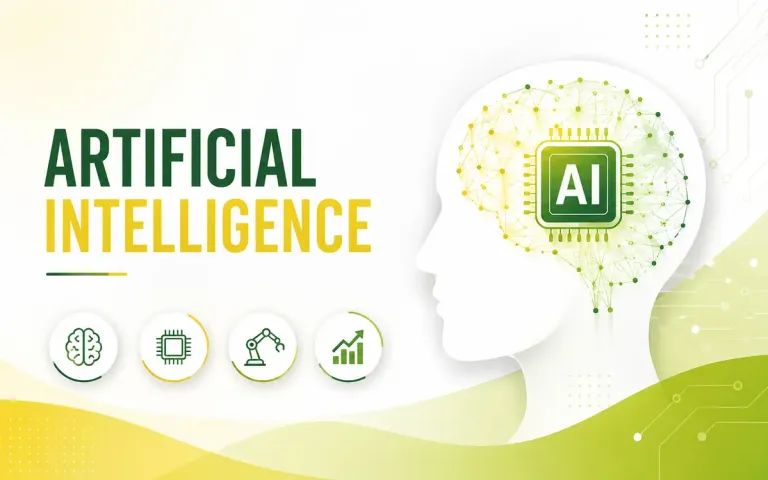
Artificial Intelligence (AI) has moved from being primarily a subject of scientific research to becoming an important part of modern technology. AI systems are now used to analyze information, recognize patterns, understand language, generate content, make predictions, automate tasks, and assist people in making decisions.
From recommendation systems and virtual assistants to generative AI and autonomous systems, artificial intelligence is increasingly influencing how individuals, businesses, and organizations use technology.
However, AI is much broader than chatbots or content-generation tools. It represents a field of computer science concerned with developing systems that can perform tasks that traditionally require aspects of human intelligence, such as learning, reasoning, perception, language understanding, and problem-solving.
Understanding AI therefore requires looking beyond individual applications and examining its fundamental concepts, major types, applications, benefits, limitations, and broader impact.
This guide provides an introduction to artificial intelligence and establishes the foundation for understanding the technologies and applications that will be explored throughout this AI series.
What Is Artificial Intelligence?
Artificial Intelligence is a field of computer science concerned with creating computational systems capable of performing tasks that involve capabilities commonly associated with human intelligence.
These capabilities can include:
- Learning from data
- Recognizing patterns
- Understanding language
- Analyzing information
- Making predictions
- Solving problems
- Supporting decisions
- Generating content
- Interacting with people
Traditional computer programs generally follow explicitly defined instructions. AI systems, particularly those based on machine learning, can instead learn patterns from data and use those patterns to produce predictions, classifications, recommendations, or other outputs.
For example, a conventional program might follow a predefined rule to identify whether a number is greater than 100. A machine-learning system, by contrast, could learn patterns from examples to classify new data.
AI is therefore not a single technology. It is an extensive field containing different approaches, methods, and technologies.
How Does Artificial Intelligence Work?
At a high level, many modern AI systems depend on data, algorithms, models, and computing resources.
Data
AI systems often require data from which patterns can be learned or against which rules and models can operate.
The data might consist of:
- Text
- Images
- Audio
- Video
- Numerical information
- Sensor data
- Business records
Algorithms
An algorithm is a defined computational procedure for solving a problem or performing a task.
In AI and machine learning, algorithms help systems learn patterns, process information, optimize performance, or produce outputs.
Models
A trained AI model represents patterns or relationships learned from data.
Once developed, a model can be used to process new information and generate an output.
For example, a model trained on large amounts of text can learn statistical relationships between words and other linguistic patterns. A model trained for image recognition can learn patterns associated with different visual categories.
Computing Power
Modern AI, particularly large-scale machine learning and generative AI, can require substantial computational resources for training and operation.
The combination of data, algorithms, models, and computing infrastructure enables modern AI systems to perform increasingly sophisticated tasks.
Types of Artificial Intelligence
AI can be classified in different ways. One common conceptual classification considers the scope of an AI system's capabilities.
Narrow or Weak AI
Narrow AI, sometimes called Weak AI, refers to AI systems designed to perform specific tasks or a relatively limited range of tasks.
Examples include:
- Recommendation systems
- Spam filters
- Image recognition systems
- Voice assistants
- Fraud detection systems
- Search ranking systems
Most AI applications currently in widespread use fall within this category.
A system may perform a particular task extremely well without possessing general human-like intelligence.
Artificial General Intelligence
Artificial General Intelligence (AGI) generally refers to a hypothetical form of AI capable of performing a broad range of intellectual tasks with a level of flexibility comparable to human intelligence.
Unlike narrow AI, AGI would not be restricted to a specific task.
AGI remains a subject of research, debate, and differing definitions. It should therefore be distinguished from AI systems that are currently deployed for specific applications.
Artificial Superintelligence
Artificial Superintelligence (ASI) refers to a hypothetical form of intelligence that would substantially exceed human intellectual capabilities across a broad range of domains.
ASI remains a theoretical concept rather than an established technology.
Discussions surrounding AGI and ASI involve significant technical, philosophical, economic, and ethical questions.
AI, Machine Learning, and Deep Learning
Artificial Intelligence, Machine Learning, and Deep Learning are related concepts, but they are not interchangeable.
Artificial Intelligence
AI is the broader field concerned with creating systems capable of performing tasks associated with intelligent behavior.
Machine Learning
Machine Learning (ML) is a major approach within AI in which systems learn patterns from data and use those patterns to make predictions or decisions.
Deep Learning
Deep Learning is a subset of machine learning that uses multi-layered neural networks to learn complex patterns from data.
The relationship can therefore be represented as:
Artificial Intelligence
→ Machine Learning
→ Deep Learning
This distinction is important because not every AI system necessarily uses machine learning, and not every machine-learning system is based on deep learning.
Generative AI
One of the most significant developments in recent AI technology is Generative AI.
Generative AI refers to systems capable of producing new content based on patterns learned from existing data.
Depending on the system, generated content may include:
- Text
- Images
- Audio
- Video
- Computer code
Large language models are an important example of generative AI systems that can generate and transform text.
Generative AI has expanded the role of AI from analyzing or classifying existing information to assisting with the creation of new content.
However, generated output can contain errors or misleading information. Human review and appropriate verification therefore remain important.
Major Applications of Artificial Intelligence
AI is being applied across a wide range of industries and activities.
Healthcare
AI can assist with areas such as medical image analysis, research, administrative processes, and clinical decision support.
AI does not automatically replace medical expertise. In high-stakes environments, appropriate human oversight is essential.
Finance
Financial institutions use AI for applications including:
- Fraud detection
- Risk analysis
- Transaction monitoring
- Customer service
- Forecasting
Manufacturing
AI can support:
- Predictive maintenance
- Quality inspection
- Process optimization
- Robotics
- Production planning
Marketing
AI can help marketers analyze customer data, identify patterns, personalize experiences, generate content, and automate selected activities.
Education
AI can support personalized learning, educational content creation, administrative tasks, and learning assistance.
However, educational institutions must also consider issues such as accuracy, academic integrity, privacy, and appropriate human supervision.
Customer Service
AI-powered systems can answer common questions, classify enquiries, assist support teams, and provide conversational interfaces.
Transportation
AI can be used for route optimization, traffic analysis, predictive maintenance, driver assistance, and research into autonomous transportation.
Benefits of Artificial Intelligence
The potential benefits of AI vary according to how it is designed and implemented.
Automation
AI can automate repetitive or data-intensive activities, allowing people to concentrate on tasks requiring judgment, creativity, or interpersonal skills.
Improved Efficiency
AI can process large quantities of information rapidly and assist organizations in improving operational efficiency.
Data-Driven Decision Support
AI can identify patterns and relationships in large datasets that may be difficult to detect manually.
Personalization
AI can help organizations tailor recommendations, services, and experiences to individual users.
Innovation
AI can enable new products, services, workflows, and ways of interacting with technology.
Limitations and Challenges of AI
AI also has important limitations.
Accuracy
AI systems can produce incorrect outputs. A sophisticated system is not necessarily a perfectly reliable system.
Bias
AI systems can reproduce or amplify undesirable patterns present in their training data or design.
Privacy
AI applications may involve large quantities of data, creating important questions about data collection, storage, access, and use.
Security
AI systems can introduce new security risks, while AI itself can also be used to improve cybersecurity.
Lack of Context
AI may struggle with situations requiring deep contextual understanding, common sense, or nuanced human judgment.
Transparency
Some AI systems can be difficult to interpret, making it challenging to understand exactly why a particular output was produced.
These limitations demonstrate why AI adoption requires not only technical capability but also appropriate governance, oversight, and responsible use.
The Impact of AI on Work
One of the most widely discussed effects of AI is its impact on employment.
AI can automate certain tasks, change job responsibilities, and create demand for new skills. However, the effect is unlikely to be identical across all occupations.
In many cases, AI may change tasks within jobs rather than simply eliminate entire occupations.
This makes skills such as:
- Critical thinking
- Problem-solving
- Communication
- Creativity
- Digital literacy
- AI literacy
- Domain expertise
increasingly important.
The long-term impact of AI on employment will depend on technological development, organizational decisions, economic conditions, regulation, and how workers and institutions adapt.
AI and Human Intelligence
It is tempting to compare AI directly with human intelligence, but the comparison requires caution.
AI systems can outperform humans in certain narrowly defined tasks, particularly those involving large-scale computation, pattern processing, or rapid analysis.
Humans, however, possess broader capabilities involving social understanding, contextual reasoning, emotional intelligence, values, physical interaction, and flexible adaptation across diverse situations.
Therefore, the most useful question is often not whether AI is "smarter" than humans, but:
How can humans and AI systems work together effectively and responsibly?
This perspective places AI within a broader human-AI collaboration framework.
The Future of Artificial Intelligence
AI is likely to continue evolving rapidly.
Areas receiving significant attention include:
- More capable generative AI
- Multimodal AI
- AI agents
- AI-assisted software development
- Robotics
- AI-powered scientific research
- Personalized AI assistants
- Human-AI collaboration
At the same time, questions surrounding safety, regulation, privacy, misinformation, intellectual property, employment, and responsible development will become increasingly important.
The future of AI will therefore be shaped not only by technical progress but also by the decisions made by businesses, governments, researchers, and society.
Conclusion
Artificial Intelligence is not a single software product or technology. It is a broad field encompassing different methods and systems designed to perform tasks associated with aspects of intelligent behavior.
From machine learning and deep learning to generative AI and emerging AI agents, the field continues to expand into new areas of technology and human activity.
AI can provide significant benefits through automation, analysis, personalization, and innovation. At the same time, it introduces challenges involving accuracy, bias, privacy, security, employment, and responsible use.
Understanding these opportunities and limitations is essential for anyone seeking to work with AI effectively.
As AI becomes increasingly integrated into everyday technology and organizational processes, AI literacy will become an important component of digital literacy. The ability to understand what AI can do, what it cannot reliably do, and how it should be used will be as important as knowing how to operate individual AI tools.
Related articles:
How Generative AI is Transforming Digital Marketing Strategies
AI Integration in Business: Opportunities and Challenges
10 Game-Changing AI Tools Revolutionizing Business in 2025
AI and Job Security: How Professionals Can Adapt and Thrive
Why Every Small Business Needs an AI Strategy in 2026
Frequently Asked Questions
What is Artificial Intelligence?
Artificial Intelligence is a field of computer science concerned with developing systems capable of performing tasks involving capabilities commonly associated with human intelligence, such as learning, pattern recognition, language processing, prediction, and problem-solving.
What is the difference between AI and Machine Learning?
AI is the broader field, while machine learning is one of the major approaches used to develop AI systems by allowing systems to learn patterns from data.
What is Generative AI?
Generative AI refers to AI systems capable of generating new content such as text, images, audio, video, or code based on patterns learned from data.
Is ChatGPT an example of AI?
Yes. ChatGPT is an example of a generative AI application based on large language model technology.
What are the main benefits of AI?
Major potential benefits include automation, improved efficiency, data analysis, decision support, personalization, and innovation.
Can AI replace humans?
AI can automate or assist with particular tasks, but whether it replaces particular roles depends on the nature of the work, technological capabilities, organizational decisions, and other economic and social factors.
What are the major risks of AI?
Important concerns include inaccurate outputs, bias, privacy, security, misuse, lack of transparency, and potential disruption to employment and social systems.