Introduction
Artificial Intelligence is moving from being primarily a technology initiative to becoming a practical business capability.
Organizations are using AI to analyze information, automate repetitive activities, support employees, improve customer experiences, identify patterns, and assist decision-making. The applications are no longer limited to technology companies. AI can be applied across marketing, finance, human resources, operations, sales, customer service, supply chains, and management.
The World Economic Forum's Future of Jobs Report 2025 found that 86% of surveyed employers expect AI and information-processing technologies to transform their businesses by 2030, making AI one of the major forces shaping organizational change.
However, using AI in business does not simply mean purchasing an AI tool.
The real question is:
Where can AI create meaningful value within an organization?
The answer depends on the organization's objectives, data, processes, workforce, customers, and risk environment.
What Does AI in Business Mean?
AI in business refers to the application of Artificial Intelligence technologies to business activities, processes, products, and decision-making.
These technologies can include:
Machine learning
Generative AI
Natural language processing
Computer vision
Predictive analytics
Recommendation systems
AI assistants
Intelligent automation
AI agents
The purpose is not necessarily to replace employees.
AI can instead be used to:
Automate tasks → Assist employees → Analyze information → Improve decisions → Enhance customer experiences → Create new products and services
This makes AI relevant to almost every major business function.
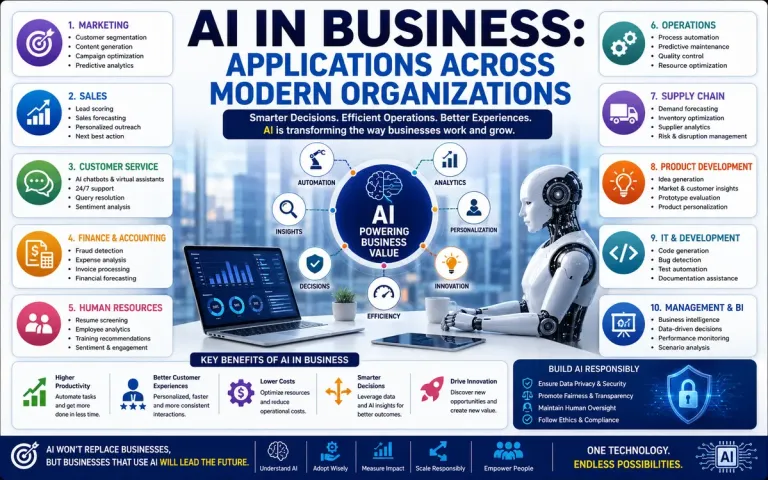
1. AI in Marketing
Marketing is one of the areas where AI has become highly visible.
Businesses can use AI to analyze customer behavior, generate content, segment audiences, support campaign planning, and personalize customer interactions.
Common applications include:
Customer segmentation
Content generation
Campaign analysis
Recommendation systems
Marketing analytics
Sentiment analysis
Personalization
Search and keyword analysis
Advertising optimization
For example, an organization can analyze customer behavior to identify different customer segments and then develop more relevant campaigns for each segment.
Generative AI can also assist marketers with initial drafts of:
Blog posts
Social media content
Email campaigns
Product descriptions
Advertising ideas
However, human review remains important because AI-generated marketing content may contain factual errors, inappropriate messaging, or content that does not fit the organization's brand.
2. AI in Sales
Sales teams deal with large amounts of customer and prospect information.
AI can help sales professionals identify patterns and prioritize opportunities.
Applications may include:
Lead scoring
Sales forecasting
Customer research
Personalized communication
Recommendation of next actions
CRM analysis
Conversation analysis
Instead of manually reviewing every potential lead, an AI system can help identify leads that appear more likely to convert.
The salesperson can then spend more time on communication, relationship building, negotiation, and closing.
This is an example of AI augmentation rather than complete automation.
3. AI in Customer Service
Customer service is another major application area.
AI-powered chatbots and virtual assistants can respond to common customer questions at any time.
They can assist with:
Frequently asked questions
Order status
Appointment information
Basic troubleshooting
Product information
Account-related queries
More advanced systems can help route complex cases to human representatives.
The advantage is not simply reducing the workload of customer-service employees. AI can also allow organizations to provide faster responses while allowing human agents to concentrate on problems requiring judgment and empathy.
However, businesses should provide an appropriate path to human assistance when automated systems cannot resolve a customer's problem.
4. AI in Finance and Accounting
Finance departments process large volumes of structured information, making them another important area for AI applications.
AI can assist with:
Financial forecasting
Expense analysis
Fraud detection
Anomaly detection
Invoice processing
Document classification
Risk analysis
Financial reporting support
For example, AI can identify unusual transaction patterns that may require further investigation.
Similarly, intelligent document-processing systems can extract information from invoices and other financial documents.
AI can therefore reduce repetitive administrative work while helping finance professionals focus on analysis and decision-making.
However, financial decisions can have significant consequences. AI outputs should therefore be appropriately validated rather than treated as automatically correct.
5. AI in Human Resources
Human Resources can use AI across several stages of the employee lifecycle.
Potential applications include:
Resume screening assistance
Job-description generation
Employee support chatbots
Workforce analytics
Training recommendations
Employee sentiment analysis
Skills analysis
Learning personalization
For example, AI can help identify skill gaps within a workforce and recommend relevant training.
However, HR is also a sensitive area because AI systems may influence decisions about people.
Organizations must therefore pay close attention to:
Bias
Fairness
Privacy
Transparency
Human oversight
AI should support responsible HR decision-making rather than become an unquestioned replacement for human judgment.
6. AI in Operations
Operations involve many repetitive and data-intensive activities.
AI can help organizations improve operational efficiency through:
Demand forecasting
Process optimization
Quality control
Predictive maintenance
Resource allocation
Inventory management
Workflow automation
For example, predictive systems can analyze equipment information to identify patterns associated with potential failures.
Instead of waiting for equipment to fail, an organization may be able to schedule maintenance earlier.
This can reduce downtime and improve resource utilization.
7. AI in Supply Chain Management
Supply chains involve multiple interconnected decisions.
AI can support organizations in analyzing:
Demand
Inventory
Supplier performance
Transportation
Delivery patterns
Market conditions
AI-powered forecasting can help businesses estimate future demand and adjust inventory accordingly.
This can potentially reduce both:
Overstocking and stock shortages.
AI can also help identify disruptions and provide decision-support information when supply conditions change.
The value of AI in supply chains therefore comes from its ability to analyze complex relationships across large quantities of information.
8. AI in Product Development
AI can also influence how businesses develop products and services.
Organizations can use AI to:
Analyze customer feedback
Identify emerging preferences
Generate product ideas
Test concepts
Analyze market information
Personalize products
Support design processes
For example, a company can analyze large volumes of customer reviews to identify recurring complaints or desired features.
This information can help product teams identify areas for improvement.
AI therefore becomes part of the customer-to-product feedback loop.
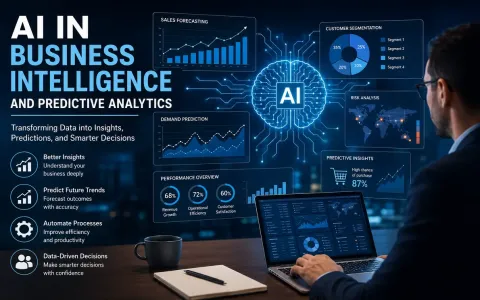
9. AI in Research and Business Intelligence
Businesses make decisions based on information from many sources.
AI can help process and organize that information.
Applications include:
Market research
Competitor analysis
Trend identification
Document analysis
Data summarization
Business intelligence
Forecasting
Generative AI can also help employees interact with large amounts of organizational information using natural language.
Instead of manually searching through numerous documents, an employee may be able to ask a system a question and receive a structured response.
The output should still be checked against reliable source information, particularly when it is used for important decisions.
10. AI in IT and Software Development
Technology departments are among the most natural users of AI.
AI can assist developers with:
Code generation
Code explanation
Debugging
Testing
Documentation
Code review
Technical support
AI can also help IT teams analyze logs, identify anomalies, and assist with troubleshooting.
The developer's role does not disappear simply because AI can generate code.
Human professionals still need to understand requirements, architecture, security, testing, maintenance, and business context.
11. AI in Management and Decision-Making
AI can also support managers and executives.
Organizations can use AI to analyze information related to:
Sales
Costs
Customers
Employees
Operations
Markets
Performance
AI can identify patterns that may not be immediately visible through manual analysis.
However, AI should not be confused with managerial responsibility.
An AI system can provide a prediction or recommendation, but managers must consider organizational objectives, ethical implications, uncertainty, stakeholder interests, and other contextual factors.
This is particularly important for high-impact decisions.
AI Across the Organization: One Technology, Many Applications
One of the most important characteristics of AI in business is that the same underlying technology can serve multiple departments.
For example, Generative AI can be used by:
Marketing → content creation
Sales → customer communication
HR → job descriptions and employee assistance
Finance → document analysis
Operations → process documentation
IT → coding assistance
Management → information summarization
This means AI adoption should not always be viewed as a collection of isolated tools.
Organizations can instead think about AI as a business capability that can support multiple functions.
Benefits of AI in Business
When appropriately implemented, AI can provide several potential benefits.
Increased productivity
AI can automate or accelerate repetitive activities.
Faster information processing
AI can analyze large quantities of information quickly.
Better customer experiences
AI can support personalization and faster service.
Improved decision support
AI can identify patterns and generate predictions or recommendations.
Cost efficiency
Automation can reduce the resources required for certain processes.
Innovation
AI can enable organizations to develop new products, services, and business models.
However, these benefits are not automatic.
An AI tool only creates business value when it addresses a genuine business problem and is implemented effectively.
Challenges of Using AI in Business
AI adoption also introduces important challenges.
Data Privacy
Organizations may process large amounts of personal or confidential information.
AI systems therefore need appropriate privacy and security controls.
Accuracy
AI systems can produce incorrect outputs.
Employees need to verify important information.
Bias
AI systems can reproduce or amplify problematic patterns in their data or design.
Security
AI systems can create additional security risks and may themselves become targets for attacks or misuse.
Employee Skills
Organizations need employees who understand how to use AI effectively.
The World Economic Forum reports that lack of skills to support AI adoption is a leading barrier identified by employers.
Integration
AI tools need to work effectively with existing systems and business processes.
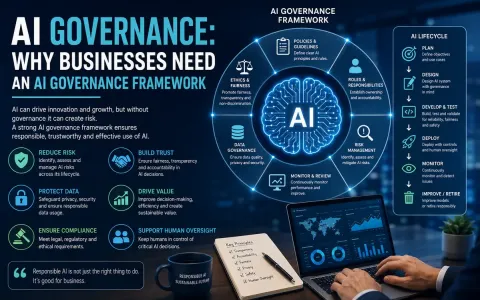
Governance
Organizations need clear responsibilities concerning how AI systems are selected, deployed, monitored, and evaluated.
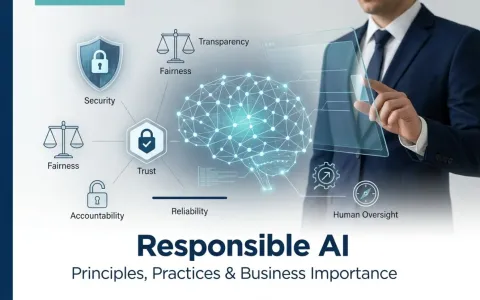
Responsible AI in Business
Successful AI adoption should include responsible AI practices from the beginning.
The NIST Artificial Intelligence Risk Management Framework is a voluntary framework designed to help organizations manage AI risks and incorporate trustworthiness considerations throughout the design, development, deployment, and use of AI systems.
NIST organizes its AI RMF around four major functions:
Govern → Map → Measure → Manage
These functions provide a useful way for organizations to think about AI risk management rather than treating risk as an issue only after deployment.
Businesses should consider:
Data privacy
Security
Reliability
Transparency
Accountability
Human oversight
Fairness
Monitoring
The appropriate safeguards depend on the particular AI application and its potential impact.
How Businesses Should Approach AI Adoption
Organizations do not need to implement AI everywhere at once.
A more practical approach is to begin with specific business problems.
Step 1: Identify the problem
Ask:
What business problem are we trying to solve?
Step 2: Identify suitable AI applications
Determine whether AI can realistically improve the process.
Step 3: Assess the data
AI applications depend heavily on data quality, availability, and appropriate access.
Step 4: Evaluate risks
Consider privacy, security, bias, accuracy, compliance, and operational risks.
Step 5: Start with a manageable use case
A focused pilot can help the organization understand the technology before expanding it.
Step 6: Measure business value
Evaluate whether AI actually improves:
Productivity
Cost
Quality
Customer experience
Revenue
Decision-making
Step 7: Scale responsibly
Successful applications can gradually be expanded while maintaining appropriate governance and monitoring.
AI Should Support Business Strategy
AI should not be adopted simply because competitors are using it.
The strongest approach is:
Business objective → Business problem → AI opportunity → Implementation → Measurement
rather than:
AI tool → Find somewhere to use it
This distinction is important.
A business can purchase dozens of AI tools and still receive little value if those tools are not connected to meaningful organizational objectives.
AI should therefore be treated as a means of achieving business outcomes, not as the outcome itself.
The Future of AI in Business
AI is likely to become increasingly integrated into everyday organizational processes.
The future may involve greater use of:
AI assistants
AI-powered analytics
Intelligent automation
AI agents
Personalized customer experiences
Predictive systems
AI-supported decision-making
As AI becomes more capable, the boundary between individual AI applications and broader business workflows may become less distinct.
Instead of employees opening a separate AI application to perform a particular task, AI may increasingly become embedded directly into the software and processes they already use.
This could make AI less visible while making its influence on business operations greater.
Conclusion
Artificial Intelligence is becoming a cross-functional business technology rather than a tool limited to IT departments.
Its applications extend across:
Marketing → Sales → Customer Service → Finance → HR → Operations → Supply Chain → Product Development → IT → Management
The greatest opportunity is not simply automation.
AI can help organizations analyze information, support employees, improve customer experiences, optimize processes, and develop new products and services.
At the same time, businesses must recognize that AI introduces risks involving privacy, security, accuracy, bias, governance, and workforce capabilities.
The organizations most likely to benefit from AI will not necessarily be those that adopt the largest number of AI tools.
They will be those that can answer three fundamental questions:
Where can AI create value?
What risks does it introduce?
How can humans and AI work together effectively?
AI is therefore best understood not simply as a technology investment, but as a potential organizational capability that can reshape how modern businesses operate, compete, and create value.
Frequently Asked Questions
What is AI in business?
AI in business refers to using Artificial Intelligence technologies to support, automate, or improve business processes, decisions, customer experiences, products, and services.
Which business functions use AI?
AI can be used across marketing, sales, customer service, finance, HR, operations, supply chain management, product development, IT, research, and management.
How does AI help businesses?
AI can help businesses automate repetitive tasks, analyze information, support decision-making, personalize customer experiences, improve operational efficiency, and create new products and services.
Is AI only useful for large companies?
No. AI can also be useful for small and medium-sized businesses. However, the appropriate application depends on the organization's needs, resources, data, and ability to manage risks.
What are the major risks of AI in business?
Important risks include inaccurate outputs, privacy problems, cybersecurity threats, bias, inadequate human oversight, regulatory issues, and poor integration with existing processes.
Should businesses replace employees with AI?
AI should not automatically be viewed as a replacement for employees. In many situations, its greater value may come from assisting employees and allowing them to focus on higher-value activities.
How can a business start using AI?
A business can begin by identifying a specific problem, evaluating whether AI is appropriate, assessing data and risks, testing a focused use case, measuring results, and scaling successful applications responsibly.
Related Articles
Artificial Intelligence: A Complete Guide to AI, Its Types, Applications, and Impact
How Does Artificial Intelligence Work? A Beginner's Guide
Machine Learning vs Artificial Intelligence: What Is the Difference?
What Is Generative AI? How It Works and Where It Is Used
Generative AI vs Traditional AI: Understanding the Key Differences
Large Language Models (LLMs): What They Are and How They Work
AI and Employment: How Artificial Intelligence Is Changing Jobs and Skills
Artificial Intelligence and Personal Data Privacy: Risks, Challenges, and Best Practices
10 Game-Changing AI Tools Revolutionizing Business
References
National Institute of Standards and Technology (NIST).
Artificial Intelligence Risk Management Framework (AI RMF 1.0).
NIST AI Risk Management Framework
World Economic Forum.
The Future of Jobs Report 2025.
World Economic Forum – Future of Jobs Report 2025
National Institute of Standards and Technology (NIST).
AI Risk Management Framework Playbook.
NIST AI RMF Playbook