Introduction
Artificial Intelligence is not a single technology. It includes different approaches designed to solve different types of problems.
For many years, AI systems have been used to analyze data, recognize patterns, classify information, make predictions, detect anomalies, and support decision-making. Examples include spam filters, recommendation systems, fraud detection tools, and demand forecasting systems.
Generative AI represents a significant development because it expands the capabilities of AI beyond analyzing existing information. Instead of only predicting, classifying, or recommending, Generative AI can create new content such as text, images, audio, video, and computer code.
This difference has led to the increasing use of the terms Generative AI and Traditional AI.
However, the distinction should not be understood as a competition in which one technology is replacing the other. Both approaches have different strengths and can be used for different purposes.
This article explains the key differences between Generative AI and Traditional AI, how they work, where they are used, and why both remain important in the development of modern intelligent systems.
What Is Traditional AI?
The term Traditional AI is commonly used to describe AI systems primarily designed to analyze information and produce specific outputs such as:
Classifications
Predictions
Recommendations
Scores
Decisions
Anomaly detections
For example, a fraud-detection system may analyze transaction data and estimate whether a particular transaction is potentially fraudulent.
A recommendation system may analyze previous purchases or user behavior and recommend relevant products.
A spam filter may classify an incoming email as spam or legitimate.
The primary purpose in these cases is generally not to create entirely new content. Instead, the system processes available information to identify patterns and produce a specific result.
A simplified process can be represented as:
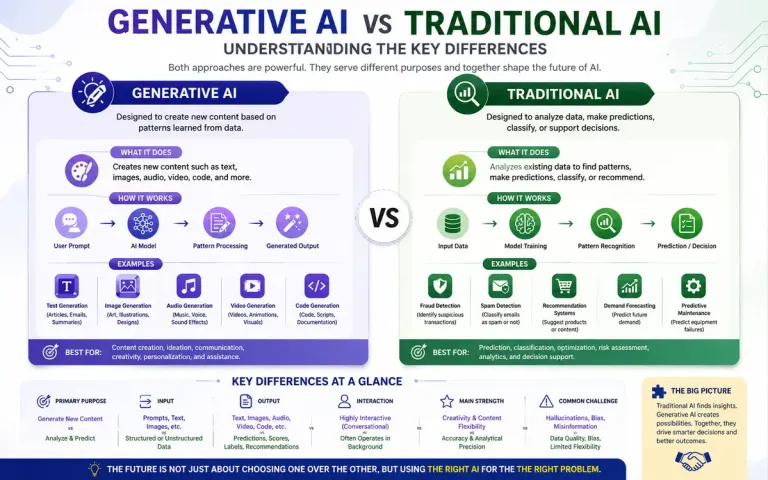
Input Data → Analysis → Pattern Recognition → Prediction or Decision
Traditional AI therefore remains highly valuable in situations where organizations need structured analysis, prediction, classification, optimization, or decision support.
What Is Generative AI?
Generative AI is a type of AI designed to create new content based on patterns learned from data.
The generated output may include:
Text
Images
Audio
Video
Computer code
Designs
Summaries
Synthetic data
For example, a user may provide a prompt asking an AI system to write a report, generate an image, summarize a document, or create computer code.
The simplified process is:
User Prompt → Generative AI Model → Pattern Processing → Generated Output
Unlike many traditional AI systems, Generative AI focuses on producing new outputs rather than only assigning an input to a predefined category or predicting a specific value.
The Fundamental Difference
The simplest distinction between the two approaches is their primary purpose.
Traditional AI primarily analyzes existing information.
Generative AI primarily creates new content.
For example, consider an organization working with customer data.
A traditional AI system might analyze customer behavior and answer:
Which customers are most likely to purchase a particular product?
A Generative AI system might use relevant information and help create:
A personalized marketing email for a particular customer segment.
One system focuses primarily on prediction and analysis, while the other focuses primarily on content generation.
In practice, however, the distinction is not always absolute. Modern AI systems can combine analytical and generative capabilities.
How Traditional AI Works
Traditional AI can use a variety of approaches, including:
Rule-based systems
Machine learning
Statistical models
Optimization algorithms
Expert systems
A machine-learning-based traditional AI system typically follows a process such as:
Historical Data → Training → Model → New Data → Prediction or Classification
Consider a system designed to predict whether a customer may leave a service.
Historical customer data is used to identify patterns associated with customers who previously left.
The trained model can then process information about current customers and estimate the likelihood that they may leave in the future.
The output might be:
High probability of churn: 78%
The system has not created a new article, image, or video. Instead, it has analyzed data and generated a prediction.
How Generative AI Works
Generative AI also learns patterns from data, but its purpose is different.
The process can be represented as:
Training Data → Model Training → Learned Patterns → User Prompt → Generated Content
For example, a language model learns relationships and patterns within large amounts of text.
When a user provides a prompt, the model processes the input and generates a response based on the patterns represented within the model.
An image-generation model operates according to a similar general principle, although the underlying architecture and generation process may differ.
A user provides a description, and the model generates an image based on its learned representation of relevant visual patterns.
The key idea is that Generative AI produces new content in response to an input.
Generative AI vs Traditional AI: Key Differences
| Aspect | Traditional AI | Generative AI |
|---|---|---|
| Primary purpose | Analyze, predict, classify, or optimize | Create new content |
| Typical input | Structured or unstructured data | Prompts, text, images, or other inputs |
| Typical output | Prediction, classification, score, or recommendation | Text, images, audio, video, code, and other content |
| Examples | Fraud detection, spam filtering, forecasting | Text generation, image generation, code generation |
| Interaction | Often operates in the background | Frequently involves direct user interaction |
| Main strength | Analytical accuracy and structured decision support | Content creation and flexible interaction |
| Common challenge | Limited flexibility outside its designed task | Inaccurate or fabricated outputs |
This comparison provides a useful overview, although real-world AI systems can combine elements of both approaches.
Examples of Traditional AI
Traditional AI remains deeply integrated into modern digital systems.
Recommendation Systems
Online platforms analyze user behavior and other information to recommend products, services, or content.
For example:
User Behavior → Pattern Analysis → Recommended Product
Fraud Detection
Financial institutions can use AI and machine learning to identify unusual transaction patterns.
The system may analyze factors such as:
Transaction amount
Location
Timing
Frequency
Previous account behavior
It can then assign a risk score or flag potentially suspicious activity.
Demand Forecasting
Businesses can use AI models to analyze historical sales data and other relevant variables to estimate future demand.
This can support:
Inventory planning
Production decisions
Supply chain management
Resource allocation
Spam Detection
A system can analyze the characteristics of an email and classify it as:
Spam or Not Spam
This is a classic example of an AI system performing a classification task.
Examples of Generative AI
Generative AI is increasingly visible because users can directly interact with many of its applications.
Text Generation
AI systems can generate:
Articles
Emails
Reports
Summaries
Explanations
Marketing content
Image Generation
Users can describe a visual concept, and an AI system can generate an image based on that description.
Possible applications include:
Illustrations
Marketing visuals
Product concepts
Educational graphics
Creative experimentation
Code Generation
Generative AI can assist developers by:
Writing code
Explaining code
Suggesting improvements
Creating documentation
Helping identify possible errors
Generated code should still be reviewed and tested.
Audio and Video Generation
Generative AI can also be used to create or modify:
Speech
Music
Sound
Video
Animation
These capabilities are expanding the role of AI in creative and media-related activities.
Differences in User Interaction
Another important difference involves how people interact with the systems.
Traditional AI often operates in the background.
For example, when a customer receives a product recommendation, the AI system may have analyzed information without requiring the customer to directly communicate with it.
Generative AI is often more interactive.
A user may:
Provide a prompt.
Receive an output.
Ask for modifications.
Provide additional instructions.
Refine the result.
For example:
Write an introduction for a business report.
The user can then request:
Make it more concise.
Or:
Rewrite it for a non-technical audience.
This conversational and iterative interaction is one reason Generative AI has become widely accessible.
Data Requirements and Model Complexity
Both Traditional AI and Generative AI depend on data, but their requirements can differ significantly.
A traditional machine-learning system may be trained for a specific task using data relevant to that problem.
For example, a system designed to predict customer churn may use historical customer records.
Generative AI models, particularly large-scale foundation models, can be trained using extremely large and diverse datasets.
These models may then be adapted or prompted for multiple tasks.
This gives Generative AI greater flexibility, but it can also require significant computing resources and complex infrastructure.
Accuracy and Reliability
Traditional AI systems can be highly effective when they are designed for a clearly defined task and operate within an appropriate environment.
For example, a well-designed model may perform consistently when predicting a specific type of outcome based on relevant data.
Generative AI is more flexible, but flexibility can introduce additional risks.
A Generative AI system may produce content that is:
Incorrect
Misleading
Biased
Incomplete
Fabricated
This is particularly important because generative systems can present incorrect information in fluent and convincing language.
Therefore, an important principle when using Generative AI is:
The quality of the language does not guarantee the accuracy of the information.
Human review and verification are especially important when AI-generated information will be used for significant decisions or public communication.
Can Generative AI Replace Traditional AI?
Generative AI is unlikely to replace every form of Traditional AI.
Different AI approaches are appropriate for different tasks.
For example, an organization that needs to:
Predict future sales
Detect fraudulent transactions
Optimize a delivery route
Identify manufacturing defects
Calculate financial risk
may require specialized analytical or predictive AI systems.
Generative AI is particularly useful when the objective involves creating, transforming, summarizing, or interacting with content.
Therefore, the future is likely to involve multiple forms of AI working together rather than one approach completely replacing another.
How Traditional AI and Generative AI Can Work Together
The combination of analytical and generative capabilities can create more powerful systems.
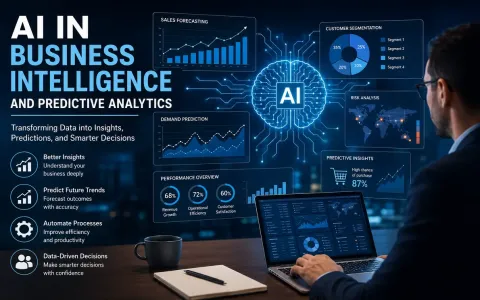
Consider a business intelligence environment.
A traditional AI or machine-learning system may:
Analyze sales data
Identify trends
Detect unusual patterns
Forecast future demand
A Generative AI system could then:
Explain the findings in natural language
Summarize the analysis
Draft a management report
Answer questions about the results
The combined process could look like:
Business Data
↓
Traditional AI Analysis
↓
Predictions and Insights
↓
Generative AI
↓
Human-Readable Explanation or Report
This type of combination demonstrates that Traditional AI and Generative AI can be complementary rather than competing technologies.
Benefits of Using the Right Approach
Selecting the appropriate AI approach depends on the problem.
Traditional AI may be more suitable when the objective is to:
Classify information
Detect anomalies
Predict outcomes
Optimize processes
Calculate risk
Support structured decisions
Generative AI may be more suitable when the objective is to:
Create content
Summarize information
Generate ideas
Interact using natural language
Draft documents
Produce creative variations
Assist with coding or design
In some situations, combining both approaches may provide the greatest value.
Limitations of Both Approaches
Neither Traditional AI nor Generative AI is perfect.
Traditional AI can face challenges involving:
Data quality
Bias
Limited flexibility
Model accuracy
Changing environments
Difficulty handling situations outside its intended scope
Generative AI can face challenges involving:
Hallucinations
Misinformation
Bias
Privacy concerns
Intellectual property issues
Lack of transparency
Overreliance by users
Responsible AI development therefore requires appropriate evaluation, governance, monitoring, and human oversight.
Conclusion
Generative AI and Traditional AI represent different but complementary approaches within the broader field of Artificial Intelligence.
Traditional AI is generally focused on analyzing information, identifying patterns, making predictions, classifying data, and supporting decisions.
Generative AI is focused on creating new content, including text, images, audio, video, and code.
The difference can be summarized simply:
Traditional AI asks: "What does the data tell us?"
Generative AI asks: "What can be created from the patterns we have learned?"
Both approaches are likely to remain important.
Traditional AI will continue to support forecasting, optimization, fraud detection, recommendation systems, and other analytical applications. Generative AI will increasingly support communication, creativity, content creation, software development, and human-computer interaction.
The greatest opportunities may emerge when analytical AI and Generative AI are combined with human expertise.
The next article in this AI series will examine one of the most important technologies behind modern text-based Generative AI:
Large Language Models (LLMs): What They Are and How They Work
Related articles:
What Is Generative AI? How It Works and Where It Is Used
Machine Learning vs Artificial Intelligence
How Does Artificial Intelligence Work? A Beginner's Guide
Artificial Intelligence: A Complete Guide to AI, Its Types, Applications
Frequently Asked Questions
What is the main difference between Generative AI and Traditional AI?
Traditional AI primarily analyzes, classifies, predicts, recommends, or optimizes based on data. Generative AI is designed primarily to create new content such as text, images, audio, video, or code.
Is Generative AI better than Traditional AI?
Neither is universally better. The appropriate approach depends on the task. Traditional AI is often suitable for prediction and structured analysis, while Generative AI is useful for content creation and natural-language interaction.
Does Generative AI use Machine Learning?
Yes. Modern Generative AI typically relies on machine-learning and deep-learning techniques to learn patterns from data and generate outputs.
Can Traditional AI and Generative AI work together?
Yes. Traditional AI can analyze data and generate predictions, while Generative AI can explain the results, answer questions, summarize insights, or create reports.
Why can Generative AI produce incorrect information?
Generative AI generates outputs based on learned patterns rather than functioning as a guaranteed source of verified facts. It can therefore produce inaccurate, incomplete, misleading, or fabricated information.
What should businesses consider before adopting AI?
Businesses should consider the specific problem they want to solve, available data, required accuracy, privacy, security, costs, governance, and the appropriate level of human oversight.