Introduction
AI agents are emerging as one of the most important developments in artificial intelligence. Unlike traditional software that follows predefined instructions or conventional chatbots that mainly respond to prompts, AI agents can pursue goals, reason about tasks, use external tools, retrieve information, make decisions, and take actions with varying degrees of autonomy.
The growing importance of AI agents is closely connected to advances in large language models (LLMs), retrieval-augmented generation (RAG), tool calling, memory systems, and orchestration frameworks. Modern agents can perform multi-step workflows rather than simply generating a single response.
For businesses, this creates an important shift: AI is moving from a system that generates information toward a system that can use information to perform work.
This article explains how AI agents work, their architecture, major capabilities, applications, advantages, limitations, and their potential impact on modern organizations.
What Is an AI Agent?
An AI agent is a software system that uses artificial intelligence to pursue a defined goal by perceiving information, reasoning about what to do, using available tools, and taking actions within an environment.
In simple terms:
An AI model generates an answer; an AI agent can determine what needs to be done and take the necessary steps to accomplish a goal.
For example, suppose a business owner asks:
"Find potential customers for my digital marketing service and prepare a report."
A conventional chatbot might explain how to find customers.
An AI agent could potentially:
Search relevant sources.
Identify potential businesses.
Collect publicly available information.
Evaluate prospects according to predefined criteria.
Organize the information.
Prepare a report.
Save the report to a designated location.
The agent does not necessarily perform all these activities independently in every implementation. Its level of autonomy depends on its design, permissions, tools, and human-approval requirements.
Google describes AI agents as systems capable of reasoning, planning, memory, decision-making, and action, while distinguishing them from simpler bots and assistants.
AI Agent vs Chatbot vs AI Assistant
Although these terms are sometimes used interchangeably, they describe different levels of capability.
| Feature | Traditional Chatbot | AI Assistant | AI Agent |
|---|---|---|---|
| Primary function | Answer predefined questions | Assist the user | Achieve a goal |
| Autonomy | Very low | Low to moderate | Moderate to high |
| Reasoning | Limited | Moderate | Advanced |
| Planning | Usually absent | Limited | Multi-step |
| Tool usage | Limited | Some | Extensive |
| Memory | Usually limited | May retain context | Can use short- and long-term memory |
| Decision-making | Rule-based | User-directed | Goal-oriented |
| External actions | Limited | Some | Can execute complex workflows |
| Adaptability | Low | Moderate | High |
| Multi-agent collaboration | Rare | Limited | Possible |
The important distinction is agency.
A chatbot generally waits for a question.
An assistant helps a user accomplish a task.
An agent can be designed to pursue a goal through multiple actions.
How Do AI Agents Work?
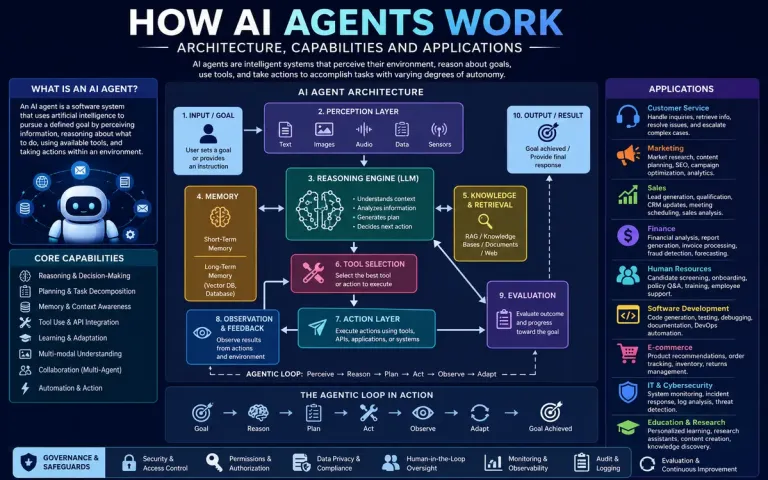
At a high level, an AI agent follows a continuous cycle:
Input → Perception → Reasoning → Planning → Tool Selection → Action → Observation → Evaluation → Next Action
This process is often called an agentic loop.
The agent receives information, determines what needs to happen, selects an appropriate action, observes the result, and decides what to do next. Modern agent architectures combine an LLM with tools, memory, orchestration, and external knowledge to support this loop
A simplified representation is:
User Goal
↓
Agent / Orchestrator
↓
LLM Reasoning Engine
↓
Planning & Decision-Making
↓
Memory + Knowledge
↓
Tool Selection
↓
External Action
↓
Result / Observation
↓
Evaluation
↓
Next Action or Final Response
Let's examine these components individually.
Architecture of an AI Agent
An AI agent is not simply an LLM. It is a system composed of several interconnected components.
Modern enterprise architectures commonly include models, grounding or knowledge sources, tools, memory/data architecture, orchestration, runtime infrastructure, security, and observability.
1. User Input and Goal
Everything begins with a goal.
For example:
"Analyze last month's sales and identify products whose sales declined significantly."
The agent must first understand what the user wants.
The goal may contain:
The desired outcome
Constraints
Available resources
Time requirements
Business rules
User preferences
Required output format
The agent converts the natural-language request into a form that can guide subsequent reasoning.
2. Perception Layer
The perception layer allows the agent to understand information coming from its environment.
Depending on the application, this information can include:
Text
Documents
Images
Audio
Video
Database records
API responses
Sensor data
Web content
User messages
Modern multimodal foundation models allow agents to process different types of information rather than relying exclusively on text.
For example, an e-commerce agent might receive:
A customer complaint
An order record
A product image
Previous conversation history
The perception component helps transform these inputs into usable context.
3. Large Language Model: The Reasoning Engine
The Large Language Model (LLM) often serves as the cognitive core of a modern AI agent.
Examples of foundation models can include models from different AI providers, depending on the architecture and application.
The model helps the agent:
Understand instructions
Interpret context
Generate plans
Select tools
Analyze information
Make decisions
Generate responses
Adapt to changing conditions
However, an LLM by itself is not necessarily an autonomous agent.
An LLM produces outputs based on its input.
An agent adds an orchestration and action layer around the model so that the model can participate in a larger decision-and-action cycle. AWS describes this distinction by emphasizing that LLMs need structured workflows, tools, memory, and coordination logic to support complex agentic behavior.
4. Planning Module
Planning is one of the most important capabilities of an AI agent.
Suppose the user says:
"Prepare a competitor analysis for my business."
The agent may divide the goal into smaller tasks:
Identify competitors.
Collect competitor information.
Analyze products and services.
Compare pricing.
Examine marketing strategies.
Identify strengths and weaknesses.
Prepare the final report.
This process is called task decomposition.
Planning allows an agent to transform a complex objective into smaller, manageable actions.
Modern agents may dynamically revise their plans when new information becomes available or when an action fails.
5. Memory
Memory allows an agent to maintain information beyond the immediate prompt.
Without memory, an agent may treat every interaction as an isolated event.
With memory, it can potentially remember relevant information from previous interactions and tasks.
AI-agent memory can broadly be divided into two categories.
Short-Term Memory
Short-term memory contains information relevant to the current task.
Examples include:
Current conversation
Current task
Recent tool results
Current plan
Temporary variables
Recent observations
Long-Term Memory
Long-term memory stores information that may remain useful across sessions.
Examples include:
User preferences
Previous decisions
Historical interactions
Business information
Past task outcomes
Important learned information
Memory systems can use databases, vector stores, knowledge graphs, or other persistent storage mechanisms.
AWS describes memory-augmented agents as systems that retrieve short- and long-term information, use it during reasoning, and update memory after completing tasks.
6. Knowledge and Retrieval
AI agents often need information that is not contained in the model's training data.
This is where Retrieval-Augmented Generation (RAG) becomes important.
RAG allows an agent to retrieve relevant information from external knowledge sources before generating an answer or taking an action.
Possible knowledge sources include:
Company documents
Product catalogs
Databases
Research papers
Internal policies
Websites
Knowledge bases
Customer records
For example, an HR agent may retrieve an organization's leave policy before answering an employee's question.
Instead of relying entirely on the model's internal knowledge, the agent can retrieve relevant information and use it as context.
This can improve factual grounding and make the system more useful for organization-specific tasks. Enterprise agent architectures commonly combine knowledge bases with semantic retrieval and access controls.
7. Tools and Function Calling
An AI model can generate text, but an agent needs the ability to do things.
Tools provide this capability.
An agent may have access to tools such as:
Search engines
Calculators
Databases
APIs
CRM systems
Payment systems
Email systems
Calendar applications
File storage
Code execution environments
Business software
For example, if an agent needs today's sales figures, it cannot simply guess them. It can use a database tool to retrieve the actual data.
Similarly, a customer-service agent might use:
Customer ID → CRM API → Customer Record → LLM → Response
Tool use therefore connects the AI agent to the real world.
Google's current documentation describes tools as capabilities that allow agents to interact with external systems and perform actions.
8. Decision-Making
After collecting information and evaluating available options, the agent must determine what to do next.
For example:
Goal: Resolve a customer complaint.
The agent may determine:
Is the complaint valid?
Is the customer eligible for a refund?
Is additional information required?
Should the case be escalated?
Which system should be updated?
Decision-making can involve:
Rules
Model-based reasoning
Business policies
Confidence thresholds
User permissions
Risk limits
Previous outcomes
In high-risk situations, organizations may require human approval before the agent executes an important action.
9. Action Layer
The action layer allows the agent to interact with external systems.
Actions may include:
Sending an email
Updating a database
Creating a support ticket
Generating a document
Calling an API
Updating a CRM record
Running code
Creating a calendar event
Triggering a workflow
This is what makes an AI agent different from a system that only generates text.
The agent does not merely say:
"You should send an email."
It may be able to prepare and, when authorized, send the email.
10. Feedback and Observation
After performing an action, the agent should observe the result.
For example:
Agent: Calls inventory API
↓
Tool: Returns "Product out of stock"
↓
Agent: Reassesses the plan
↓
Agent: Searches for alternative products
This feedback loop makes agentic systems adaptive.
AWS describes this as a continuous perceive-reason-act cycle in which actions influence future observations and subsequent decisions.
The Agentic Loop
The complete process can be represented as:
1. Receive Goal
↓
2. Understand Context
↓
3. Retrieve Relevant Memory/Knowledge
↓
4. Plan the Task
↓
5. Select Tool or Action
↓
6. Execute Action
↓
7. Observe Result
↓
8. Evaluate Result
↓
9. Revise Plan if Necessary
↓
10. Repeat Until Goal Is Achieved
↓
11. Provide Final Result
This loop may run only a few times for a simple task or continue through many steps for a complex workflow.
A Practical Example: AI Marketing Agent
Consider a small business that wants to improve its digital marketing.
The owner gives an AI agent the instruction:
"Analyze my website and suggest a three-month SEO strategy."
The agent could potentially perform the following workflow.
Step 1: Understand the Goal
The agent identifies:
Website
Business type
Target audience
SEO objective
Time period
Step 2: Collect Information
It may use authorized tools to analyze:
Website pages
Search performance
Keywords
Competitors
Technical SEO
Content
Step 3: Retrieve Knowledge
The agent may access:
SEO guidelines
Previous reports
Business information
Historical performance
Step 4: Analyze
The LLM evaluates the information and identifies:
Technical problems
Content gaps
Keyword opportunities
Internal-linking opportunities
Competitor gaps
Step 5: Create a Plan
It may produce:
Month 1: Technical SEO
Month 2: Content development
Month 3: Authority and optimization
Step 6: Take Actions
If appropriate permissions exist, the agent could:
Create content briefs
Generate reports
Update project-management tasks
Monitor performance
Step 7: Monitor Results
The agent can periodically evaluate new data and recommend changes.
This illustrates how AI agents can transform AI from a content-generation tool into a workflow-oriented system.
Core Capabilities of AI Agents
Modern AI agents can provide several important capabilities.
1. Reasoning
Agents can analyze information and determine appropriate next steps.
2. Planning
They can decompose complex objectives into smaller tasks.
3. Tool Use
They can interact with APIs, databases, software applications, search systems, and other tools.
4. Memory
They can maintain relevant information across interactions and tasks.
5. Adaptation
They can modify their approach based on new information or failed actions.
6. Goal Orientation
Instead of simply responding to individual prompts, they can work toward defined objectives.
7. Multimodal Processing
Advanced agents can work with combinations of text, images, audio, video, and other data.
8. Collaboration
Multiple specialized agents can cooperate on complex tasks.
9. Automation
Agents can automate workflows that previously required significant human involvement.
Multi-Agent Systems
A single agent may not always be sufficient for a complex business problem.
This leads to the concept of multi-agent systems.
A multi-agent system contains multiple specialized AI agents that collaborate.
For example, a digital marketing system might contain:
Research Agent
↓
Collects market information
SEO Agent
↓
Analyzes keywords and technical SEO
Content Agent
↓
Creates content strategies
Analytics Agent
↓
Analyzes performance
Manager Agent
↓
Coordinates the other agents
The agents can communicate with one another and divide responsibilities.
IBM identifies multi-agent systems as architectures in which multiple AI agents work collectively to perform tasks for users or other systems.
Multi-agent systems can therefore resemble a digital organization, where different agents perform specialized roles.
Types of AI Agents
AI agents can be classified in several ways.
1. Reactive Agents
These agents respond directly to current inputs.
They generally have limited memory and planning capabilities.
Example: A simple customer-support system responding to predefined events.
2. Goal-Based Agents
These agents work toward a defined objective.
For example:
Goal: Reduce customer-support response time.
The agent determines appropriate actions to achieve that objective.
3. Planning Agents
These agents break complex goals into sequences of actions.
They are particularly useful for multi-step workflows.
4. Memory-Augmented Agents
These agents use persistent information to maintain context and personalize future actions.
5. Tool-Using Agents
These agents can call external tools, APIs, databases, or applications.
6. Autonomous Agents
These agents can operate with relatively limited human intervention within predefined boundaries.
The level of autonomy should always be determined by the risk and consequences of the task.
7. Multi-Agent Systems
These systems involve multiple agents cooperating to accomplish a larger objective.
Applications of AI Agents
AI agents are being explored across almost every major business function.
1. Customer Service
Customer-service agents can:
Answer questions
Retrieve customer information
Classify requests
Troubleshoot problems
Create support tickets
Recommend solutions
Escalate complex cases
Instead of answering only one question, an agent can potentially manage an entire support workflow.
2. Marketing
Marketing agents can assist with:
Market research
Competitor analysis
Keyword research
Content planning
SEO analysis
Social-media planning
Campaign monitoring
Customer segmentation
Performance analysis
This is particularly relevant for small businesses that may not have large marketing teams.
3. Sales
Sales agents can:
Identify prospects
Research companies
Qualify leads
Update CRM systems
Prepare personalized messages
Schedule meetings
Analyze sales pipelines
This can reduce repetitive administrative work for sales teams.
4. Finance
AI agents can support:
Financial analysis
Expense categorization
Report generation
Invoice processing
Fraud monitoring
Budget analysis
Forecasting
Because financial decisions can have significant consequences, human oversight and strong controls are especially important.
5. Human Resources
HR agents can assist with:
Candidate screening
Interview scheduling
Employee queries
Policy retrieval
Training recommendations
Onboarding workflows
HR documentation
Organizations must be particularly careful about bias, privacy, and discriminatory decision-making when agents influence employment decisions.
6. Software Development
Coding agents can potentially:
Understand requirements
Generate code
Inspect existing code
Identify bugs
Run tests
Debug problems
Create documentation
Submit changes
Modern agentic development architectures increasingly emphasize rapid feedback loops in which agents can write, test, and refine software.
7. Research and Knowledge Work
Research agents can assist with:
Literature discovery
Information retrieval
Document analysis
Data comparison
Research summaries
Report preparation
Knowledge management
However, researchers should verify sources and claims rather than treating agent-generated research as automatically reliable.
8. E-Commerce
E-commerce agents can support:
Product recommendations
Customer service
Order tracking
Inventory monitoring
Personalized marketing
Product research
Returns processing
An agent can potentially connect multiple systems, such as the website, CRM, inventory database, and customer-support platform.
9. IT and Cybersecurity
AI agents can assist IT teams with:
System monitoring
Incident classification
Log analysis
Troubleshooting
Alert prioritization
Routine remediation
Security analysis
Because cybersecurity actions can have serious consequences, autonomous execution should be tightly controlled.
10. Education
Educational agents can support:
Personalized learning
Student assistance
Question generation
Feedback
Lesson planning
Research assistance
Learning analytics
A future educational environment could use multiple specialized agents for teaching, assessment, research, and administration.
Advantages of AI Agents
1. Automation of Complex Workflows
Agents can automate sequences of tasks rather than only individual actions.
2. Increased Productivity
Employees can delegate repetitive activities to AI systems.
3. 24/7 Operation
Agents can operate continuously when infrastructure and governance permit it.
4. Personalization
Memory and contextual information can allow agents to provide more personalized services.
5. Scalability
An organization can potentially deploy many software agents without expanding human teams proportionally.
6. Faster Decision Support
Agents can retrieve and process large quantities of information rapidly.
7. Integration Across Systems
Tool access allows agents to connect different business applications and workflows.
Limitations and Challenges of AI Agents
AI agents are powerful, but they are not infallible.
1. Hallucinations
LLMs can generate incorrect information.
If an agent uses incorrect information to make decisions or execute actions, the consequences can be more serious than a simple incorrect chatbot response.
2. Incorrect Tool Use
An agent may select an inappropriate tool or use a correct tool incorrectly.
This makes tool permissions and validation important.
3. Lack of Predictability
Generative AI systems are probabilistic.
The same task may sometimes produce different results, which creates challenges for highly deterministic business processes. AWS highlights this probabilistic nature as one reason production systems require additional context, controls, evaluation, and architecture.
4. Security Risks
An agent with access to business systems can become a security risk if permissions are poorly designed.
Potential concerns include:
Unauthorized actions
Data leakage
Prompt injection
Excessive permissions
Malicious tool calls
Insecure external integrations
5. Privacy
Agents may process sensitive business or customer information.
Organizations must therefore establish appropriate:
Access controls
Data policies
Encryption
Retention policies
Audit mechanisms
6. Cost
Complex agents may make numerous model calls and tool calls.
A poorly designed agent can therefore become expensive to operate.
7. Over-Autonomy
Not every task should be fully autonomous.
For high-risk activities, organizations may require:
AI recommendation → Human review → Approval → Action
rather than:
AI decision → Automatic action
Human-in-the-Loop AI Agents
Human oversight remains important, particularly when agents perform consequential actions.
A human-in-the-loop system can introduce approval checkpoints.
For example:
Agent analyzes transaction
↓
Agent recommends action
↓
Human reviews recommendation
↓
Human approves
↓
Agent executes action
This approach can combine AI efficiency with human judgment.
The appropriate level of human involvement depends on:
Risk
Cost of failure
Regulatory requirements
Data sensitivity
Reversibility of actions
Organizational policies
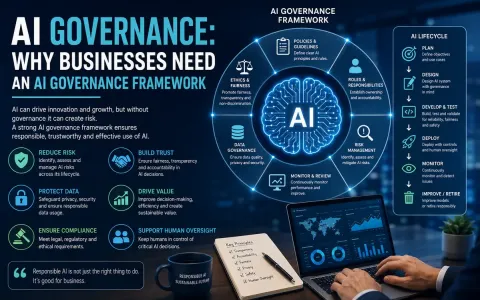
AI Agent Governance
As agents become more autonomous, governance becomes increasingly important.
A production-grade AI-agent architecture should consider:
Security
Who is allowed to use the agent?
Authorization
What actions is the agent allowed to perform?
Data Governance
What information can the agent access?
Monitoring
What did the agent do?
Auditability
Can the organization reconstruct the agent's actions?
Evaluation
How accurately and reliably does the agent perform its tasks?
Human Oversight
When must the agent request human approval?
AWS identifies security, observability, governance, evaluation, and monitoring as important cross-cutting concerns for enterprise agentic systems.
AI Agents and Business Transformation
The significance of AI agents goes beyond automation.
Traditional automation generally follows:
Rule → Process → Output
Generative AI typically follows:
Prompt → Model → Response
Agentic AI increasingly follows:
Goal → Reason → Plan → Act → Observe → Adapt
This represents a significant change in how organizations may design software.
Instead of asking:
"What software should employees use to perform this task?"
organizations may increasingly ask:
"What goal should the AI system accomplish, what tools should it be allowed to use, and what controls should govern its actions?"
This shift could influence:
Business-process management
Customer service
Marketing
Software development
Knowledge management
Decision support
Operations
Human-resource management
AI Agents vs Traditional Automation
| Aspect | Traditional Automation | AI Agents |
|---|---|---|
| Logic | Predefined rules | Dynamic reasoning |
| Workflow | Fixed | Potentially adaptive |
| Input | Structured | Structured + unstructured |
| Planning | Usually predefined | Can be dynamically generated |
| Tool use | Programmed | Can select among available tools |
| Adaptability | Limited | Higher |
| Decision-making | Rule-based | Model-assisted |
| Natural language | Limited | Strong |
| Memory | Application-dependent | Can include agent memory |
| Autonomy | Usually predetermined | Can vary by design |
However, AI agents should not automatically replace traditional automation.
For predictable, deterministic tasks, traditional automation may still be cheaper, faster, and more reliable.
The strongest enterprise architecture may combine both.
What Makes an AI Agent "Agentic"?
The term agentic generally refers to systems that exhibit goal-directed behavior through some combination of:
Autonomy
Reasoning
Planning
Tool use
Memory
Decision-making
Environmental interaction
Adaptation
The important point is that using an LLM does not automatically make an application an AI agent.
For example:
Simple LLM application:
User → Prompt → LLM → Answer
Agentic application:
User → Goal → Agent → Plan → Tools → Observations → Reasoning → Actions → Result
The second system contains a control loop that allows it to work toward an objective.
Future of AI Agents
AI agents are likely to become increasingly integrated into business software and digital services.
Several developments are particularly important.
1. More Specialized Agents
Instead of one general-purpose agent, organizations may deploy specialized agents for:
Marketing
Finance
HR
Sales
IT
Research
Operations
2. Multi-Agent Collaboration
Agents may increasingly cooperate, with one agent delegating tasks to another specialized agent.
3. Better Memory
Persistent memory systems may allow agents to maintain richer context across longer periods.
4. Greater Tool Integration
Agents will increasingly interact with enterprise software, APIs, databases, browsers, and other digital systems.
5. Improved Governance
As autonomy increases, organizations will need stronger:
Identity management
Authorization
Monitoring
Auditing
Evaluation
Safety controls
6. AI-Native Business Processes
Organizations may redesign workflows around AI agents rather than simply adding AI to existing processes.
This could lead to a new model of organizational design in which humans and AI agents collaborate as parts of the same workflow.
How Small Businesses Can Use AI Agents
AI agents are not only relevant to large enterprises.
Small businesses can potentially use agents for:
Marketing
Content planning
SEO research
Social-media management
Competitor monitoring
Sales
Lead research
CRM updates
Follow-up management
Customer Service
Customer queries
Ticket classification
FAQ assistance
Administration
Report preparation
Document processing
Scheduling
Analytics
Sales analysis
Website performance analysis
Marketing reporting
For a small business, the objective should not be to deploy autonomous AI everywhere.
Instead, businesses should identify repetitive workflows where AI can create measurable value while maintaining appropriate human oversight.
A Simple Framework for Implementing AI Agents
Organizations considering AI agents can follow a structured approach.
Step 1: Identify the Business Problem
Do not begin with the question:
"Where can we use AI?"
Begin with:
"Which business problem should we solve?"
Step 2: Define the Goal
Specify the desired outcome and success criteria.
Step 3: Map the Workflow
Identify:
Inputs
Decisions
Actions
Systems
Human approvals
Outputs
Step 4: Determine Required Tools
Identify the APIs, databases, applications, and knowledge sources the agent needs.
Step 5: Define Permissions
Give the agent only the permissions necessary to perform its role.
Step 6: Establish Human Oversight
Determine which actions require approval.
Step 7: Test the Agent
Evaluate:
Accuracy
Reliability
Cost
Speed
Safety
Failure behavior
Step 8: Monitor Production Performance
Track the agent's actions and outcomes continuously.
Step 9: Improve the System
Use evaluation results and operational feedback to improve prompts, tools, workflows, memory, and governance.
Conclusion
AI agents represent an important evolution in artificial intelligence.
Traditional chatbots primarily respond to questions. Generative AI systems can create content. AI agents go a step further by combining AI models with planning, memory, tools, knowledge, orchestration, and action capabilities to pursue defined goals.
Their basic operating principle can be summarized as:
Perceive → Reason → Plan → Act → Observe → Adapt
The architecture behind an AI agent typically includes an AI model, orchestration layer, memory, knowledge sources, tools, action mechanisms, and governance controls.
The potential applications are extensive, ranging from marketing and customer service to software development, finance, education, research, and business operations.
However, greater autonomy also creates greater responsibility. Hallucinations, security vulnerabilities, privacy risks, unpredictable behavior, excessive permissions, and inappropriate autonomous decisions must be addressed through careful architecture, evaluation, monitoring, and human oversight.
The future of AI may therefore not simply be about better chatbots. It may increasingly involve AI systems capable of performing meaningful work through coordinated reasoning and action.
For businesses, the key question is no longer simply whether AI can generate useful information. The more important question is:
Can AI safely and reliably perform part of the workflow that creates value for the organization?
That is the central promise—and challenge—of AI agents.
Related articles:-
AI Agents vs AI Chatbots: What Is the Difference?
Retrieval-Augmented Generation (RAG): How It Makes AI More Accurate
AI and Cybersecurity: How Artificial Intelligence Is Changing Digital Security
AI Hallucinations: Why AI Can Generate Incorrect Information and How to Verify It
AI in Business: Applications Across Modern Organizations
10 Game-Changing AI Tools Revolutionizing Business
Key Takeaways
AI agents are goal-oriented AI systems capable of reasoning and taking actions.
An LLM is often the cognitive core, but an agent requires additional components.
Planning allows agents to break complex goals into smaller tasks.
Memory enables contextual continuity across interactions.
RAG and knowledge bases provide access to external information.
Tools and APIs allow agents to interact with real-world systems.
The agentic loop enables agents to observe results and adapt their next action.
Multi-agent systems allow specialized agents to collaborate.
AI agents have applications across marketing, sales, customer service, finance, HR, IT, education, research, and software development.
Greater autonomy requires stronger security, governance, monitoring, evaluation, and human oversight.
AI agents represent a shift from AI that generates responses to AI that can participate in workflows and perform actions.