Introduction
Publishing content consistently is important for SEO, but simply producing more articles does not automatically make a website authoritative.
A website becomes stronger when it develops depth, relevance, and useful coverage around a particular subject. Instead of publishing isolated articles targeting individual keywords, a topical SEO strategy connects related subjects and provides users with comprehensive information.
This approach is commonly known as topical authority.
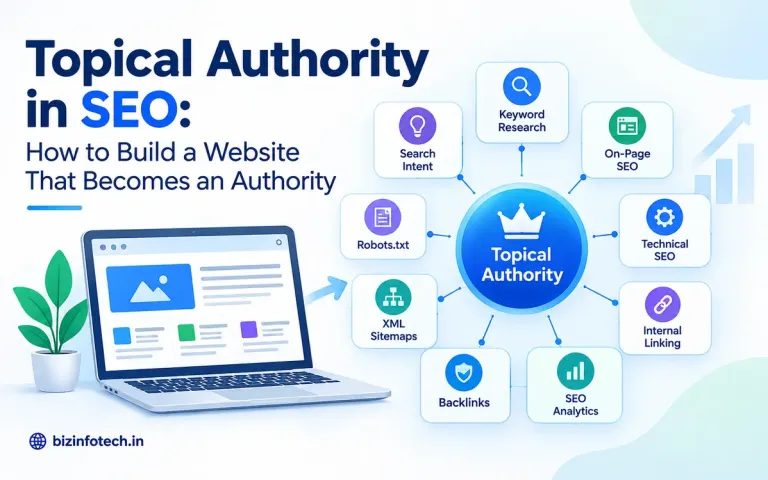
For example, a website trying to establish authority around SEO might publish articles about keyword research, search intent, on-page SEO, technical SEO, internal linking, backlinks, canonical URLs, XML sitemaps, robots.txt, and SEO analytics. These subjects are different, but they are closely connected within the broader topic of SEO.
The objective is not simply to publish hundreds of articles. It is to build a useful content ecosystem in which individual articles answer specific questions while collectively covering an important subject.
In this guide, we will explore what topical authority means, why it matters, how topic clusters work, how internal linking supports topical relevance, and how you can build a practical topical authority strategy for your website.
What Is Topical Authority in SEO?
Topical authority refers to the depth and breadth of useful content a website develops around a particular subject.
A website demonstrates topical depth when it provides valuable information covering the important aspects, questions, problems, and subtopics related to a subject.
For example, consider two websites.
Website A
It publishes one article:
What Is SEO?
Website B
It publishes articles about:
What Is SEO?
How Search Engines Work
Keyword Research
Search Intent
On-Page SEO
Technical SEO
Internal Linking
Backlinks
SEO Analytics
Canonical URLs
XML Sitemaps
Robots.txt
Keyword Cannibalization
Website B has developed much broader coverage of SEO.
However, more content does not automatically equal greater authority. The content should be relevant, useful, accurate, logically connected, and created primarily to help users.
Why Is Topical Authority Important for SEO?
Search engines need to understand the subject and purpose of webpages.
A well-organized collection of related content can make it easier for users to explore a subject and understand the relationship between different pages.
Topical coverage can also help a website build a stronger content structure.
For example, someone reading an article about keyword research may also need information about:
Search intent
Keyword mapping
Long-tail keywords
Keyword cannibalization
Content optimization
If these topics are covered on related pages and linked appropriately, users can move naturally through the website.
Topical Authority vs. Domain Authority
Topical authority and domain authority are not the same thing.
Topical Authority
Topical authority refers to the depth and relevance of a website's content around a particular subject.
For example:
A website has extensive and useful content about SEO.
Domain Authority
Domain Authority is also the name of a third-party SEO metric used by some SEO tools.
It is important not to confuse such third-party metrics with a Google ranking score.
Therefore, instead of asking:
"What is my Domain Authority score?"
a content strategist should also ask:
"Does my website provide useful and comprehensive information about the subject I want to cover?"
Topical Authority Is Not About Publishing More Content
One of the most common misconceptions about topical authority is that publishing a large number of articles will automatically establish authority.
That is not a reliable strategy.
For example, publishing 100 short articles that provide little original value is unlikely to be more useful than publishing 30 well-researched articles that collectively cover a subject comprehensively.
Content should therefore be created based on:
User needs
Search intent
Topic relevance
Content gaps
Practical usefulness
Quality and accuracy
The objective should be useful coverage rather than content volume.
What Is a Topic Cluster?
A topic cluster is a group of related pages organized around a central subject.
For example, suppose the main topic is:
SEO
The supporting topics could include:
Keyword Research
Search Intent
On-Page SEO
Technical SEO
Internal Linking
Backlinks
SEO Analytics
Canonical URLs
XML Sitemaps
Robots.txt
These articles can be connected through relevant internal links.
A simple structure could look like this:
SEO | ------------------------------------ | | | Keyword Strategy On-Page SEO Technical SEO | | | Search Intent Title Tags Robots.txt Keyword Mapping Meta Data XML Sitemap Cannibalization Internal Links Canonical URLs
This creates a logical relationship between individual articles.
Pillar Content and Supporting Content
A topic cluster often contains two important types of content.
Pillar Content
A pillar page provides broad coverage of a major subject.
For example:
Complete Guide to SEO
It introduces the major areas of SEO and links to more detailed resources.
Supporting Content
Supporting articles focus on individual subtopics.
Examples include:
Keyword Research
Search Intent
Technical SEO
Backlinks
Canonical URLs
SEO Analytics
The pillar page and supporting pages can link to each other where appropriate.
How to Build Topical Authority Step by Step
1. Choose a Core Topic
Start with a subject that is closely related to your website's purpose and audience.
Possible subjects include:
SEO
Artificial Intelligence
Digital Marketing
Marketing Management
Web Development
Digital Transformation
Cybersecurity
Avoid trying to establish deep authority across too many unrelated subjects at the same time.
2. Define Your Main Subject
Once you select a subject, define exactly what you want to cover.
For example:
SEO
Then ask:
What would a beginner, practitioner, or business owner need to understand about SEO?
This question can help you identify the major areas that should be covered.
3. Divide the Topic Into Subtopics
Break the main topic into logical sections.
For example, SEO can be divided into:
SEO Fundamentals
What Is SEO?
How Search Engines Work
Crawling
Indexing
Search Rankings
Keyword Strategy
Keyword Research
Search Intent
Keyword Mapping
Long-Tail Keywords
Keyword Cannibalization
On-Page SEO
Title Tags
Meta Descriptions
Heading Structure
Image SEO
Content Writing
Internal Linking
Technical SEO
XML Sitemap
Robots.txt
Canonical URLs
Website Speed
Mobile SEO
Structured Data
Off-Page SEO
Backlinks
Link Building
Brand Mentions
Digital PR
SEO Measurement
SEO Analytics
Search Console
Organic Traffic
Click-Through Rate
SEO Reporting
This becomes your topical map.
4. Understand Search Intent
Search intent refers to the underlying reason behind a search query.
Users may want to:
Learn something
Find an answer
Compare options
Solve a problem
Complete a task
Research a product or service
For example:
What is a canonical URL?
is primarily informational.
While:
How to add a canonical URL to a PHP website
has a stronger practical intent.
Understanding intent allows you to create content that actually addresses what users are trying to accomplish.
5. Create Useful Content
Once you identify a topic, create content that answers the user's question clearly.
A useful article should generally:
Address the main question.
Explain important concepts.
Provide examples where useful.
Cover relevant related questions.
Link to deeper resources where appropriate.
Avoid adding unnecessary information simply to make an article longer.
6. Build Contextual Internal Links
Internal linking connects related pages within your website.
For example:
Keyword Research
can naturally link to:
Search Intent
Keyword Mapping
Keyword Cannibalization
Similarly, an article about:
Canonical URLs
could link to:
Technical SEO
XML Sitemap
Robots.txt
Indexing
Internal links should be useful and relevant rather than added simply to increase the number of links.
7. Create a Logical Website Structure
Your website structure should make it easy for visitors to discover related content.
For example:
SEO │ ├── Fundamentals ├── Keyword Strategy ├── On-Page SEO ├── Technical SEO ├── Off-Page SEO └── SEO Analytics
This structure can also make your content easier to manage as the website grows.
8. Cover a Topic From Beginner to Advanced Levels
A strong content library should serve readers with different levels of knowledge.
For example:
Beginner
What Is SEO?
Intermediate
Keyword Research: A Complete Guide
Advanced
Keyword Cannibalization in SEO
Technical
Canonical URLs in SEO
Measurement
SEO Analytics: How to Measure Search Performance
This creates a natural learning path.
9. Add Practical Experience and Original Value
A website should not simply repeat information that can be found everywhere else.
Where appropriate, add:
Practical examples
Screenshots
Case studies
Original observations
Experiments
Implementation examples
Data
Lessons learned
For technical subjects, practical implementation can make an article significantly more useful.
10. Make Authorship Clear
Consider providing clear information about who created the content.
An article can include:
Author name
Author profile
Relevant professional background
Publication date
Updated date where appropriate
This helps readers understand who is responsible for the content.
11. Keep Your Content Updated
Topical authority is not a one-time project.
Important subjects change over time.
For example, SEO continues to evolve as search technology, user behavior, and search features change.
Regularly review important articles and ask:
Is the information still accurate?
Are there important developments missing?
Are internal links still relevant?
Are there new related articles that should be connected?
Are outdated examples or statistics still appropriate?
Topical Authority and Keyword Research
Keyword research remains useful, but topical SEO requires looking beyond individual keywords.
Instead of asking only:
Which keyword should I target next?
also ask:
Which important aspect of this subject have I not covered yet?
For example, if your website already has articles about:
Keyword Research
Search Intent
Keyword Mapping
a logical next topic could be:
Keyword Cannibalization
The topics naturally connect and expand the keyword-strategy cluster.
Topical Authority and Search Volume
Search volume should not be the only factor used to select topics.
A topic with relatively low search demand may still be valuable if it:
Completes an important topic cluster
Answers an important user question
Supports another page
Provides practical information
Fills a content gap
For example, robots.txt is an important technical SEO subject even if its search demand is smaller than the broader term "SEO."
Topical Authority and Long-Tail Keywords
Long-tail queries can help identify specific questions within a broader topic.
For example:
Broad topic:
SEO
Subtopic:
Technical SEO
Specific question:
How does robots.txt affect search engine crawling?
The specific question may become a useful supporting article within the larger technical SEO cluster.
How Internal Linking Creates a Content Network
Imagine that your website has ten SEO articles.
If every article exists independently, the relationship between them may be unclear.
Instead, create connections:
SEO Guide / | \ / | \ Keyword Research | Technical SEO / | \ Search Intent | Robots.txt | | | Keyword Mapping XML Sitemap Canonical URLs | Keyword Cannibalization
The result is a connected content network rather than a collection of isolated articles.
Topical Authority and Keyword Cannibalization
Building many articles around one subject can sometimes create another problem: keyword cannibalization.
Keyword cannibalization occurs when multiple pages target the same or very similar search intent.
For example, these titles may overlap heavily:
SEO Keyword Research Guide
Complete Keyword Research Guide
Keyword Research for SEO
SEO Keyword Research Tutorial
Instead, differentiate the topics:
Keyword Research
Search Intent
Keyword Mapping
Keyword Cannibalization
Long-Tail Keywords
Each article then serves a distinct purpose within the larger cluster.
Topical Authority and AI-Generated Content
AI can be useful for:
Content brainstorming
Topic research
Outlining
Editing
Identifying content gaps
Organizing information
However, using AI to produce large quantities of repetitive, low-value content simply to increase search visibility is not a sustainable content strategy.
The important question is not:
Was AI used to create this article?
The more important question is:
Does this article provide genuine value to the reader?
AI should therefore be treated as a productivity and research tool, while human judgment remains important for accuracy, originality, experience, and usefulness.
How to Find Topical Content Gaps
Once you have created a topic map, compare it with your existing content.
For example:
| Topic Area | Existing Content | Potential Gap |
|---|---|---|
| SEO Fundamentals | Yes | Search Engine Indexing |
| Keyword Strategy | Yes | Long-Tail Keywords |
| On-Page SEO | Yes | Heading Optimization |
| Technical SEO | Yes | Structured Data |
| Off-Page SEO | Yes | Digital PR |
| SEO Analytics | Yes | Search Console |
The missing topics can become part of your future content plan.
This approach helps prevent random topic selection.
Use Search Console to Discover New Topics
Google Search Console can provide useful information about how your existing pages appear in search.
Look for:
Queries generating impressions
Queries with impressions but relatively few clicks
Related queries you did not specifically target
Pages appearing for unexpected searches
Queries where your pages have visibility but need improvement
These observations can lead to:
New supporting articles
Content updates
Better internal links
New topic clusters
Topical Authority and Content Updates
Creating new content is only one part of a topical strategy.
Your existing content should also be maintained.
For example, if you publish an article about:
SEO Title Tags
and later publish:
Keyword Mapping
you may discover that the older article should link to the new article.
Therefore, every new article can create opportunities to improve older content.
This creates a continuous content improvement cycle:
Create → Link → Review → Update → Expand → Create
Common Topical Authority Mistakes
1. Publishing Unrelated Topics
Publishing articles simply because they have search volume can make your content strategy unfocused.
2. Creating Similar Articles
Multiple articles targeting nearly identical search intent can create unnecessary competition between your own pages.
3. Ignoring Internal Links
Related articles should be connected where the links provide genuine value.
4. Focusing Only on Broad Topics
Broad guides are useful, but readers also need detailed answers to specific questions.
5. Focusing Only on Very Narrow Topics
A collection of small articles without broader resources can make the website difficult to navigate.
6. Ignoring Existing Content
Sometimes improving an existing article is more useful than immediately publishing another one.
7. Measuring Only Rankings
Rankings are useful, but topical development should also consider impressions, clicks, content coverage, engagement, and the usefulness of the overall content structure.
A Practical Topical Authority Strategy
A simple workflow can help you build topical authority systematically.
Step 1: Choose a Core Topic
Select a subject that is relevant to your website and audience.
Step 2: Create a Topic Map
List the major subtopics.
Step 3: Audit Existing Content
Identify what you have already published.
Step 4: Identify Content Gaps
Find important topics that are missing.
Step 5: Prioritize New Articles
Choose topics based on relevance, user needs, content gaps, and search intent.
Step 6: Publish Useful Content
Create comprehensive but focused articles.
Step 7: Build Internal Links
Connect new content with relevant existing pages.
Step 8: Update Older Articles
Add links and information where appropriate.
Step 9: Monitor Search Performance
Use tools such as Google Search Console to understand how your content performs.
Step 10: Expand the Cluster
Continue covering meaningful gaps within the subject.
Example: Building an SEO Topic Cluster
Suppose a website wants to build a strong SEO knowledge hub.
A possible structure could be:
SEO Fundamentals
What Is SEO?
How Search Engines Work
Search Intent
Keyword Strategy
Keyword Research
Keyword Mapping
Keyword Cannibalization
Long-Tail Keywords
On-Page SEO
On-Page SEO
SEO Title Tags
Meta Descriptions
SEO Content Writing
Image SEO
Internal Linking
Technical SEO
Technical SEO
XML Sitemap
Robots.txt
Canonical URLs
Mobile SEO
Website Speed
Structured Data
Off-Page SEO
Off-Page SEO
Backlinks
Link Building
Digital PR
SEO Measurement
SEO Analytics
Google Search Console
Organic CTR
SEO Reporting
This structure creates a clear roadmap for future content development.
How BizInfoTech Can Apply Topical Authority
For a website such as BizInfoTech, topical authority can be developed through separate content hubs.
For example:
SEO
Focus on:
SEO fundamentals
Keyword strategy
On-page SEO
Technical SEO
Off-page SEO
SEO analytics
AI
Focus on:
AI fundamentals
Generative AI
Large Language Models
AI in business
AI in marketing
AI and cybersecurity
AI strategy
Marketing
Focus primarily on:
Marketing Management
Consumer Behaviour
Marketing Strategy
Brand Management
Strategic Marketing
Marketing Planning
Digital Transformation
Focus on:
Digital transformation strategy
Technology adoption
Digital business models
Business process transformation
Organizational change
This approach gives each category a clearer purpose.
How to Measure Your Progress
There is no single Google Search Console metric called "Topical Authority."
Instead, monitor several indicators.
Search Impressions
Are more relevant pages receiving impressions?
Search Queries
Are your pages appearing for a broader range of relevant queries?
Organic Clicks
Are search impressions generating visits?
Indexed Content
Are your useful pages being indexed?
Internal Traffic
Are users moving between related articles?
Content Coverage
Have you covered the major areas of your chosen subject?
Search Performance
Are multiple pages gaining visibility for relevant queries?
These indicators together provide a more useful picture of topical development.
Topical Authority Checklist
Before publishing a new article, ask:
Topic
Is the topic relevant to my website?
Search Intent
What does the user actually want to know or accomplish?
Content Quality
Does the article provide a clear and useful answer?
Original Value
Does it add something beyond a generic summary?
Internal Linking
Which existing pages should this article link to?
Content Relationship
Which future articles could naturally link back to this page?
Structure
Is the article easy to read and navigate?
Accuracy
Are the facts, examples, and technical explanations correct?
Updating
Will this article need periodic review?
Conclusion
Topical authority is not about publishing the largest number of articles.
It is about building a useful, organized, and interconnected body of knowledge around a subject.
A practical topical SEO strategy can be summarized as:
Choose a subject → map its subtopics → identify content gaps → create useful content → satisfy search intent → connect related pages → update existing content → expand the topic systematically.
For a growing website such as BizInfoTech, this approach can help transform individual blog posts into organized knowledge hubs around subjects such as SEO, AI, Marketing, and Digital Transformation.
Instead of asking:
"What article should I publish today?"
ask:
"What important part of this subject have I not explained yet?"
That shift from individual articles to a connected content ecosystem is the foundation of a sustainable topical SEO strategy.
Related articles:-
How to Write Titles That Improve Rankings and Click-Through Rates
SEO Content Writing: How to Create Content That Ranks and Engages Readers
What Is SEO? A Complete Guide to Search Engine Optimization
How Do Search Engines Work? Crawling, Indexing, and Ranking Explained