Introduction
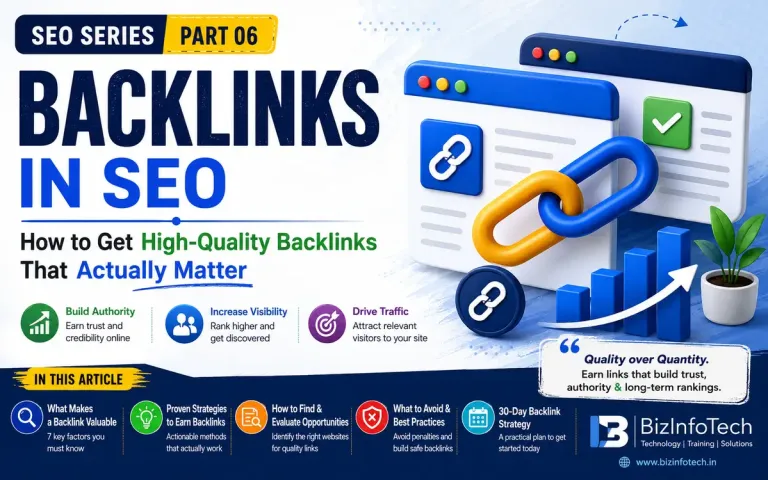
Backlinks remain one of the most discussed aspects of search engine optimization. Website owners often hear that they need more backlinks to improve their Google rankings. As a result, many businesses start searching for websites with high Domain Authority, buying backlink packages, submitting their websites to hundreds of directories, or exchanging links with unrelated websites.
But this approach misses an important point:
The goal is not simply to get more backlinks. The goal is to earn relevant, credible, and useful links.
A single editorial backlink from a relevant and trusted website can potentially be more valuable than dozens of links created purely for SEO purposes.
In this guide, we will understand what backlinks are, why they matter, what makes a backlink valuable, and—most importantly—how you can build a sustainable strategy to earn high-quality backlinks.
What Is a Backlink?
A backlink is a hyperlink from one website to another.
For example, if Website A publishes an article and includes a link to an article on Website B, Website B has received a backlink from Website A.
Backlinks are also commonly called:
Inbound links
Incoming links
External links pointing to a website
For search engines, links can help provide information about the relationship between pages and websites.
However, not every backlink has the same value.
A link from a highly relevant industry publication, academic resource, respected organization, or useful article is fundamentally different from a link placed randomly on hundreds of unrelated websites.
That is why modern link building should focus on quality and relevance rather than quantity alone.
Why Are Backlinks Important for SEO?
Search engines use multiple signals to understand and evaluate web pages. Links can help search engines discover pages and understand how content is connected across the web.
More importantly, when another website voluntarily links to your content, it can indicate that the content is useful as a reference.
For example, imagine that you publish a detailed guide titled:
"A Complete Beginner's Guide to Technical SEO"
Later, several digital marketing blogs, SEO professionals, and business websites link to your guide as a useful resource for their readers.
Those links may provide several benefits.
1. They can help search engines discover your content
Links create pathways between pages on the web. Search engine crawlers can use these links to discover content.
2. They can provide contextual signals
The content surrounding a link can help indicate what the linked page is about.
For example, a link placed inside an article about SEO strategies for small businesses is more contextually relevant to an SEO guide than a random link placed on an unrelated website.
3. They can bring referral traffic
A good backlink does not only exist for search engines.
If readers of another website find your link useful and click on it, that backlink can bring relevant visitors directly to your website.
4. They can improve credibility and visibility
Being referenced by respected and relevant websites can help increase the visibility of your content and brand.
This leads to an important principle:
A valuable backlink should ideally make sense for both search engines and human readers.
If a link would be useful even if Google did not exist, it is more likely to represent a genuine editorial connection.
Do More Backlinks Always Mean Better Rankings?
No.
One of the biggest misconceptions in SEO is:
More backlinks automatically mean better rankings.
This is not necessarily true.
Imagine two websites.
Website A
5,000 backlinks
Most links come from low-quality directories
Many links are from unrelated websites
Several links are automatically generated
Very few people actually visit through those links
Website B
50 backlinks
Links come from relevant industry websites
Links are editorially placed
The websites have genuine audiences
Readers actually click the links
The linked content provides useful information
Website B may have a much stronger backlink profile despite having significantly fewer links.
Therefore, instead of asking:
"How many backlinks do I need?"
A better question is:
"What kind of websites and pages would genuinely have a reason to reference my content?"
That question changes the entire approach to link building.
What Makes a Backlink Valuable?
Not all backlinks are equal. A useful backlink should generally be evaluated using several factors.
1. Relevance
Relevance is one of the most important considerations.
Suppose you operate a website about business, technology, digital marketing, and SEO.
A backlink from:
A digital marketing blog
A business publication
A technology website
An entrepreneurship resource
An educational platform teaching SEO
is generally more contextually relevant than a backlink from an unrelated website about pets, fashion, or gaming.
The linking website does not need to be an exact copy of your niche. However, there should ideally be a logical connection between the content, audience, and topic.
Example
An article titled:
"How Small Businesses Can Improve Their Online Visibility"
could naturally link to your detailed SEO guide.
That is a logical and useful connection.
2. Editorial Placement
A valuable backlink is often placed because the publisher believes the linked resource will be useful to readers.
For example:
"For a detailed explanation of keyword research, you can read this comprehensive guide."
This type of link has a clear editorial purpose.
Compare that with a random list of 100 websites placed in the footer of a webpage.
The first link provides context and potential value to readers. The second may simply exist to manipulate rankings.
Whenever possible, focus on earning editorial links.
3. Context
The context surrounding a backlink matters.
Suppose your article is about AI tools for small businesses.
A link placed within an article discussing:
Artificial intelligence
Business technology
Automation
Productivity software
is contextually relevant.
The same link placed on an unrelated page about travel destinations provides a much weaker contextual connection.
The ideal situation is when:
The topic of the linking page + the surrounding content + the destination page all have a logical relationship.
4. Quality and Credibility of the Linking Website
A backlink from a credible and well-maintained website can be more valuable than a link from a website created solely for generating backlinks.
Before pursuing a backlink opportunity, examine the website.
Ask:
Does the website publish useful content?
Does it have a clear purpose?
Does it appear professionally maintained?
Does it have genuine authors or contributors?
Does it have a relevant audience?
Does the content demonstrate expertise?
Does the website link naturally to useful external resources?
A website does not need to be a globally famous brand to be valuable.
A smaller but highly relevant industry website may provide more value than a large but completely unrelated website.
5. Placement Within the Content
Links placed naturally within the main body of relevant content may be more meaningful than links hidden in:
Footers
Sidebars
Large lists of unrelated websites
Automatically generated pages
For example, a backlink within a detailed paragraph explaining a concept provides context.
A random link placed at the bottom of every page does not necessarily provide the same value.
6. Referral Traffic Potential
One often ignored question is:
Could a real person click this backlink?
If the answer is yes, the link may provide value beyond SEO.
For example, imagine your article is referenced by a website that receives readers genuinely interested in your topic.
Even if the backlink does not immediately improve rankings, it may:
Bring targeted visitors
Increase brand awareness
Generate subscribers
Create professional relationships
Lead to future opportunities
This is why good link building should be considered part of digital marketing, not just an SEO technique.
The 7-Point Backlink Quality Test
Before pursuing a backlink, ask the following questions:
| Factor | Question to Ask |
|---|---|
| Relevance | Is the website or page related to my topic? |
| Credibility | Does the website appear trustworthy and professionally maintained? |
| Editorial Value | Would the publisher have a genuine reason to link to my content? |
| Context | Is the surrounding content relevant to my page? |
| Placement | Will the link appear naturally within useful content? |
| Traffic Potential | Could real visitors click the link? |
| Naturalness | Would this link still make sense if search engines did not exist? |
If the answer to most of these questions is yes, the opportunity may be worth exploring.
Domain Authority: Useful Metric or SEO Myth?
Many website owners search for backlinks from websites with high:
Domain Authority (DA)
Domain Rating (DR)
Authority Score
These metrics can be useful for comparing websites.
However, it is important to understand that they are third-party metrics, not official Google ranking scores.
A website with a DA of 80 is not automatically a better backlink opportunity than a highly relevant website with a DA of 35.
Consider these two opportunities:
Opportunity A
A DA 85 general website with no connection to your industry.
Opportunity B
A DA 35 website entirely focused on digital marketing, SEO, and small businesses.
For an SEO-related article, Opportunity B may provide a much more relevant audience and contextual relationship.
Therefore:
Use authority metrics as indicators, not as the only decision-making factor.
Relevance, editorial quality, audience, and context should also be considered.
High-Quality Backlinks vs Low-Quality Backlinks
Let us compare the difference.
Example of a Potentially Valuable Backlink
A respected digital marketing website publishes an article titled:
"10 Resources Every Small Business Should Use to Improve SEO."
The author reviews useful resources and links to your detailed keyword research guide.
The link is:
Relevant
Editorial
Contextual
Useful to readers
Placed naturally within the content
This is the type of backlink you should aim to earn.
Example of a Low-Quality Backlink
A website promises:
"Get 10,000 backlinks in 24 hours."
Your website is automatically submitted to hundreds of unrelated directories, forums, comment sections, and websites.
These links may:
Be irrelevant
Have no real audience
Be automatically generated
Exist primarily for manipulating rankings
Provide no referral traffic
This is not a sustainable SEO strategy.
How to Get High-Quality Backlinks
Now we come to the most important question:
How do you actually get valuable backlinks?
The answer is not simply "send thousands of emails asking for links."
A better approach is:
Create value first, then identify people and websites for whom that value is genuinely relevant.
Here are practical strategies.
1. Create Link-Worthy Content
The easiest content to promote is content that solves a real problem.
People are more likely to link to something that provides unique value.
Examples include:
Comprehensive guides
Original research
Industry statistics
Surveys
Case studies
Templates
Checklists
Tools and calculators
Detailed tutorials
Resource collections
Expert insights
For example, instead of publishing another generic article titled:
"What Is SEO?"
you could publish:
"The Small Business SEO Checklist: 50 Actions to Improve Your Website"
A useful checklist is more likely to be bookmarked, shared, and referenced.
Ask yourself:
Why would another website link to this article instead of simply writing the same information themselves?
If you can answer that question clearly, you may have created something link-worthy.
2. Publish Original Research and Data
Original data can be a powerful link-building asset.
Journalists, bloggers, researchers, and content creators often need statistics and evidence to support their articles.
You could conduct:
Industry surveys
Customer surveys
LinkedIn polls
Analysis of public datasets
Case studies
Experiments
Trend analysis
For example, instead of writing:
"Small businesses are using AI."
you could conduct a survey and publish:
"How 100 Small Business Owners Are Using AI in 2026"
The second article contains original information that other writers may cite as a source.
That creates a natural reason for backlinks.
3. Create Useful Free Resources
People frequently link to resources that help their audience.
Examples include:
SEO checklists
Digital marketing templates
Business planning templates
Keyword research worksheets
Marketing calendars
PDF guides
Industry glossaries
For example, your website could create:
Free SEO Audit Checklist for Small Businesses
The article could explain how to perform the audit, while a downloadable checklist provides additional practical value.
This creates two possible reasons for people to link to the resource:
The educational article
The downloadable tool
This is known as creating a linkable asset.
4. Find Broken Link Opportunities
Websites frequently contain broken external links.
For example, a blog may have linked to a useful SEO guide five years ago, but that website no longer exists.
You can identify relevant broken links and ask yourself:
Do I have an existing resource that could replace this missing page?
The process is simple:
Step 1: Find relevant resource pages or articles
Search for websites in your niche that curate useful resources.
Step 2: Identify broken links
Check whether some of their external links no longer work.
Step 3: Create or identify a suitable replacement
Your content should genuinely match the original topic.
Step 4: Contact the website owner
Inform them about the broken link and politely suggest your resource if it is genuinely relevant.
The goal should not be:
"Please give me a backlink."
Instead:
"I noticed that one of the resources in your article is no longer available. I recently published a detailed guide covering the same topic, which may be useful as an alternative for your readers."
This approach provides value to the website owner by helping them improve their content.
5. Look for Resource Pages
Many websites maintain pages such as:
Useful resources
Recommended tools
Helpful links
Learning resources
SEO resources
Small business resources
You can search for opportunities using queries such as:
SEO "useful resources" digital marketing "recommended resources" small business "helpful resources" keyword research "resources"
However, do not submit your website to every resource page you find.
First ask:
Is the website relevant?
Does the resource page appear actively maintained?
Would your content genuinely help its audience?
If the answer is yes, contact the publisher with a personalized message.
6. Write Guest Contributions
Guest posting can still be useful when the purpose is to contribute valuable content to a relevant audience.
For example, if you specialize in SEO for small businesses, you could contribute an article to a relevant business or marketing publication.
Your contribution should:
Provide original value
Be relevant to the website's audience
Demonstrate genuine expertise
Not simply exist for placing a keyword-rich backlink
A good guest contribution can provide:
Brand exposure
Referral traffic
Professional credibility
Relationships with publishers
Potential editorial links
The backlink should be a natural result of the contribution, not the only objective.
7. Reclaim Unlinked Brand Mentions
Sometimes websites mention your:
Brand
Website
Article
Research
Tool
Original data
without linking to the original source.
For example:
"According to research published by BizInfoTech..."
If the website mentions your research but does not link to it, you can politely contact the author.
A simple message could be:
"Thank you for referencing our research in your article. I noticed that the mention is not currently linked. If helpful for your readers, here is the original source."
This is often a reasonable opportunity because the publisher is already aware of your content.
8. Become a Useful Source for Writers and Publishers
Instead of always asking for backlinks, try becoming a person that publishers want to reference.
You can do this by:
Publishing original insights
Sharing research
Providing expert opinions
Creating useful statistics
Responding to relevant industry discussions
Building a professional presence
For example, if you regularly publish high-quality articles about:
SEO
AI for business
Digital marketing
Small business technology
you gradually create a body of work that writers can reference.
This is a slower strategy, but it can create more sustainable results.
9. Build Relationships Before Asking for Links
One of the most overlooked aspects of link building is relationship building.
Do not make your first interaction:
"Hello, please give me a backlink."
Instead:
Follow relevant professionals
Engage meaningfully with their content
Share useful insights
Mention their research when appropriate
Participate in industry discussions
Build genuine professional relationships
Over time, collaboration opportunities may naturally emerge.
This could include:
Guest contributions
Interviews
Expert roundups
Podcast appearances
Collaborative research
Resource recommendations
Relationships can create opportunities that automated outreach campaigns cannot.
10. Turn Existing Content Into Linkable Assets
You may already have articles that can become stronger backlink assets.
Review your existing content and ask:
Can I make this article more useful than the competing pages?
For example, you could upgrade an existing article by adding:
Original diagrams
Data
Examples
Templates
Case studies
Expert quotes
Checklists
Downloadable resources
A basic article can become a comprehensive resource.
For example:
Before
What Is Keyword Research?
After
Keyword Research for Beginners: Step-by-Step Guide + Free Template + Examples
The improved version gives other websites more reasons to reference it.
How to Find Websites for Backlink Opportunities
You do not need to contact thousands of websites.
Start with a targeted approach.
Method 1: Analyze Competitor Backlinks
Identify websites that link to similar content in your niche.
Ask:
Why did they link to that content?
What type of content do they prefer?
Can I create something more useful?
Is there an opportunity for my resource to add value?
The goal is not to copy competitors blindly.
The goal is to understand:
What type of content earns links in your industry?
Method 2: Search for Articles Mentioning Your Topic
Suppose you have published a comprehensive guide about SEO.
Search for:
"SEO guide" + resources "learn SEO" + beginners "SEO for small business" + guide
Then identify articles where your resource could genuinely complement the existing content.
Method 3: Find Roundup Articles
Many publishers create articles such as:
Best SEO resources
Top digital marketing blogs
Useful business websites
Recommended tools for entrepreneurs
If your content is genuinely useful, these articles may represent outreach opportunities.
How to Evaluate a Website Before Requesting a Backlink
Do not rely on one number.
Use a broader evaluation process.
Check Relevance
Is the website related to your industry?
Review the Content
Does it publish useful, original, and well-written content?
Check Recent Activity
Has the website been updated recently?
Look at the Audience
Would the readers actually be interested in your content?
Examine Existing External Links
Does the website link naturally to useful external sources?
Review Authority Metrics Carefully
DA, DR, and similar metrics can provide additional information, but they should not be your only criteria.
A Simple Backlink Evaluation Scorecard
You can score opportunities from 1 to 5.
| Factor | Score |
|---|---|
| Topic relevance | /5 |
| Content quality | /5 |
| Editorial credibility | /5 |
| Audience relevance | /5 |
| Referral traffic potential | /5 |
| Natural linking opportunity | /5 |
A website scoring 28 out of 30 may be worth prioritizing even if it does not have the highest DA.
What Types of Backlinks Should You Avoid?
Avoid strategies designed primarily to manipulate search rankings.
Be cautious about:
Buying large backlink packages
Automated link-building software
Spammy blog comments
Low-quality article directories
Irrelevant link exchanges
Private blog networks
Automatically generated pages
Hidden links
Excessive reciprocal linking
Links from irrelevant websites created solely for SEO
If someone promises:
"10,000 high-quality backlinks for $10"
you should be extremely skeptical.
A genuine editorial backlink usually requires either:
Valuable content
A relevant relationship
Useful expertise
A legitimate contribution
That is why real link building takes time.
Do-Follow, No-Follow, Sponsored and UGC Links
Not every link is treated in exactly the same way.
Common link attributes include:
rel="nofollow"
This indicates that the linking website does not want to provide a traditional endorsement signal in the same way as a standard followed link.
rel="sponsored"
This should be used for paid or sponsored links.
rel="ugc"
This can be used for links appearing in user-generated content, such as certain comments or forum posts.
A common mistake is believing that nofollow links have absolutely no value.
A relevant nofollow link can still:
Generate referral traffic
Increase brand visibility
Introduce your website to a new audience
Lead to future opportunities
Therefore, do not evaluate every link only by whether it is "dofollow."
A good marketing mindset is:
First ask whether the link can provide genuine value. SEO benefits are only one part of the picture.
How Many Backlinks Do You Need?
There is no universal number.
The number of backlinks required depends on factors such as:
Your industry
Your competitors
The keywords you target
The quality of your content
The authority and relevance of competing pages
Search intent
Your existing website profile
A new website competing for:
"What is digital marketing?"
may face significant competition.
However, targeting a more specific topic such as:
"How small manufacturing businesses can use AI for customer support"
may require a completely different level of competition.
Instead of setting a goal like:
"I need 1,000 backlinks."
Try setting a goal like:
"I will create two highly useful resources and build relationships with 20 relevant publishers this month."
That is a more sustainable strategy.
A Practical 30-Day Backlink Strategy for a Small Website
Here is a simple plan.
Week 1: Audit Your Existing Content
Identify your three best articles.
Look for articles that are:
Comprehensive
Useful
Original
Relevant to your target audience
Improve them by adding:
Examples
Statistics
Visuals
Checklists
FAQs
Practical steps
Choose one article as your primary linkable asset.
Week 2: Build a List of Relevant Opportunities
Identify:
Industry blogs
Resource pages
Relevant publications
Bloggers
Business websites
Educational websites
Professionals writing about your topic
Create a spreadsheet containing:
| Website | Contact Person | Relevant Article | Opportunity Type | Status |
|---|---|---|---|---|
| Example Website | Editor | SEO Resources | Resource Page | Not Contacted |
Focus on quality rather than creating a list of thousands of websites.
Week 3: Start Personalized Outreach
Contact a small number of highly relevant websites.
Your outreach should be:
Personalized
Short
Relevant
Respectful
Focused on value
Example
Subject: A resource that may complement your SEO guide
Hello [Name],
I was reading your article about [specific topic] and found the section on [specific point] particularly useful.
I recently published a detailed guide on [topic], including [specific value such as a checklist, research, or examples].
Since your article discusses [related topic], I thought it may be a useful additional resource for your readers.
Here is the guide: [Your Link]
No problem at all if it is not a good fit. I simply thought it was relevant to your audience.
Regards,
[Your Name]
The purpose is not to pressure someone into giving you a backlink.
The purpose is to introduce a genuinely relevant resource.
Week 4: Build Relationships and Measure Results
Track:
Outreach emails sent
Responses
Links earned
Referral traffic
New referring domains
Brand mentions
Also examine which types of content attract the most interest.
Over time, you may discover that:
Research earns more links than general articles
Templates attract more referrals
Case studies receive more shares
Long-form guides attract resource links
Use these insights to improve your content strategy.
The Biggest Backlink Mistake: Creating Content Only for Search Engines
The best backlink strategy often begins before you send a single outreach email.
Ask:
Would anyone have a reason to reference this content?
If your article simply repeats information already available on hundreds of websites, earning links may be difficult.
Instead, try to add something new.
This could be:
A new perspective
Original data
A practical framework
A downloadable template
A case study
An experiment
A useful tool
A detailed explanation
Your goal should be to create content that makes people think:
"This would be useful for my readers."
That is the foundation of sustainable link earning.
Backlink Myths You Should Stop Believing
Myth 1: More backlinks always mean better SEO
Reality: Relevance, quality, context, and natural editorial placement are more important than simply accumulating links.
Myth 2: High DA automatically means a high-quality backlink
Reality: DA and similar metrics are third-party estimates. A relevant website with a smaller authority score may still provide significant value.
Myth 3: You need thousands of backlinks
Reality: There is no fixed number. A smaller number of strong and relevant links may be more useful than thousands of low-quality links.
Myth 4: Buying backlinks is the fastest way to succeed
Reality: Paid links intended to manipulate search rankings can create risk and are not a sustainable SEO strategy.
Myth 5: Every nofollow link is worthless
Reality: Relevant nofollow links can still generate traffic, visibility, and business opportunities.
Myth 6: Link building is only about SEO
Reality: The best backlinks can also create referral traffic, brand recognition, professional relationships, and credibility.
A Better Way to Think About Link Building
Instead of thinking:
"How can I convince websites to give me backlinks?"
Think:
"How can I create something useful enough that relevant websites would want to reference it?"
This shift changes your strategy from link manipulation to link earning.
A sustainable backlink strategy has three foundations:
1. Create valuable content
Give people a reason to reference your website.
2. Make relevant people aware of it
Promotion is necessary. Great content cannot earn links if nobody knows it exists.
3. Build credibility and relationships
Over time, your content, expertise, and professional relationships can create natural opportunities for links and mentions.
Backlink Building Checklist
Before pursuing a backlink, use this checklist:
Is the website relevant to my industry or topic?
Does the website publish useful and credible content?
Would its audience benefit from my content?
Is there a genuine reason for the website to link to my page?
Is my content better than simply asking for a link?
Can the backlink potentially generate referral traffic?
Is the linking opportunity editorial and natural?
Am I avoiding manipulative or automated link-building tactics?
Would this link make sense even if search engines did not exist?
If the answer is yes to most of these questions, it may be a valuable opportunity.
Frequently Asked Questions About Backlinks
What is the best type of backlink?
There is no single "best" backlink. However, a strong backlink is generally relevant, editorially placed, contextually appropriate, and useful to the audience of the linking website.
Are backlinks still important for SEO?
Links remain an important part of how the web is connected and can help search engines discover and understand pages. However, backlinks are only one part of SEO. Content quality, technical SEO, relevance, user experience, and many other factors also matter.
Should I buy backlinks?
Avoid purchasing links for the purpose of manipulating search rankings. A better long-term strategy is to invest in useful content, genuine promotion, digital PR, and relevant professional relationships.
Are nofollow backlinks useful?
Yes, they can still provide referral traffic, visibility, and brand awareness. Not every valuable link needs to be evaluated solely based on whether it passes a traditional ranking signal.
How long does it take to get backlinks?
It depends on your content, industry, outreach strategy, and existing reputation. Some links may be earned quickly, while others may take weeks or months.
How can a new website get backlinks?
Start by creating a few genuinely useful resources, then identify relevant websites, publishers, bloggers, and professionals who may find those resources useful. Focus on quality and relevance rather than large-scale automated outreach.
Final Thoughts
Backlinks are not simply numbers that you collect.
A backlink represents a connection between your content and another website.
The strongest links are usually earned because:
Your content provides useful information
Your research offers something original
Your resource solves a problem
Your expertise contributes value
Another publisher believes their audience will benefit from your work
Therefore, do not make "getting backlinks" your only objective.
Make it your objective to:
Create resources worth referencing.
When your content is genuinely useful, relevant publishers and readers have a reason to share it, recommend it, and link to it.
That is the difference between chasing backlinks and building a sustainable online presence.
In SEO, the most valuable backlink is not simply a link that points to your website. It is a link that exists because your content genuinely deserves to be referenced.
Related articles:-
Internal Linking: A Complete Guide
Technical SEO: A Complete Guide
Off-Page SEO: A Complete Guide