Introduction
Search engine optimization is no longer simply about placing keywords throughout a webpage. Search engines have become increasingly sophisticated at understanding what users are actually trying to accomplish when they perform a search.
A person searching for “what is SEO” has a very different goal from someone searching for “best SEO tools” or “buy SEO software.” Although these searches may contain related keywords, the type of information the user expects is completely different.
This underlying purpose behind a search is known as search intent.
Understanding search intent helps businesses and content creators produce pages that better satisfy users' needs. When your content matches the reason behind a search, it has a better opportunity to attract relevant visitors, improve engagement, and support stronger organic search performance.
In this article, we will explore what search intent means, the major types of search intent, how to identify intent from search results, and how to create SEO content that matches what users actually want.
What Is Search Intent?
Search intent is the underlying purpose or goal a user has when entering a query into a search engine.
In simple terms, search intent answers the question:
“Why is the user searching for this?”
For example:
“What is digital marketing?” → The user wants information.
“Best digital marketing tools” → The user is researching available options.
“HubSpot pricing” → The user wants information about a specific product and may be considering purchase.
“Facebook login” → The user wants to reach a particular website or page.
The keyword itself provides useful information, but the intent behind the keyword is what determines what type of content should be created.
Keyword vs Search Intent
Consider the keyword:
“SEO tools”
The keyword tells you the subject.
But it doesn't completely tell you what the user wants.
The user could be looking for:
A list of SEO tools
Free SEO tools
Reviews of SEO tools
A comparison of SEO platforms
Pricing information
A specific SEO tool
Therefore, successful SEO requires understanding both the keyword and the intent behind it.
Why Search Intent Matters in SEO
Search engines aim to provide users with results that best satisfy their queries.
If someone searches for a tutorial and the search results primarily contain product pages, the results may not satisfy the user's needs.
Similarly, if someone is ready to purchase a product but finds only general educational articles, the search experience may also be poor.
Understanding search intent helps you align your content with the user's stage in the search journey.
Key benefits include:
1. More relevant traffic
When your content matches search intent, you are more likely to attract visitors who are genuinely interested in what you offer.
2. Better user experience
Visitors can find the information they are looking for more easily.
3. Improved content relevance
Search engines can better understand the relationship between your page and the query.
4. Better conversion opportunities
Content that matches commercial or transactional intent can guide users toward appropriate actions.
5. Stronger content strategy
Search intent helps you determine whether a query requires a guide, comparison, product page, tutorial, review, or another type of content.
The Four Major Types of Search Intent
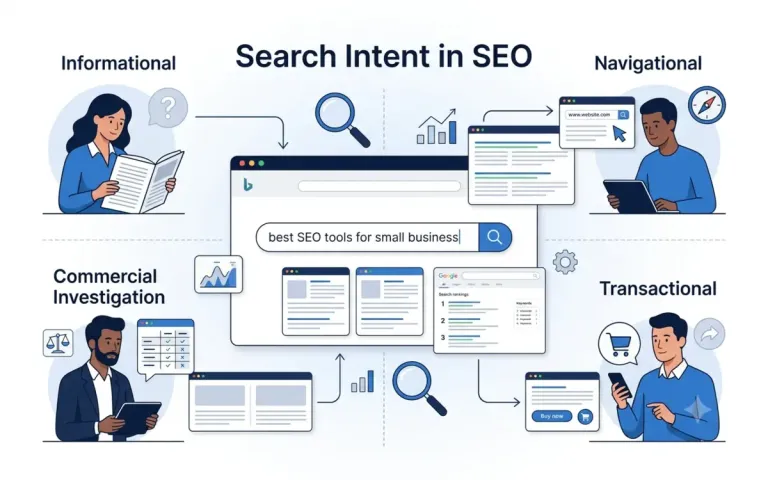
Search intent is commonly divided into four major categories:
Informational intent
Navigational intent
Commercial investigation intent
Transactional intent
Let's examine each one.
1. Informational Search Intent
Informational intent occurs when users want to learn something or find an answer.
They are generally not looking to purchase something immediately.
Examples
What is SEO?
How does artificial intelligence work?
What is consumer behaviour?
How to create a website
Benefits of digital marketing
What is machine learning?
The user is primarily seeking knowledge.
Suitable content formats
For informational searches, suitable formats include:
Guides
Tutorials
Blog articles
Explanations
How-to articles
Educational videos
FAQs
Definitions
Step-by-step instructions
For example, a search for:
“How does SEO work?”
would generally be better served by a detailed educational article than by a product landing page.
2. Navigational Search Intent
Navigational intent occurs when the user wants to reach a particular website, company, brand, platform, or webpage.
Examples
Google Search Console login
YouTube
OpenAI
LinkedIn login
Canva
The user usually already knows where they want to go.
Suitable content
For navigational queries, the most relevant result is normally the official website or specific destination page.
Businesses should therefore ensure that their:
Brand name is clearly represented
Official website is accessible
Important pages are indexable
Brand information is consistent
Website architecture is clear
Strong brand visibility can be particularly important for navigational searches.
3. Commercial Investigation Intent
Commercial investigation occurs when users are researching options before making a purchase or decision.
The user may not be ready to buy immediately, but they are evaluating alternatives.
Examples
Best SEO tools
Best AI tools for small businesses
ChatGPT vs Gemini
Semrush vs Ahrefs
Best website hosting for small businesses
Canva review
Best CRM software for startups
These searches often occur somewhere between informational research and a potential transaction.
Suitable content formats
Good formats include:
Product reviews
Comparison articles
“Best” lists
Alternatives articles
Buying guides
Feature comparisons
Case studies
For example:
“ChatGPT vs Gemini”
is not the same search intent as:
“What is generative AI?”
The first involves evaluating options, while the second is primarily informational.
4. Transactional Search Intent
Transactional intent occurs when users are ready or nearly ready to take a specific action.
That action may involve purchasing, subscribing, downloading, booking, or signing up.
Examples
Buy web hosting
SEO software pricing
Download SEO plugin
Buy domain name
Subscribe to AI software
Purchase accounting software
Suitable content formats
Transactional searches are usually best served by:
Product pages
Service pages
Pricing pages
Checkout pages
Registration pages
Product landing pages
Service comparison pages
The content should make the desired action clear and easy.
A Fifth Concept: Local Search Intent
Local searches are often treated as a separate category because they contain a strong location-based requirement.
Examples include:
Web developer near me
Digital marketing agency in Patna
Restaurants near me
SEO consultant in Delhi
Computer training institute near me
The user is looking for a product, service, or business in a particular geographical area.
For local businesses, relevant SEO elements include:
Google Business Profile
Local landing pages
Business name, address and phone information
Customer reviews
Local citations
Location-specific content
Local SEO therefore combines search intent with geographical relevance.
Search Intent and the Buyer's Journey
Search intent can also be understood through the customer journey.
A potential customer may move through several stages.
Awareness
The user identifies a problem.
Example:
“How to improve website traffic”
Research
The user explores possible solutions.
Example:
“Best SEO strategies for small businesses”
Evaluation
The user compares solutions.
Example:
“SEO agency vs doing SEO yourself”
Decision
The user is ready to take action.
Example:
“SEO services for small business pricing”
This progression demonstrates why businesses should not create only one type of content.
A strong content strategy should address users at different stages of their journey.
How to Identify Search Intent
Understanding search intent does not require guessing.
One of the most effective approaches is to study the actual search results.
This process is often called analyzing the Search Engine Results Page (SERP).
Step 1: Search the Target Keyword
Enter the keyword into Google or another search engine.
Look at the pages appearing near the top.
Ask:
What type of content dominates the results?
Are they:
Blog posts?
Tutorials?
Product pages?
Category pages?
Videos?
Reviews?
Comparisons?
Local business listings?
The dominant content format provides an important clue about intent.
Step 2: Analyze the Titles
Look at the titles of ranking pages.
Suppose you search:
“best AI tools for marketing”
and most results contain phrases such as:
Best AI Marketing Tools
Top AI Tools for Marketers
AI Marketing Tools Compared
This strongly suggests commercial investigation intent.
Users are probably looking for options rather than a basic explanation of AI.
Step 3: Examine the Content Format
Suppose the results for a keyword are mostly:
“How to…”
This indicates that users probably want instructions.
If the results are mostly:
“Best…”
users may be comparing options.
If the results are mostly:
Product pages
the keyword may have transactional intent.
The format of the SERP is therefore an important signal.
Step 4: Look at Search Features
Search engine results can contain additional features such as:
Featured snippets
People Also Ask
Local packs
Images
Videos
Shopping results
Knowledge panels
These features provide additional clues about what users want.
For example, if a query produces many instructional videos and step-by-step results, creating a purely promotional page may not match the dominant intent.
Step 5: Study the Questions Users Ask
The People Also Ask section can help identify related information users want.
For example, a search about SEO might generate questions such as:
What is SEO?
How does SEO work?
Why is SEO important?
How long does SEO take?
Is SEO still relevant?
These questions can help you expand your article and cover the topic more comprehensively.
Search Intent Optimization: A Practical Example
Suppose you want to target:
“SEO tools for small business”
There are several possible approaches.
Poor approach
Create a general article explaining:
“What Is SEO?”
Even though the topic is related, it doesn't directly satisfy someone looking for tools.
Better approach
Create:
“Best SEO Tools for Small Businesses: Features, Pricing and Use Cases”
The article should then discuss:
Different SEO tools
Their features
Pricing
Strengths
Limitations
Suitable business sizes
Use cases
Comparisons
This directly addresses the likely intent.
Search Intent and Content Format
Different search intents usually require different content formats.
| Search Intent | User Goal | Suitable Content |
|---|---|---|
| Informational | Learn | Guide, tutorial, article |
| Navigational | Find a specific destination | Official website/page |
| Commercial | Compare and evaluate | Review, comparison, buying guide |
| Transactional | Take action | Product/service/pricing page |
| Local | Find a nearby solution | Local landing page, business profile |
This isn't an absolute rule. A single keyword can have mixed intent, and search results can contain several content types.
Mixed Search Intent
Not every query fits neatly into one category.
For example:
“best website builder”
could have both:
Informational intent
Commercial investigation intent
The user may want to learn about website builders while also comparing products.
Similarly:
“SEO audit”
could mean:
What is an SEO audit?
How to perform an SEO audit
SEO audit tools
Hire an SEO consultant
Therefore, you should analyze the actual SERP rather than relying only on predefined intent categories.
How to Create Content That Matches Search Intent
Once you understand the intent, your content should be designed around it.
1. Start With the User's Question
Before writing, ask:
What does the user want to accomplish?
Don't begin with:
“What keywords can I put into this article?”
Begin with:
“What problem is the searcher trying to solve?”
2. Choose the Correct Content Type
If the user wants to learn, create an educational resource.
If they want to compare products, create a comparison.
If they want to purchase, create a product or service page.
If they want instructions, create a practical tutorial.
The content format should support the user's goal.
3. Answer the Main Question Early
Don't make readers go through several paragraphs before getting the answer.
A strong article should address the primary question early and then provide deeper explanation.
This improves usability and makes the content easier to navigate.
4. Cover Related Questions
Once the primary intent is satisfied, address closely related questions.
This can help create a more complete resource.
For example, an article about:
“Keyword Mapping”
could also discuss:
Why keyword mapping matters
How to create a keyword map
Keyword-to-page mapping
Common mistakes
Keyword cannibalization
Examples
5. Use Clear Structure
Organize content using:
Descriptive headings
Short paragraphs
Bullet points
Tables
Examples
Step-by-step instructions
FAQs where appropriate
Good structure helps both users and search engines understand the page.
Common Search Intent Mistakes
Mistake 1: Targeting Keywords Without Understanding Intent
A keyword may have substantial search volume but still be unsuitable for your website.
Traffic is valuable only when it is relevant traffic.
Mistake 2: Creating Content for Search Engines Instead of Users
Keyword repetition doesn't guarantee that content will satisfy search intent.
The goal should be to answer the user's question comprehensively and naturally.
Mistake 3: Ignoring SERP Results
The current search results provide valuable information about what search engines are already considering relevant.
Ignoring them can result in a mismatch between your content and the expected format.
Mistake 4: Using the Same Page for Multiple Intents
Trying to make one page rank for unrelated intents can weaken its focus.
For example, a page designed to explain “what SEO is” shouldn't simultaneously try to function as a detailed SEO services sales page.
Separate pages can serve different purposes.
Mistake 5: Optimizing Only for Informational Keywords
Businesses sometimes publish hundreds of informational articles but fail to create content for users who are ready to compare or purchase.
A balanced SEO strategy should cover multiple stages of the customer journey.
Search Intent and Keyword Research
Search intent should be integrated into your keyword research process.
Instead of maintaining a keyword list like:
SEO
SEO tools
SEO services
SEO strategy
create a more useful keyword map:
| Keyword | Intent | Content Type |
|---|---|---|
| What is SEO? | Informational | Guide |
| How does SEO work? | Informational | Tutorial |
| Best SEO tools | Commercial | Comparison |
| SEO software pricing | Transactional/Commercial | Pricing/Comparison |
| SEO agency near me | Local/Transactional | Service page |
This approach makes your keyword research more actionable.
Search Intent and Internal Linking
Search intent can also improve your internal linking strategy.
For example, an informational article about SEO can link to:
Keyword Research
which can link to:
Keyword Mapping
which can link to:
Keyword Cannibalization
Meanwhile, a commercial article about SEO tools could link to relevant tool reviews or comparisons.
This creates logical relationships between pages based on the user's journey.
Search Intent in the Age of AI Search
Search intent is becoming even more important as search experiences evolve.
AI-powered search systems can provide direct answers, summaries, comparisons, and recommendations.
This means content creators need to focus increasingly on:
Clear answers
Original information
Demonstrated expertise
Useful examples
First-hand experience
Well-structured information
Strong topical coverage
Simply matching an exact keyword is not enough.
The broader objective is to satisfy the user's information need.
A Practical Search Intent Checklist
Before publishing an SEO article, ask:
Understanding the query
What is the user trying to accomplish?
What problem are they trying to solve?
What information do they expect?
SERP analysis
What type of pages currently rank?
What formats dominate?
What questions appear in the SERP?
Are there featured snippets, videos, local results or other features?
Content creation
Does my content answer the main question?
Is the format appropriate for the intent?
Have I covered important related questions?
Does the article provide useful examples?
SEO optimization
Is the primary keyword naturally incorporated?
Are the title and headings descriptive?
Are internal links relevant?
Is the page easy to navigate?
User experience
Can the visitor find the answer quickly?
Is the content readable?
Does it provide genuine value beyond what is already available?
If the answer to these questions is yes, your content is much more likely to align with search intent.
Conclusion
Search intent is one of the most important concepts in modern SEO.
Keywords tell us what people search for, while search intent helps us understand why they search for it.
The four major categories—informational, navigational, commercial investigation, and transactional—provide a useful framework for understanding user goals. Local searches and mixed-intent queries add further complexity.
Successful SEO therefore requires more than inserting keywords into an article. It requires creating the right content, in the right format, for the right user need.
Before creating a page, don't simply ask:
“What keyword should I target?”
Ask:
“What does the person searching this keyword actually want?”
That shift—from keyword targeting to user-intent targeting—can make your SEO strategy more relevant, useful, and effective.
Frequently Asked Questions
What is search intent in SEO?
Search intent is the reason or purpose behind a user's search query. It describes what the user is trying to find, learn, compare, or accomplish.
What are the four types of search intent?
The four commonly recognized types are informational, navigational, commercial investigation, and transactional intent.
Why is search intent important for SEO?
Understanding search intent helps you create content that satisfies what users are actually looking for, improving relevance, user experience, and the potential for organic search visibility.
How can I identify search intent?
Analyze the search engine results for your target query. Look at the ranking pages, titles, content formats, SERP features, and questions users are asking.
Can a keyword have multiple search intents?
Yes. Some keywords have mixed intent. For example, “best SEO tools” may involve both informational research and commercial investigation.
Does search intent affect keyword research?
Yes. Assigning search intent to keywords makes keyword research more useful because it helps determine what type of page should be created for each keyword.
Is search intent more important than keyword density?
Modern SEO should focus on satisfying the user's information need rather than achieving a particular keyword density. Keywords remain useful for communicating topic relevance, but they should be used naturally.
Related articles
SEO Content Writing: How to Create Content That Ranks and Engages Readers