1. Introduction
Every organization needs to understand where it stands before making strategic decisions. Managers must know:
- What are we good at?
- Where are we weak?
- What opportunities exist in the market?
- What threats may affect our business?
SWOT Analysis is one of the most widely used strategic planning tools that helps answer these questions.
It provides a structured framework for evaluating an organization's internal capabilities and the external business environment.
2. Definition of SWOT Analysis
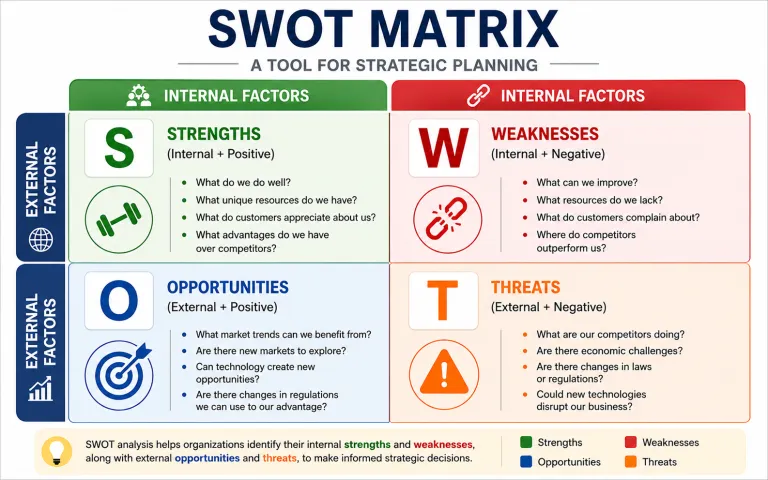
SWOT Analysis is a strategic planning technique used to identify an organization's:
- Strengths
- Weaknesses
- Opportunities
- Threats
to formulate effective business strategies.
It combines the analysis of internal factors (Strengths and Weaknesses) with external factors (Opportunities and Threats).
3. Components of SWOT Analysis
A. Strengths
Strengths are the internal capabilities and resources that give an organization a competitive advantage.
Examples
- Strong brand image
- Skilled employees
- High product quality
- Financial stability
- Advanced technology
- Loyal customers
- Efficient supply chain
- Patented products
- Strong leadership
- Excellent customer service
Questions to Identify Strengths
- What do we do better than competitors?
- What unique resources do we possess?
- Why do customers choose us?
B. Weaknesses
Weaknesses are internal limitations that reduce organizational performance.
Examples
- Limited financial resources
- Poor marketing
- High employee turnover
- Outdated technology
- Weak online presence
- Lack of innovation
- Poor customer service
- High production cost
- Inefficient management
Questions to Identify Weaknesses
- Where do we lack resources?
- What complaints do customers have?
- Which competitors outperform us?
C. Opportunities
Opportunities are favorable external conditions that can help an organization grow.
Examples
- Growing market demand
- Government incentives
- Technological advancements
- Expansion into new markets
- Rising disposable income
- New customer segments
- Strategic partnerships
- Digital transformation
- Export opportunities
Questions to Identify Opportunities
- Which market trends can benefit us?
- Are customer preferences changing?
- Can technology improve our operations?
D. Threats
Threats are external challenges that may negatively affect organizational performance.
Examples
- New competitors
- Economic recession
- Inflation
- Changing government regulations
- Substitute products
- Technological disruption
- Cybersecurity risks
- Supply chain disruptions
- Changing customer preferences
Questions to Identify Threats
- What external risks exist?
- Are competitors introducing better products?
- Are government policies changing?
4. SWOT Analysis Process
Step 1
Define the objective.
Example:
Increase market share.
Step 2
Identify strengths.
Step 3
Identify weaknesses.
Step 4
Identify opportunities.
Step 5
Identify threats.
Step 6
Develop strategic alternatives.
Step 7
Implement and monitor.
5. SWOT Analysis of Apple Inc.
Strengths
- Strong global brand
- Premium products
- Innovation
- Loyal customers
- Large cash reserves
Weaknesses
- Premium pricing
- Limited product customization
- High dependence on iPhone sales
Opportunities
- Artificial Intelligence
- Emerging markets
- Wearable devices
- Healthcare technology
Threats
- Intense competition
- Government regulations
- Counterfeit products
- Rapid technological change
6. SWOT Analysis of a Student
Strengths
- Good communication
- Time management
- Strong academic performance
Weaknesses
- Lack of practical experience
- Public speaking anxiety
- Limited technical skills
Opportunities
- Online certifications
- Internships
- Networking events
- AI learning platforms
Threats
- High competition
- Automation
- Economic uncertainty
7. Advantages of SWOT Analysis
- Simple and easy to understand.
- Supports strategic planning.
- Improves decision-making.
- Identifies competitive advantages.
- Encourages objective thinking.
- Helps allocate resources effectively.
- Applicable to businesses, institutions, and individuals.
8. Limitations of SWOT Analysis
- Subjective in nature.
- Does not prioritize factors.
- Provides a static view.
- No direct solution to problems.
- Depends on the quality of information.
- External factors change rapidly.
9. SWOT and Strategic Planning
SWOT Analysis acts as a bridge between environmental scanning and strategy formulation.
Managers use SWOT findings to:
- Develop business strategies.
- Enter new markets.
- Launch new products.
- Improve organizational performance.
- Gain competitive advantage.